



PE Fundraisers As Successful as Ever, Suggesting Industry’s Maturation
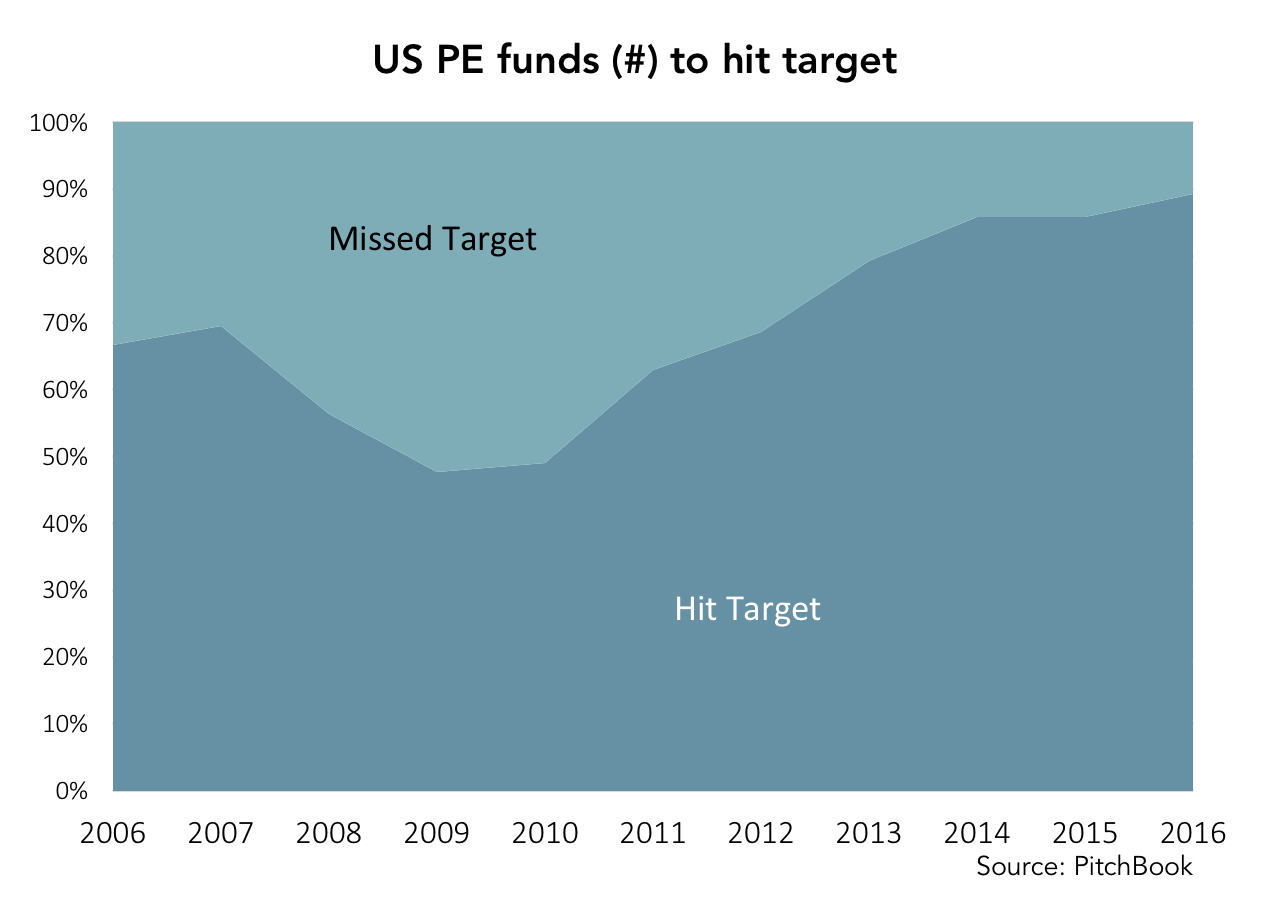
89% of private equity funds closed in the US last year, against a backdrop of healthy fundraising levels—252 vehicles combined for a total of $180 billion committed. This decade-high proportion of fundraising success leads one to the most evident conclusion that limited partners are still eager for exposure to the asset class. Combined with the historically strong median buyout fund size of $250 million in 2016, it’s not that PE firms had more modest goals, but rather that fundraising strategies are becoming more targeted among the majority of investors. At the same time, the largest LPs continue to favor the big buyout shops more and more, still subscribing on to their multibillion-dollar raises and helping push up that fundraising success rate even more. Both of these phenomena speak to the overall maturation of the PE industry, which in turn explains much of its current state. The level of competition that has helped keep multiples quite high is not solely attributable to the entry of strategic acquirers at the higher end of the market, but also the sheer number of PE firms hunting for worthwhile targets across all segments of the US middle market. With continual inflows of capital from investors, moreover, the weight of competition generated by dollars looking for deployment looks unlikely to slacken. What this may well result in is even greater downward pressure on future returns for current PE funds in the marketplace. PE investors are well aware more diversified strategies are necessary in order to differentiate not only their approach to prospective targets but also their portfolio construction. Accordingly, the PE industry is in a typical maturation phase for an investment class, wherein more classic approaches must evolve or a return to the basics is necessitated.
View PitchBook 2016 Annual US PE Breakdown report here.


Latest news

Share of PE middle-market deal count by backing type
Add-ons remain the workhorse for middle-market deployment, accounting for 67. 1% of all middle-market transactions YTD, in line with activity seen in recent years.

Software deal share falls in middle markets, rises in large caps
In Q3’26 software’s share of total deals fell in both the Lower Middle Market (to 7%) and Upper Middle Market (to 9%), while Large Cap saw a modest uptick in share to 8%.

Secondary loan prices stabilize following steep declines
Secondary loan prices came under significant pressure through September and October, with the Bloomberg U.S. Leveraged Loan Index declining 119…