


Markit Recap – 7/31/2017

Italian banks bounce back
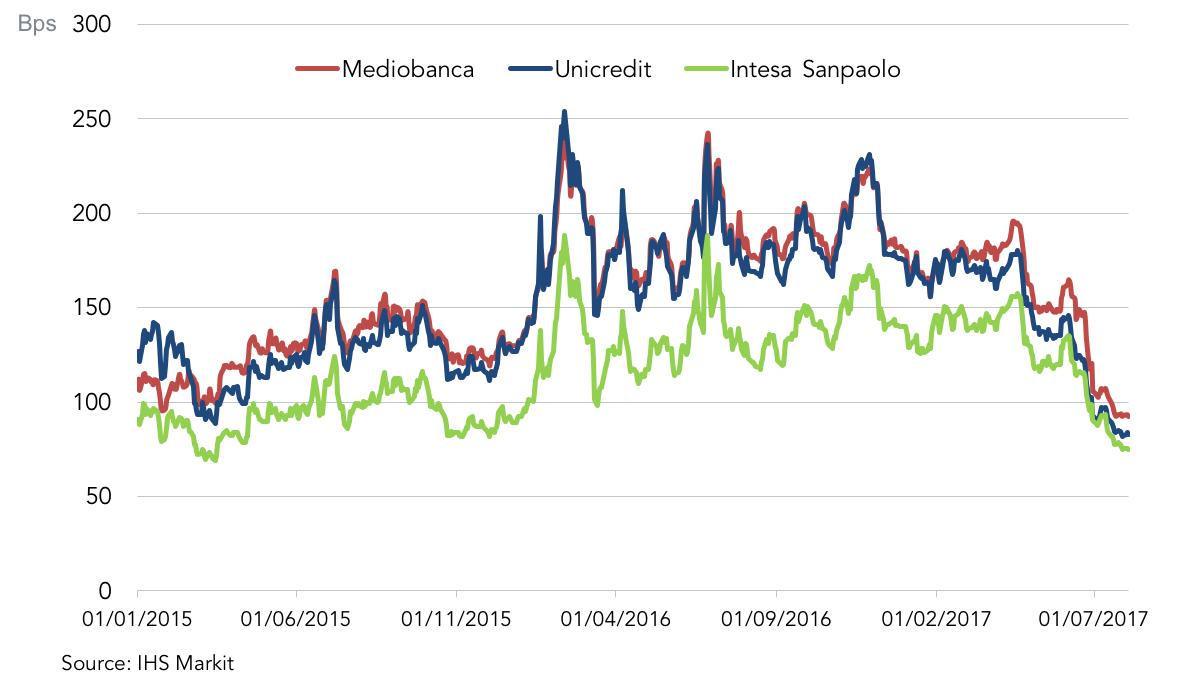
The Eurozone has many structural flaws, inherent design failings that were painfully exposed over the last decade. Some of these have been rectified and good progress has been made on a banking union, in particular. But the work is not complete, and if there was an Achilles heel that threatened to scupper efforts to strengthen the currency bloc, it was the Italian banking system.
At the beginning of 2017 the outlook appeared bleak. Balance sheet quality was poor – non-performing loans were 15% of assets, three times the EU average. Political obstacles to state rescues of weaker banks were high in the new EU recovery and resolution framework. It seemed like a tall order to heal the significant wounds of Italian banks with minimum damage elsewhere, both domestically and internationally.
And yet here we are in the second-half of the year looking at a quite different picture. Unicredit just announced second-quarter profits of €945m, easily beating consensus expectations. NPLs are down by 30% over the past 12 months and its tier one capital ratio has improved to 12.8% from 11.5% in the first quarter. Unicredit’s decision to raise capital through a €13bn rights issue in January was no doubt a pivotal moment. The bank’s 5-year CDS spreads are now trading at 78bps, just short of a 100bps tighter since the beginning of the year. Unicredit’s rival Intesa Sanpaolo – long considered the strongest of Italy’s banks, a fact reinforced by its role in the rescue of the Veneto banks – has also rallied and is now quoted at 73bps.
So, the forecast looks brighter for the more robust end of Italian banking. But it is the changing landscape at the beleaguered portion of the industry that is curtailing systemic risk. As well as the aforementioned Vento bank bailouts, Monte dei Paschi’s state bailout was passed into law on July 28. This will involve a precautionary recapitalization and burden sharing for subordinated bondholders.
The latter has prompted a question to the ISDA DC asking if a Governmental Intervention credit event has occurred under 2014 definitions, and also if a Restructuring credit event has occurred under 2003 rules. The market has been expecting this for some time, and this is reflected in CDS levels. Subordinated 5-year is trading at 51 points upfront on a steeply inverted curve, indicating impending default, while the senior is trading at a relatively respectable 180bps on a normal positive slope curve. The divergence is due to the splitting of sub and senior for GI and restructuring credit events under 2014 definitions.
If the DC answers ‘Yes’, then it might be the end of a long road for Monte CDS, but it still has some way to go before it matches the fundamentals of its peers.
Contact: Gavan Nolan
Gavan.Nolan@ihsmarkit.com



Latest news

Open Tab
Leveraged loans keep running up a tab. Senior direct lending already knows what it owes.


Information technology topped nonaccruals on a cost basis
Maturities of loans switching to at least partial PIK tends to be longer-dated than Octus’ other stress trackers: nonaccrual and fair value write-down reports.