
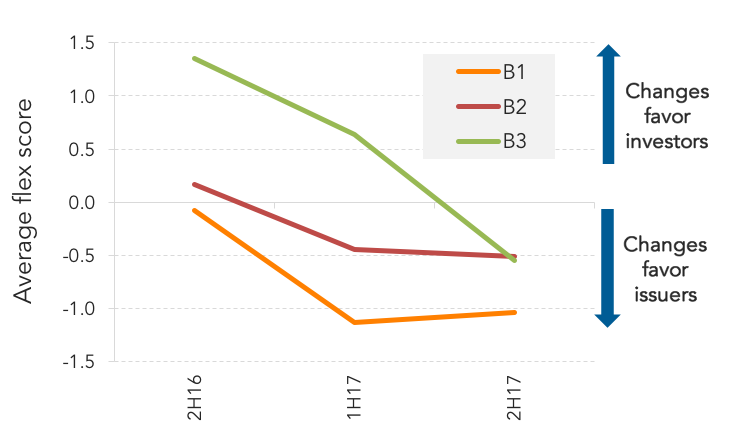
Since the second half of 2016, investors have increasingly gotten more comfortable with riskier names. According to the Flex Factor, which aggregates price and structural flex activity on institutional loans, B3 rated issuers have seen more issuer friendly changes to their loans now compared to a year ago. In 2H16, the average flex score for a B3 rated issuer’s loan was 1.4, comfortably in investor friendly territory and over a point higher than the B2 average score. In 1H17, the average B3 score had decreased to 0.6 showing less investor pushback on these deals, but still over a point higher than the B2 average. Now in 2H17 the average B3 score has dropped to -0.5, well into issuer friendly territory and roughly on par with the B2 average. Demand is outstripping supply and investors chasing new money assets have responded to the better mix of M&A deals in the current market compared with the heavier mix of repricings that occurred in 2H16 and 1H17. Recent deal pushback has largely been sector specific with certain retail and mining loans getting flexed higher during negotiations.
Contact: David Puchowski
David.Puchowski@thomsonreuters.com




Latest news

US leveraged loans returns turn negative in October
The Bloomberg US Leveraged Loan Index (Ticker: LOAN) has returned -0.26% this month through October 21, reducing its year-to-date return…

M&A activity begins to tick upward
In the third quarter of 2026, acquisition-linked loan volume across North America and Europe reached about $47 billion, up from $30.6 billion in Q2 and $29.5 billion a year ago.