



Download PitchBook’s 2Q 2018 US PE Breakdown report here.
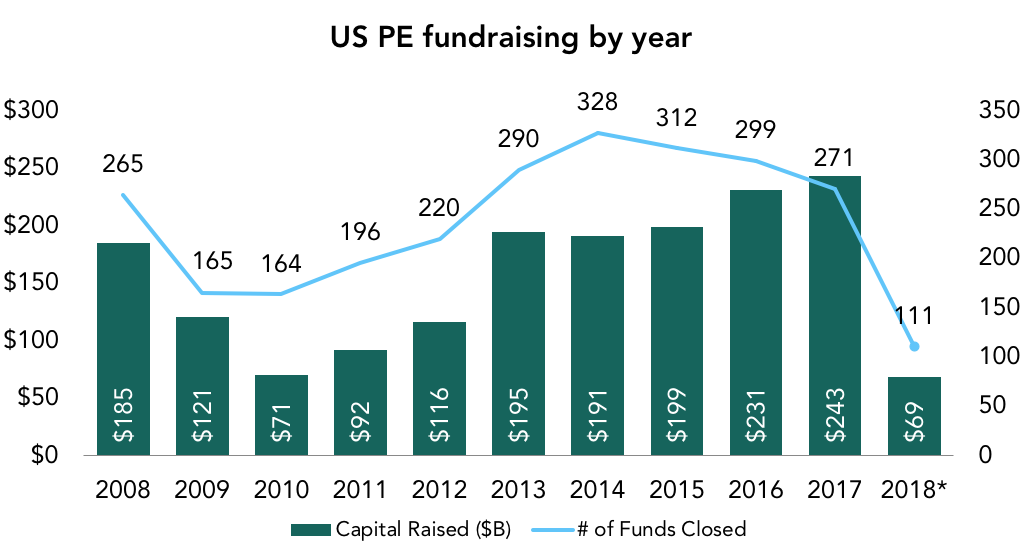
It isn’t news that US private equity fundraising has been on a tear in recent years. The flood began in 2013, which saw $195 billion raised across 290 vehicles. At the time, both figures were head-and-shoulders above 2012 totals, but it turned out to be the start of an extended boom in PE fundraising, which topped out last year at $243 billion raised. Much of the enthusiasm for PE funds was out of necessity, as a reverse denominator effect roiled asset allocations across much of the institutional landscape. Like dominoes, mark-to-market appraisals on the public side impacted allocation percentages on the alternative side, chiefly in private equity. To maintain those targets, and aided by record distributions from prior PE investments, institutional investors turned the market into a free-for-all on the demand side. The average time taken to close buyout funds plunged from about 19 months for 2011 vintages to just 12.5 months for 2017 vintages. Among other things, wrapping up fundraising six months sooner means focusing on deals can happen that much sooner.
If the first half of this year is any harbinger, the frenzy might be dying down. It was bound to eventually—PE fund cashflows offer a reliable tea leaf into future fundraising trends, and net cashflows will likely turn negative when Q4 2017 and Q1 2018 numbers are released. PE firms took advantage of their opportunity in a significant way, raising over $1 trillion collectively between 2013 and 2017. Combined with leverage, $1 trillion in commitments translates closer to $2.5-$3 trillion in raw purchasing power. That’s quite a bit of capital to put to use in any market, and all that fresh powder has dampened deal flow and fueled today’s high multiples. Maybe it’s a good thing to see 2018 get off to a “slow” start, with only $69 billion raised through H1. While today’s funds are being raised that much quicker, PE capital is being bottlenecked by heightened competition and near-record price tags, like an expensive game of red-light green-light. Even as the fundraising slows, however, investor enthusiasm might stay high for a while longer. Bloomberg reported this week that the largest firms marketing new funds are raising their management fees on their new and bigger pools. “A lot of investors are more worried about access than fees,” according to Probitas Partners. Access might become more of a concern as the number of new fundraises finally starts to slow.
Contact: Alex Lykken
alex.lykken@pitchbook.com


Latest news

Share of PE middle-market deal count by backing type
Add-ons remain the workhorse for middle-market deployment, accounting for 67. 1% of all middle-market transactions YTD, in line with activity seen in recent years.

Software deal share falls in middle markets, rises in large caps
In Q3’26 software’s share of total deals fell in both the Lower Middle Market (to 7%) and Upper Middle Market (to 9%), while Large Cap saw a modest uptick in share to 8%.

Secondary loan prices stabilize following steep declines
Secondary loan prices came under significant pressure through September and October, with the Bloomberg U.S. Leveraged Loan Index declining 119…