



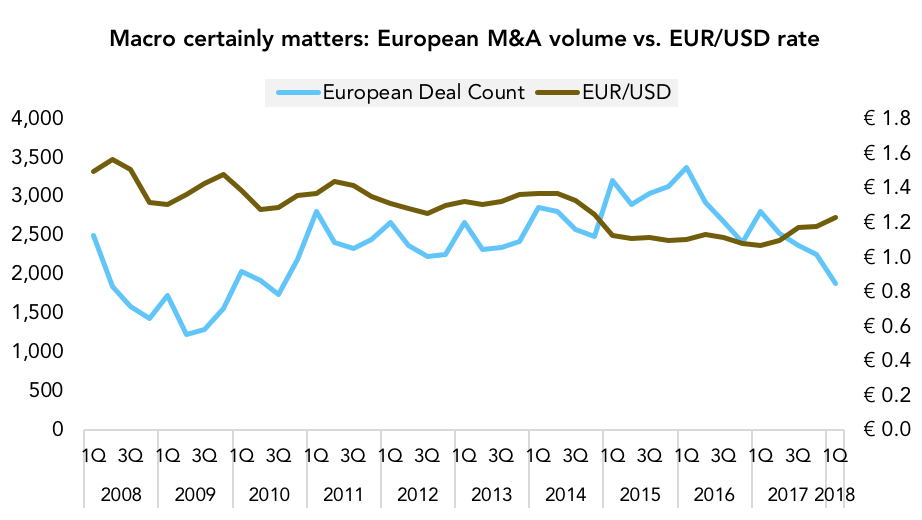
Download PitchBook’s 2Q 2018 M&A Report here.
Like every tariff-related conversation, it’s too early to tell what impacts they’ll have on private equity. But like many PE-related conversations, different investors see different outcomes when looking at the same thing. Carlyle’s David Rubenstein, in an interview with CNBC, says that while the impact is so far de minimis, a long-standing trade war “wouldn’t be something people would like.” KKR believes otherwise, at least as it regards opportunities for PE. Again via CNBC: “KKR recently visited China and came away seeing a multitude of opportunities both due to and in spite of the ongoing trade war.” US/China tariffs could accelerate China’s transition from an export-based economy to a consumer-driven one, where outsized opportunities await.
Both are what-ifs at the moment, but other factors that could impact PE are coming into view. Valuations for US-based companies are vulnerable, especially for businesses with significant revenues coming from Europe or China. Having to pass on those higher costs will have an impact on valuations, though they haven’t yet materialized and may be reasonably small. Or not! Lenders are already starting to take a closer look at EBITDA add backs and add forwards in the current market, especially for secondary buyouts, where any low-hanging fruit has already been harvested. Antares Capital notes that lenders have become more selective and disciplined on terms and pricing as they consider trade-impacted deals. “Lenders are largely in the business of worrying about what can go wrong, while equity investors are in the business of dreaming about what can go right.” Opinions may diverge on the topic of trade in the near future.
One major question is how long tariffs will remain in place, and the likely answer is: not indefinitely. It’s possible that tariffs will only be in place for a handful of years, depending what happens in 2020. Theoretically, PE could potentially benefit from near-term valuation drops, if they accidentally get the timing right. All things being equal, any depression in valuations today due to the trade war could conceivably bounce back once those tariffs are rescinded. For investors who operate in five-year timeframes, the timing could work out in their favor if they plan to exit after 2021.
Contact: Alex Lykken
alex.lykken@pitchbook.com





Private Credit Defaults 101: Back to School
As Labor Day approaches, the unofficial end of summer is upon us. But, before we get too sad, there is also the familiar back-to-school energy.