



Download PitchBook’s Report here.
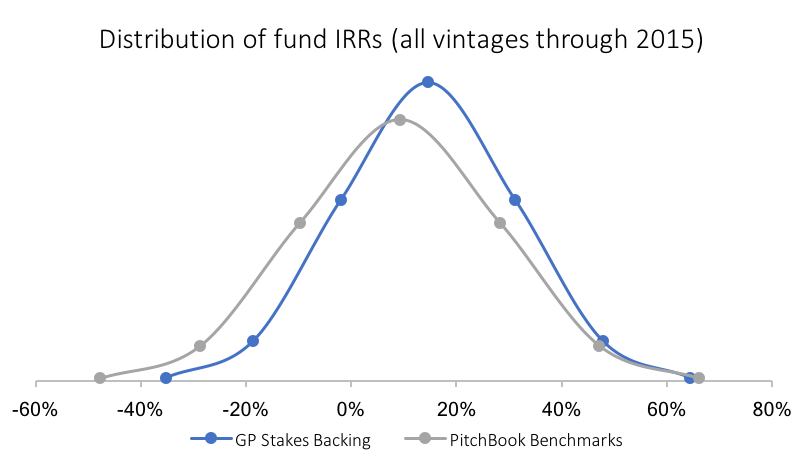
Last week we discussed the rising trend of GP stake sales, which are now officially in record territory in terms of volume. For now, GP stake transactions are highly concentrated in large, top-performing firms. That makes sense—buying a stake in a GP hinges on the GP’s ability to generate fees over time, and high AUMs are a proxy for strong investor demand. GPs that have successfully sold stakes have raised, on average, more than $23 billion since launching, much higher than the $1 billion average for those who have not sold stakes. One asset manager told the Financial Times that selling a chunk of your firm has become something of a “branding milestone,” a final proof of long-term success. IRR data also bears this out. The corresponding graph shows a clear preference for better-performing managers for buyers of those stakes.
It’s worth wondering what is prompting these sales. Why sell a valuable percentage of your firm if you anticipate more success down the road? One public motivation is diversification—GP stake sales are helping finance new strategies, and many of the biggest PE firms have been turning themselves into one-stop-shop asset managers with a myriad of investment strategies. More strategies mean more funds, which mean more fee revenue in the years ahead. But many of the brand-name firms involved in GP stake sales wouldn’t have too difficult time raising debut funds for their new strategies. The Blackstones of the world are known quantities and attract some of the best professionals around. Do they really need to sell stakes of their businesses to diversify?
Perhaps another motivation for recent stake sales is an attempt at market timing. PE fundraising and LP allocation targets correspond strongly to returns in the public markets. The latest bull run in the market has created a reverse denominator effect for LPs, which are trying to reinvest the record payouts coming back to them from past PE investments while keeping their current allocations intact. That’s resulted in an unsustainable fundraising market that will only last as long as the bull run does. The GPs who are selling stakes today—again, some of the oldest, largest and most successful GPs in the market—might be demonstrating what made them so successful in the first place: selling high at the top of the market. It doesn’t hurt that some of the proceeds will also help facilitate succession planning, according to the GPs themselves. Perfect timing all around, if that’s the case.
Contact: Alex Lykken
alex.lykken@pitchbook.com


Latest news

Share of PE middle-market deal count by backing type
Add-ons remain the workhorse for middle-market deployment, accounting for 67. 1% of all middle-market transactions YTD, in line with activity seen in recent years.

Software deal share falls in middle markets, rises in large caps
In Q3’26 software’s share of total deals fell in both the Lower Middle Market (to 7%) and Upper Middle Market (to 9%), while Large Cap saw a modest uptick in share to 8%.

Secondary loan prices stabilize following steep declines
Secondary loan prices came under significant pressure through September and October, with the Bloomberg U.S. Leveraged Loan Index declining 119…