



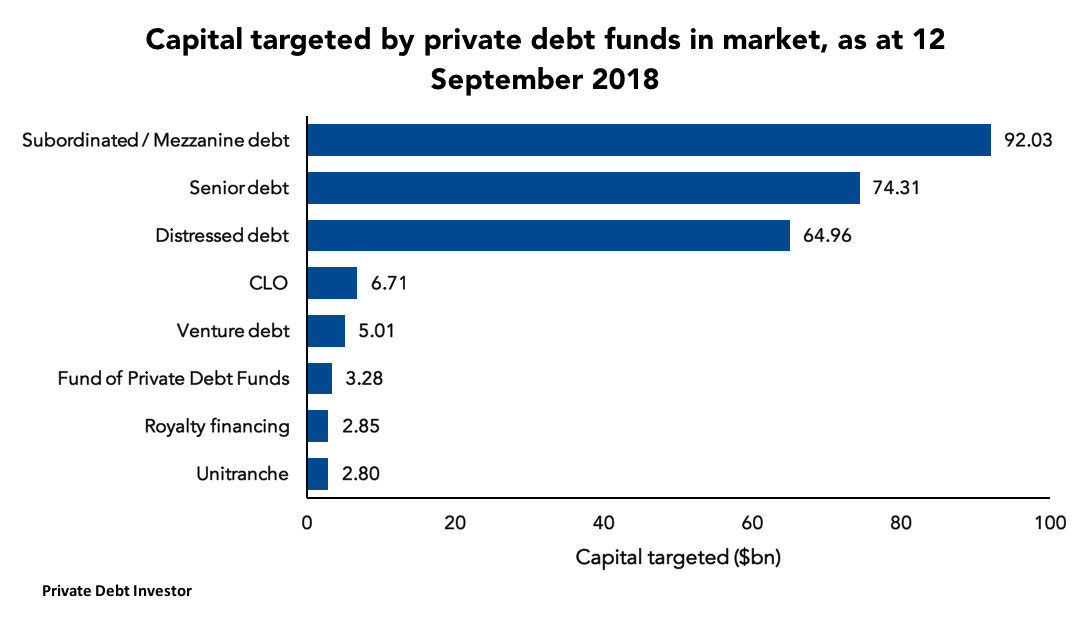
After a dip in mezzanine fundraising in 2017, credit managers are hoping limited partner demand for the strategy is strong in 2018 with almost 200 funds in market.
Senior debt and distressed debt have been the favoured investment choices for limited partners recently, but those strategies may be fading from the limelight as mezzanine debt takes center stage.
Some 197 mezzanine debt funds are in market seeking $92.03 billion, and if investors want to round out their exposure to private credit investment options, the strategy might not be a bad choice.
Last year, subordinated debt funds raised $48.64 billion – a far cry from the $66.12 billion and $65.57 billion that senior and distressed debt funds, respectively, raised in 2017. In 2016, subordinated debt funds raised a healthy figure of $54.68 billion, much of which was attributable to a handful of vehicles like the HPS Investments’ $6.6 billion Highbridge Principal Strategies Mezzanine Partners Fund III and GSO Capital Partners’ $6.5 billion GSO Capital Opportunities Fund III.
Before the global financial crisis, mezzanine debt was one of the larger alternative credit strategies. Some of the large publicly-traded asset managers had mezzanine debt groups before the crisis and only built out senior debt strategies following the retrenchment of banks.
The total capital being sought by mezzanine funds may stay elevated for some time as well. As the large subordinated debt funds that closed in 2016 start to exhaust their capital, they’ll return to market and possibly raise even more the next time around.







Private Credit Defaults 101: Back to School
As Labor Day approaches, the unofficial end of summer is upon us. But, before we get too sad, there is also the familiar back-to-school energy.