



Download PitchBook’s Report here.
The PE fundraising trail hasn’t been too difficult to navigate lately. For one, most newly raised funds are larger in size than their predecessors. About 69% of the funds that closed last year were larger than their predecessors, and the percentage was even higher for 2016 vintages—76%. Moreover, PE fund step-ups have been visibly bigger in recent years, with both 2017 and 2018 vintages coming in at 1.4x larger versus their predecessors. The time taken to raise those funds is also going down. On average, 2018 vintage funds were wrapped up in 12.4 months, down from a more typical 16-month timeframe seen between 2012 and 2016. Each of those statistics speak more to LP demand than anything—investors can start drawing down capital on their newest funds before they hold final closes. The decline in time to close likely reflects less difficulty in PE firms hitting their hard targets toward the end of their fundraises.
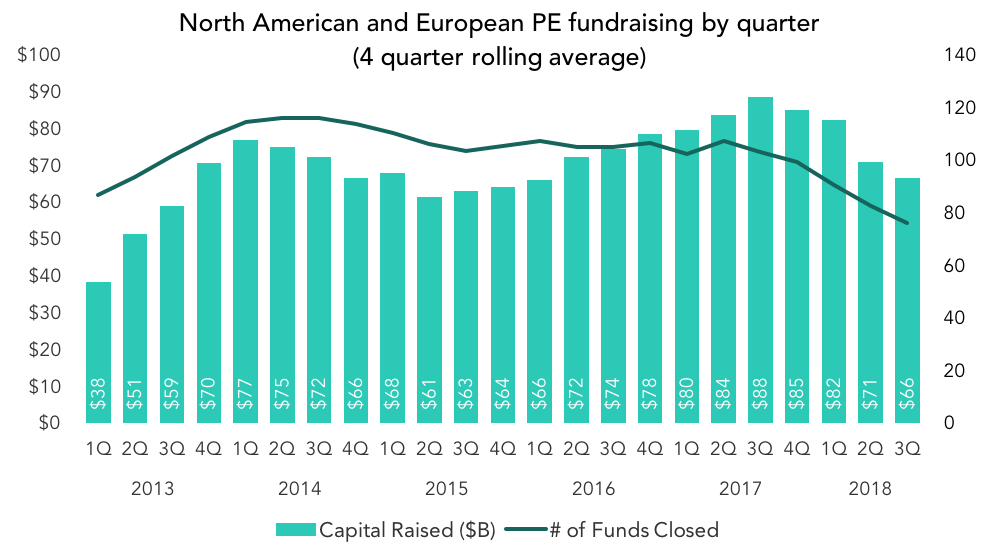
That said, there is some evidence that the fundraising bonanza is slowing. Viewing the data through a 4-quarter rolling average smooths out the data somewhat, helping control for outlier $10B+ funds that can skew the bigger picture. The rolling average for both fund counts and capital raised are swinging down, a trend that began in late 2017. We’re not ready to say fundraising has peaked—fundraising is cyclical, and this is one of the better ways to visualize that—but it does provide credence to recent side conversations about fundraising. Fewer funds are outperforming their equivalents in the public markets, and distributions to LPs from prior funds are slowing down. Depending what happens with the current run in the bull market, LPs may rethink their alternatives allocations in the near future, if they haven’t already.
Contact: Alex Lykken
alex.lykken@pitchbook.com


Latest news

Share of PE middle-market deal count by backing type
Add-ons remain the workhorse for middle-market deployment, accounting for 67. 1% of all middle-market transactions YTD, in line with activity seen in recent years.

Software deal share falls in middle markets, rises in large caps
In Q3’26 software’s share of total deals fell in both the Lower Middle Market (to 7%) and Upper Middle Market (to 9%), while Large Cap saw a modest uptick in share to 8%.

Secondary loan prices stabilize following steep declines
Secondary loan prices came under significant pressure through September and October, with the Bloomberg U.S. Leveraged Loan Index declining 119…