
The lack of mid-market mezzanine opportunities has likely caused the size of mezzanine funds to grow faster than senior debt vehicles.
Fewer firms are raising a greater portion of all private debt capital, but this stands out to be particularly true in mezzanine debt.
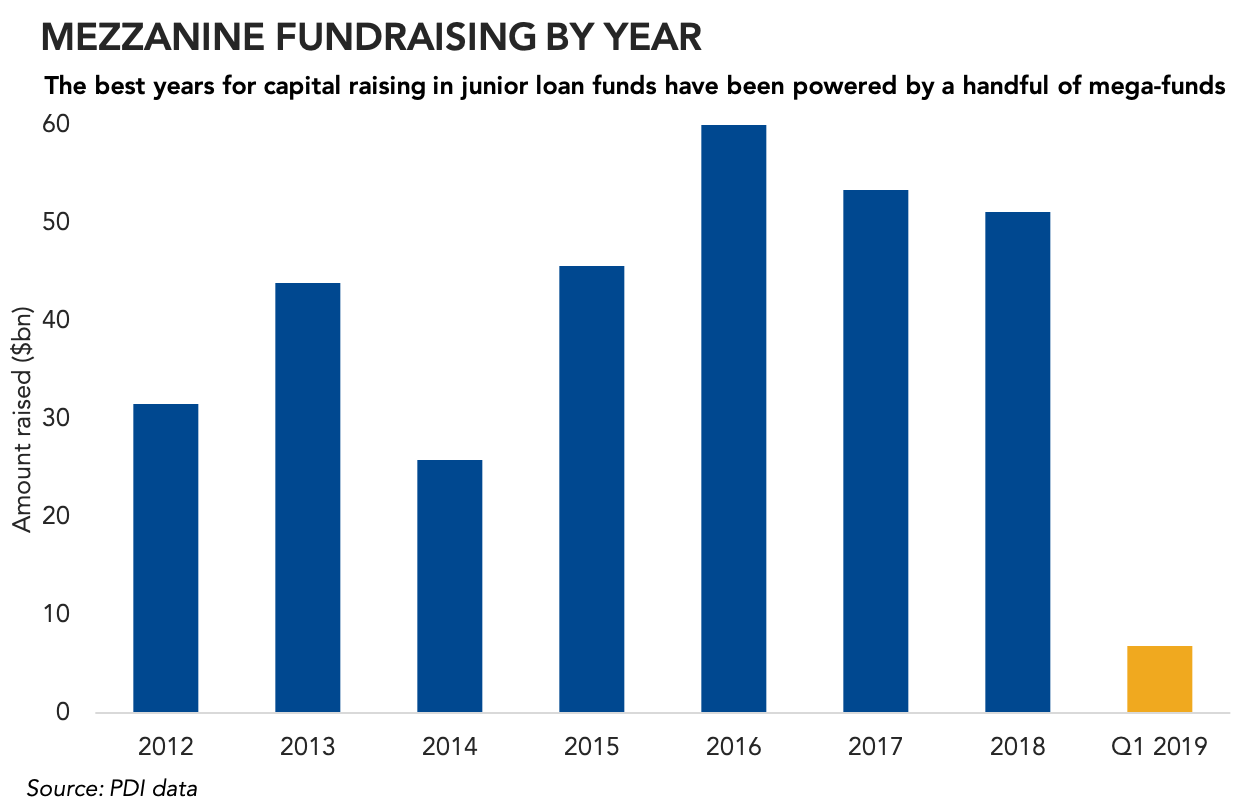
Junior loan funds raised the most across all private debt strategies last year – some $51.17 billion of the $134.9 billion raised, according to PDI data. For the first quarter, both senior and distressed debt raised more.
Among those, several managers raised mega-funds for mezzanine debt investments last year: Goldman Sachs collected an eye-popping $9.9 billion for a global vehicle, while Intermediate Capital Group locked down €4.5 billion for investments in Europe. In addition, ICG raised a $1.35 billion vehicle for mezzanine debt in North America.
The larger funds clearly can write larger cheques and participate in much larger deals – transactions that could access the syndicated markets.
The rise in the popularity of unitranche loans has likely contributed to the stratification of mezzanine funds recent years; one mid-market fund manager noted that dealflow among mid-market subordinated debt has decreased as one-stop loans have become more common. As this trend carried on, the bifurcation between the haves and have-nots in the strategy became more acute.
Indeed, the last year when fundraising for mezzanine strategies posted the strongest numbers when compared to other credit strategies was 2016, when unitranche loans were also popular. A spate of massive junior debt funds powered the strategy’s fundraising that year to $60.56 billion. At that time, HPS Investment Partners locked down $6.6 billion, while Blackstone’s corporate credit arm raised $6.5 billion and its real estate debt group raised $4.5 billion.


Latest news

YTD 2026 investment grade loan volume tops US$1.4trn, poised to set new annual record
Over US$1.4trn of investment grade loan volume has been completed so far this year, an 11% increase compared to the…