


Private Debt Intelligence – 7/1/2019

Is Real Estate Debt Expecting a Drop in 2019?
Chart
Download Data
[wpdm_package id=’26336′]
Specialized debt providers have started to take on the role of traditional lenders in the real estate sector, changing banks for funds, while creating a new way for investors to gain access across the capital structure. Debt as a real estate strategy has been growing in prominence in recent years; however, over the past year it appears the appeal of debt has declined slightly and in 2019 it seems not to be increasing. Based on the Preqin Investor Outlook for H1 2019, just 15% of investors said real estate debt was presenting favourable opportunities in the current climate. Is the market expecting a drop?
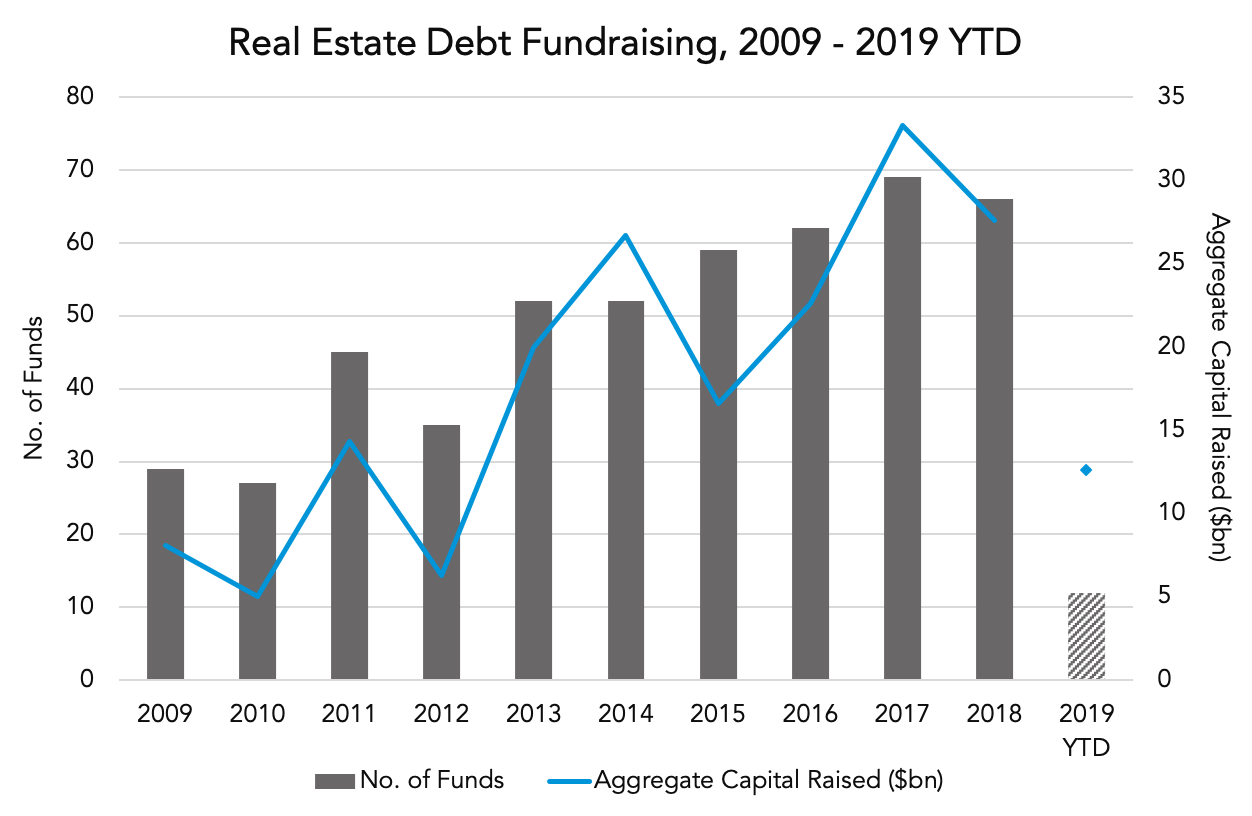
From 2012 until 2014 fundraising was rapidly growing; fund managers closed 52 funds and secured $27bn, reaching the second highest amount of capital raised in real estate debt ever. In 2015 a big drop was seen; the number of funds closed went slightly up (59) but the amount if capital secured decreased $10bn. After this, two years later, fundraising strongly recovered and by 2017 fundraising was at its peak – fund managers were able to close 69 funds and raise over $33bn. Last year fundraising started to decrease and as far as we are in 2019 there have just been 12 funds closed with a value of $12.6bn.
The geographic focus of real estate debt has been very dominated by North America, raising most of the capital. Currently, more than 90% of the amount raised is attributed to North America. Europe would be the second region to raise more capital, by securing half or less capital as North America. Asia and the rest of the world would not be attracting much capital as they have never raised $1bn for real estate debt.
Looking towards how the market has been developing, real estate debt has been growing for the last 10 years. In December 2008, the sector had $29bn in assets and by September 2018 it had $169.5bn. The market is more than five times bigger than it was 10 years ago. Dry powder accumulation coincided with the year prior to the fundraising drops, which might be a sign that investors may wait for some of the capital to be allocated before they make further investments. As at September 2018 dry powder stands at its highest over the last 10 years ($66.8bn), meaning that fund managers would need to allocate more capital if they want to increase the fundraising.
Contact: William Clarke
william.clarke@preqin.com



Latest news

European mid-market direct lending margins face steady compression since 2024
European mid-market direct lending margins have seen consistent compression over recent years but recorded a slight increase in the second quarter of 2026…

US leveraged loan issuance rebounds in September
Following three consecutive months of declining issuance, the US leveraged loan market has reversed course in September. Approximately $48.7b of…

Reversion to the Mean
Climbing toward the average is a very different story than surpassing it.