



Download PitchBook’s Report here.
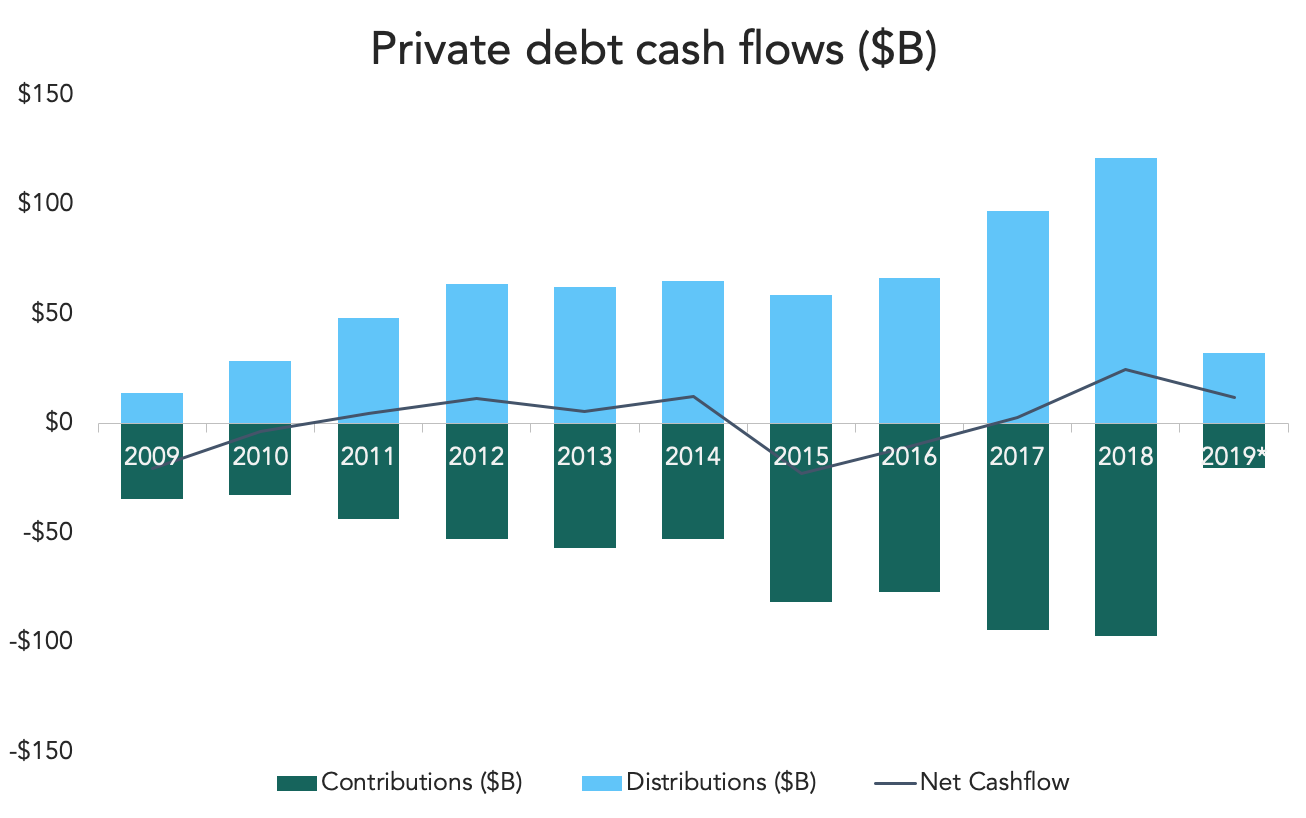
Net cash flows have been hugely positive for private debt funds recently. PitchBook’s Global Private Debt Report showed a record $24.6 billion funneled back to LPs in 2018, alongside a strong start to 2019 numbers as the data slowly rolls in. Private debt treaded water in terms of net cash flows between 2011 and 2014 before going negative in 2015 and 2016. The private debt market matured as an asset class throughout that span—as discussed last week, private lenders became an important spigot to the PE industry following the financial crisis and has scaled over the past ten years. Both contributions and distributions topped $90 billion in 2017 and 2018, signaling an increased demand for private debt and a bigger supply of it available to PEGs.
The positive trends look like they’ll continue. For one, the wave of recent distributions will need to be recommitted to new private debt funds to maintain target allocations. That might be one reason 2019 fundraising was 17% higher than 2018. Over half of last year’s fundraising haul was sequestered in direct lending funds, which are growing in popularity relative to other sub-strategies. Almost $186 billion has been raised in direct lending funds since 2017, and since they’ll be used predominantly for LBOs, their financing power is at least double that. The broader PE market shows few signs of slowing, so we can expect to see capital calls substantially increase over the next few years.
A second positive might be the middle market itself. Direct lending funds are a growing force in the sub-$1B segment—lenders are deepening their relationships with middle-market PEGs, leading to repeat business and more familiarity with investor preferences. An Ares Management note found similarly positive trends: “Compared to broadly syndicated loans…directly originated middle market loans offer an attractive risk-reward profile with substantial illiquidity premiums, reduced volatility and greater influence over terms and overall structures.” Ares cited a Thompson Reuters report that found higher spreads and better pricing compared to broadly syndicated ones. They pointed to lower annual default rates as well, citing Fitch data. Positive trends abound for a maturing and increasingly important asset class that was tiny ten years ago.


Latest news

Share of PE middle-market deal count by backing type
Add-ons remain the workhorse for middle-market deployment, accounting for 67. 1% of all middle-market transactions YTD, in line with activity seen in recent years.

Software deal share falls in middle markets, rises in large caps
In Q3’26 software’s share of total deals fell in both the Lower Middle Market (to 7%) and Upper Middle Market (to 9%), while Large Cap saw a modest uptick in share to 8%.

Secondary loan prices stabilize following steep declines
Secondary loan prices came under significant pressure through September and October, with the Bloomberg U.S. Leveraged Loan Index declining 119…