



Download PitchBook’s Report here.
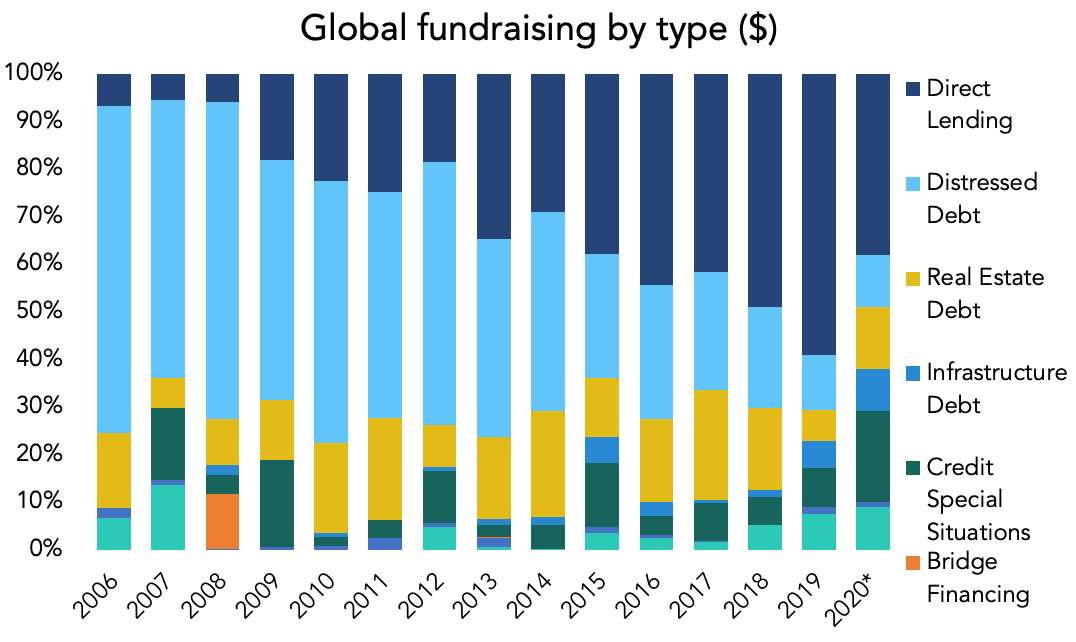
We’re starting to see a spate of distress-focused vehicles hitting the market. Distressed debt and special situations funds accounted for a combined 29.9% of debt capital raised in H1, a leap above the 19.7% they accounted for last year, according to PitchBook’s latest Global Private Debt Report. Special situations funds, which tend to originate loans to bespoke and/or risky companies that other lenders shy away from, have already seen $9.1 billion worth of fundraising through June 30. That’s almost as much as was raised last year ($11.7 billion) and promises to grow significantly throughout 2020. Direct lending, on the other hand, is off to a slow start. With only $18.2 billion worth of funds closed thus far, a back-half pickup would be needed to close the gap with last year’s total ($85.5 billion). Since direct lending funds tend to coexist with bread-and-butter buyouts, it’s likely not an accident to see that slowdown. Distress-focused vehicles are in vogue.
Distress funds are getting bigger, too. Oaktree’s latest effort is targeting $15 billion, which would make it the largest distress fund of all time if it hits its target. Other names on the trail include KKR, Bain Capital and PIMCO, alongside a few credit-focused hedge funds that are also eyeing the market. Timing appears healthy—a consensus is forming that the expected bankruptcy wave will start in Q3 and roll into Q4. The lifelines—federal stimulus money, debt refinancing, tapping into revolving lines of credit—have kept many companies afloat so far. But we’re reaching the point where 90-day credit extensions (going back a few months now) are hitting their dates, and lenders have to start thinking about what those conversations will sound like going forward. The distressed asset space, which had been relatively quiet just a few months ago, appears to be getting crowded and increasingly competitive.


Latest news

Share of PE middle-market deal count by backing type
Add-ons remain the workhorse for middle-market deployment, accounting for 67. 1% of all middle-market transactions YTD, in line with activity seen in recent years.

Software deal share falls in middle markets, rises in large caps
In Q3’26 software’s share of total deals fell in both the Lower Middle Market (to 7%) and Upper Middle Market (to 9%), while Large Cap saw a modest uptick in share to 8%.

Secondary loan prices stabilize following steep declines
Secondary loan prices came under significant pressure through September and October, with the Bloomberg U.S. Leveraged Loan Index declining 119…