



Download PitchBook’s Report here.
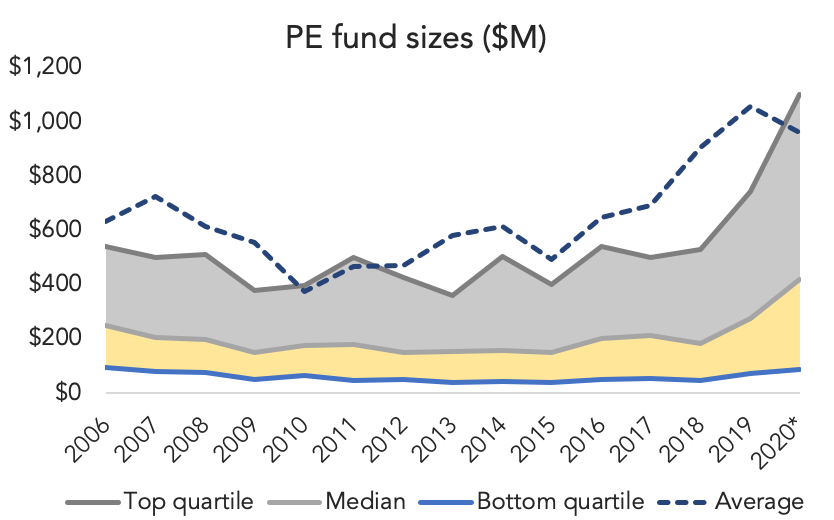
Fundraising has been more difficult in 2020, more so for smaller funds but less difficult for larger ones. The funds that have closed this year have tended to be on the larger side, according to PitchBook’s just released Private Fund Strategies Report, causing a spike in the “top-quartile” fund size. Just going by dollar amount (and disregarding performance), the top-quartile fund size for the 2020 vintage topped $1 billion for the first time against the backdrop of a falling average fund size. It’s mostly a function of bigger funds skewing the data amidst a slowdown more generally. But they’re still getting raised; others aren’t having as easy a time. First-time fundraises, for example, total only $3.2 billion across 21 funds through H1, a far cry from the $18.6 billion raised across 57 first-time funds last year.
There’s reason to believe this flight to size will continue in H2—we identified 15 open funds targeting anywhere between $6 billion and $18 billion still on the market. Names like Silver Lake, Thoma Bravo and CD&R are all looking to clear at least $10 billion for their next flagship funds. If all 15 funds we identified were to close this year, the combined value alone would eclipse the total raised across the industry through June. There’s a chance 2020 will end with a flourish, even if the rest of the year has stunk.
Our methodology only counts funds that have officially closed, so there’s something of a survivorship bias with these next numbers: 83% of the funds closed so far in 2020 have been larger than their predecessors, with a median step-up size of 49%. Both figures are in-line with pre-COVID trends, but that’s subject to change. Poor past performance will no doubt have an impact on current fundraises, and pre-COVID target sizes might be wishful thinking for bottom performers. There’s also a dichotomy in strategy—proven investors in the distressed space are getting flooded with calls. According to a June report from Institutional Investor, KKR and Apollo raised $1.75 billion and $4 billion, respectively, “for credit funds focused on ‘dislocation’ resulting from the COVID-19 crisis,” adding that “both funds were raised in just 8 weeks.” PitchBook data shows that the fastest 2020 funds needed only 4.5 months on average to close, down from a 6.1 month average for the fastest funds to close last year.


Latest news

Share of PE middle-market deal count by backing type
Add-ons remain the workhorse for middle-market deployment, accounting for 67. 1% of all middle-market transactions YTD, in line with activity seen in recent years.

Software deal share falls in middle markets, rises in large caps
In Q3’26 software’s share of total deals fell in both the Lower Middle Market (to 7%) and Upper Middle Market (to 9%), while Large Cap saw a modest uptick in share to 8%.

Secondary loan prices stabilize following steep declines
Secondary loan prices came under significant pressure through September and October, with the Bloomberg U.S. Leveraged Loan Index declining 119…