
It’s an investment option that’s become big in Japan, but strong competition for deals casts a cloud.
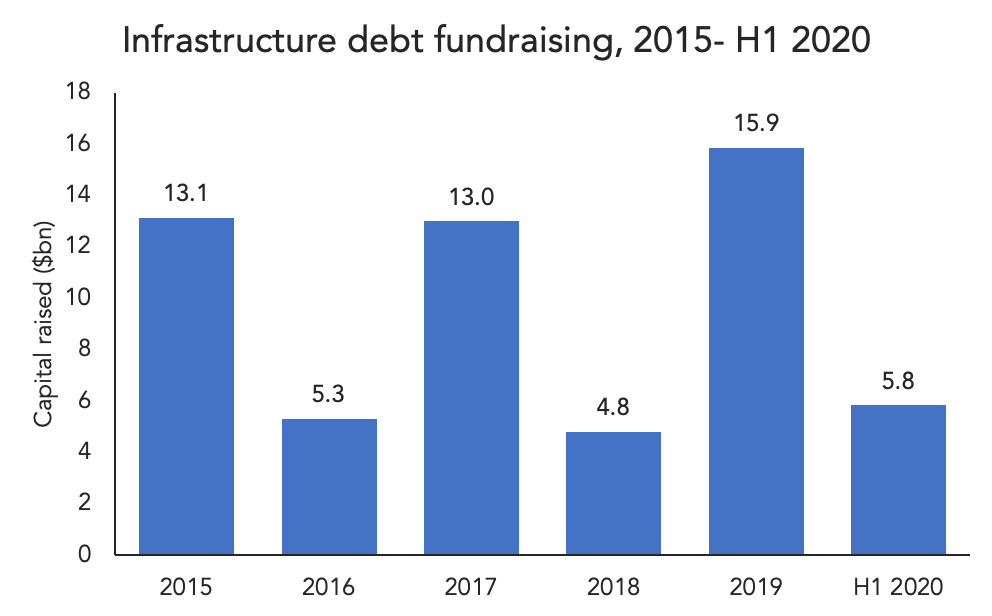
Infrastructure debt continues to attract interest from long-term investors. As can be seen from the chart above, fundraising reached a five-year peak in 2019 and was also strong at the beginning of this year before the pandemic struck.
Many Japanese investors in particular have begun looking keenly at the asset class because of robust cash holdings sitting idle, delegates heard at our sister publication Infrastructure Investor’s first virtual Tokyo Forum on 10 and 11 September.
Toru Inoue, a Tokyo-based vice president at Goldman Sachs, pointed out that Japanese LPs’ direct exposure to infrastructure has been growing aggressively. “The concept of direct lending, from a Japanese point of view, has suddenly arisen,” he says.
Historically, infrastructure projects in Japan were financed by taxpayer money or from the corporate balance sheets of large utility companies, according to Inoue. Japanese LPs did not have direct exposure to infrastructure, such as project financing or non-recourse infrastructure financing, five to six years ago, he added.
However, since the Japanese government’s initiative to privatise some infrastructure assets in 2012, starting with renewables and airports, the change has been dramatic, he noted.
“The rise of infrastructure direct lending is very welcome from the lenders’ point of view,” Inoue said, adding: “It is because Japanese LPs are awash with so much liquidity and … have no idea what to do with it.”
Some fund managers at the event feared there was too much money chasing too few deals, however.
Nick Cleary, a New York-based partner at Vantage Infrastructure, noted that covid-19 would be a catalyst for change in selected industry segments. His team focuses on the renewables, energy distribution and storage sectors, as well as telecommunication and data-related sectors. “These are still driven by the development and build-out phases and there is still a lot of competition in this space,” he said.
Erik Savi, a New York-based managing director and global head of Carlyle Infrastructure Credit, agreed with Cleary on the increasing amount of capital flowing into the market. “Investors are searching for dealflow, searching for yield,” he claimed.

Latest news

YTD 2026 investment grade loan volume tops US$1.4trn, poised to set new annual record
Over US$1.4trn of investment grade loan volume has been completed so far this year, an 11% increase compared to the…