



In an increasingly turbulent and inflationary world, could an ‘old-fashioned’ wave of distressed debt be around the corner?
The covid pandemic, inflation that now looks more long term than transitory, the promise of hikes in base rates, supply chain pressures, the conflict in Ukraine. The list may go on, though one can only hope it stops there – at least for long enough to take a breath and take stock. But regardless of what the future brings, surely there’s already plenty enough volatility in the system to create a serious amount of dealflow for distressed investors?
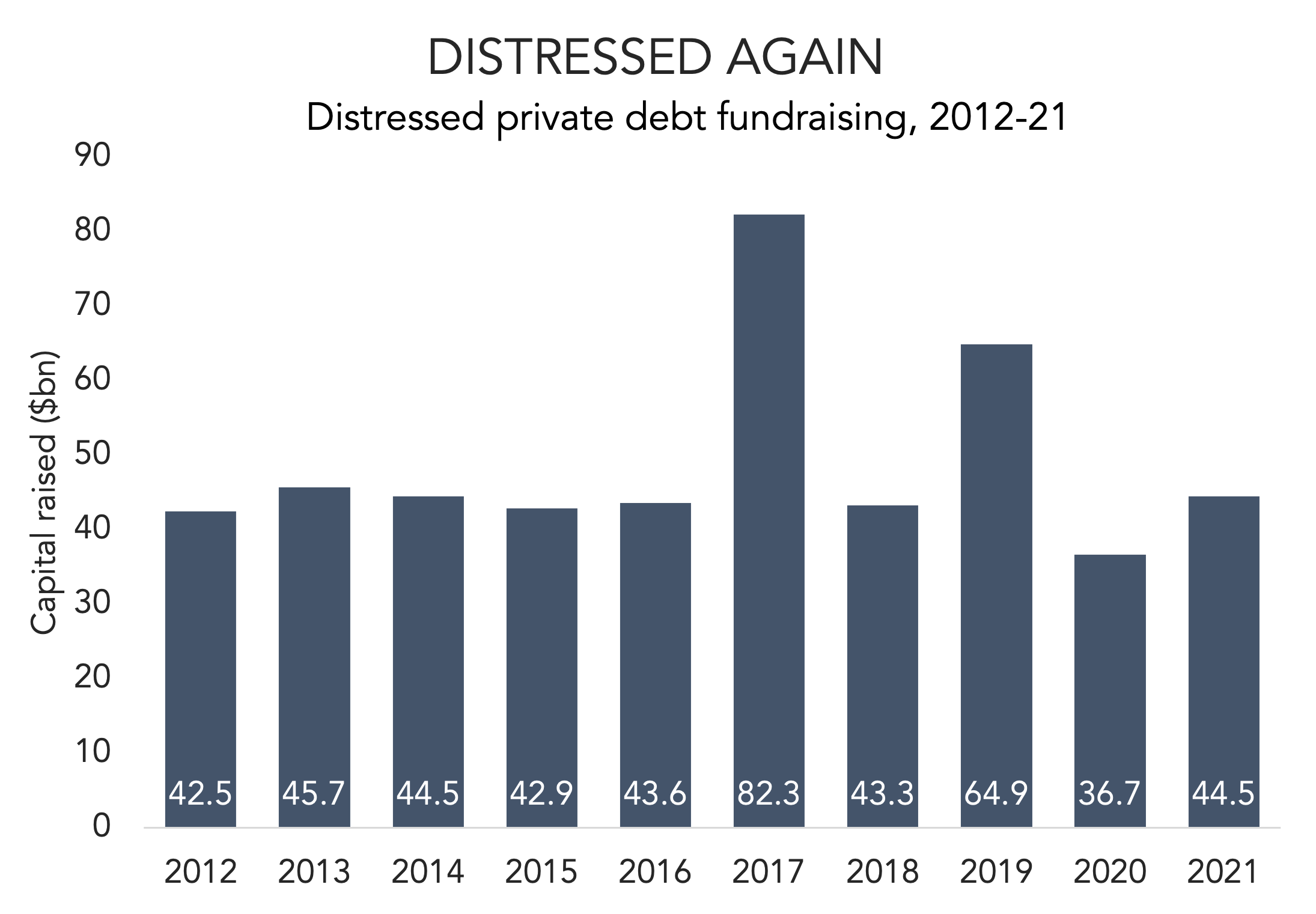
There are some signs from the fundraising data (see above) that investors are prepared to take a punt on distressed, with the amount raised last year showing an increase on 2020. But LPs are certainly not yet climbing aboard the distressed bandwagon in the numbers that they did in the peak fundraising year of 2017.
Part of this is due to a sceptical view of large, distressed funds based on the 2013/14 vintage that were often multi-billion dollars in size but struggled to deploy capital. Under pressure to invest because of fees sitting idle, some took concentrated bets in the energy sector which didn’t tend to have favourable outcomes.
One of the problems with the “jumbo size” fundraisings is the size of deals they are restricted to. If the minimum deal size is around $300 million to $500 million then chances are you want to be the only firm looking at the deal. So, whilst you may see 30 opportunities of this size you may also miss out on 500 or more which are all smaller but won’t move the needle for your fund size.
But despite the scepticism, the fact is large-scale distress would invite the reappearance of large-scale distressed funds. Up to now, investors may have been more inclined to back the likes of special situations and capital solutions funds which are more to do with operational issues at individual companies. But the world today is a volatile one in which inflation is once again rearing its ugly head. Fashions can, and do, change.
(Past performance is no guarantee of future results.)






Private Credit Defaults 101: Back to School
As Labor Day approaches, the unofficial end of summer is upon us. But, before we get too sad, there is also the familiar back-to-school energy.