



Competition between liquid and illiquid debt financing is heating up amid broader economic uncertainty generated by rising inflation, interest rate hikes and the war in Ukraine.
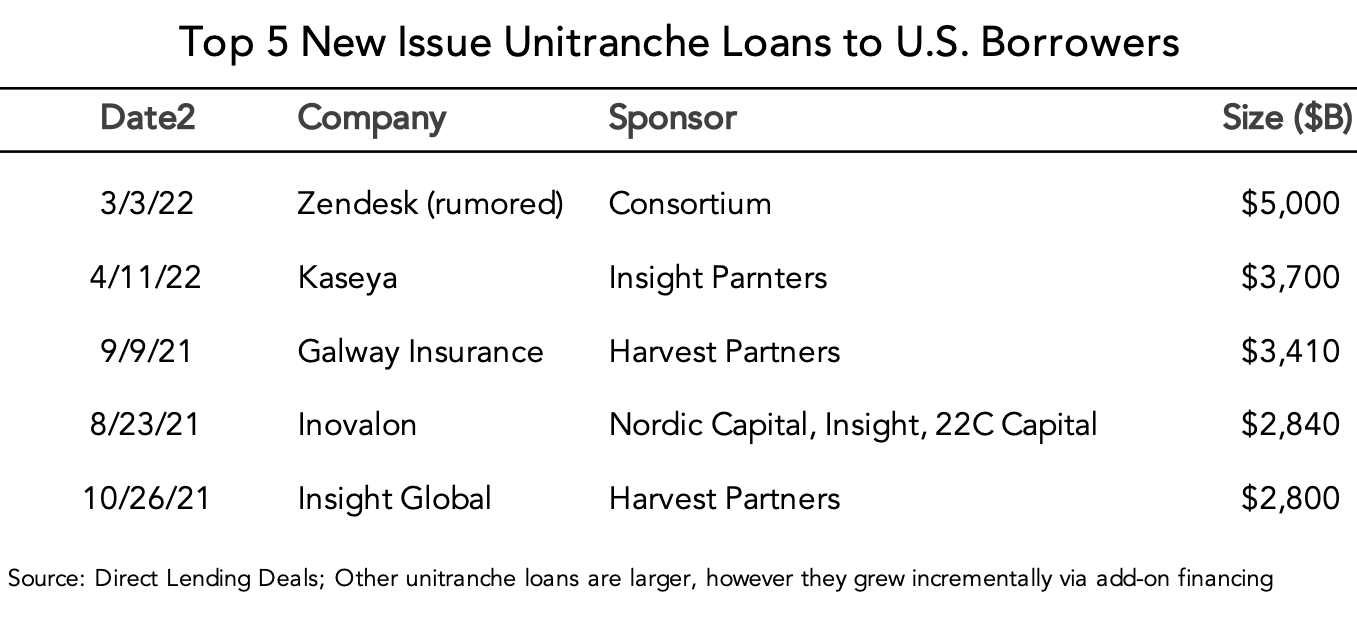
Software company Kaseya surfaced this month with a $3.7 billion jumbo unitranche loan to kick Galway Insurance’s $3.4 billion credit to second place.
Kaseya follows Anaplan, which emerged in March with a $2.5 billion unitranche, the largest recurring revenue structure tracked by Direct Lending Deals.
This month, SailPoint Technologies tapped the private market for a $2.5 billion unitranche, also a recurring revenue loan, although the size of the financing is unlikely to trump Anaplan. Even if SailPoint’s financing were extremely aggressive, say 35% of the capital structure, that would still come in short of Anaplan, which has a loan to value of 23%, as is typical for recurring revenue financing.
With large unitranche loans now a fixture in the private credit space, arrangers for broadly syndicated deals have been experimenting with replicating the unitranche structure by offering total leverage of more than 7x.
Veracode flipped to an $815 million unitranche loan after initially launching a $580 million first-lien term loan and a privately placed $235 million second-lien term loan. An adjoining $75 million revolver was upgraded to super-priority status over the unitranche term loan. Pricing is S+475.
With no second-lien to cushion senior lenders, agencies penalized the larger term loan by one notch. Moody’s, S&P and Fitch downgraded the term loan to B3 from B2; B- from B; and B+ from BB-, respectively.
The move by Veracode follows Sovos Compliance’s shift last July to an all-first-lien deal. Sovos moved to a $1.245 billion first-lien term loan and a $215 million delayed-draw first-lien term loan, from a first- and second-lien structure. Pricing cleared at L+450 with a 0.5% floor.
Banks are looking to expand their tool kits to compete with direct lenders, which can now vie for increasingly large mandates, although not Twitter-sized. The big threat for the private market is pricing —Veracode and Sovos cleared under a spread of 500. The lowest margin on a privately arranged jumbo unitranche is L+525, and that was for Galway in September 2021. None have cleared lower than L+550 since.
There’s more to costs than just spreads, however, and some sponsors argue private jumbos are actually less costly than syndicated financing options in some cases.
Private arrangers charge lower underwriting fees; there are no fees paid to rating agencies; legal costs are lower because the credit agreement is simpler; and raising delayed-draw capital is much easier and less costly from private lenders.







Private Credit Defaults 101: Back to School
As Labor Day approaches, the unofficial end of summer is upon us. But, before we get too sad, there is also the familiar back-to-school energy.