



Download PitchBook’s Report here.
During the buyout boom of 2005-2008, “club” deals were a common sight, especially at the high end. When the music stopped in 2008, many of the biggest portfolio companies were held by three or more PE firms, who had to make “club” decisions about what to do next. That approach to dealmaking largely fell out of fashion after that.
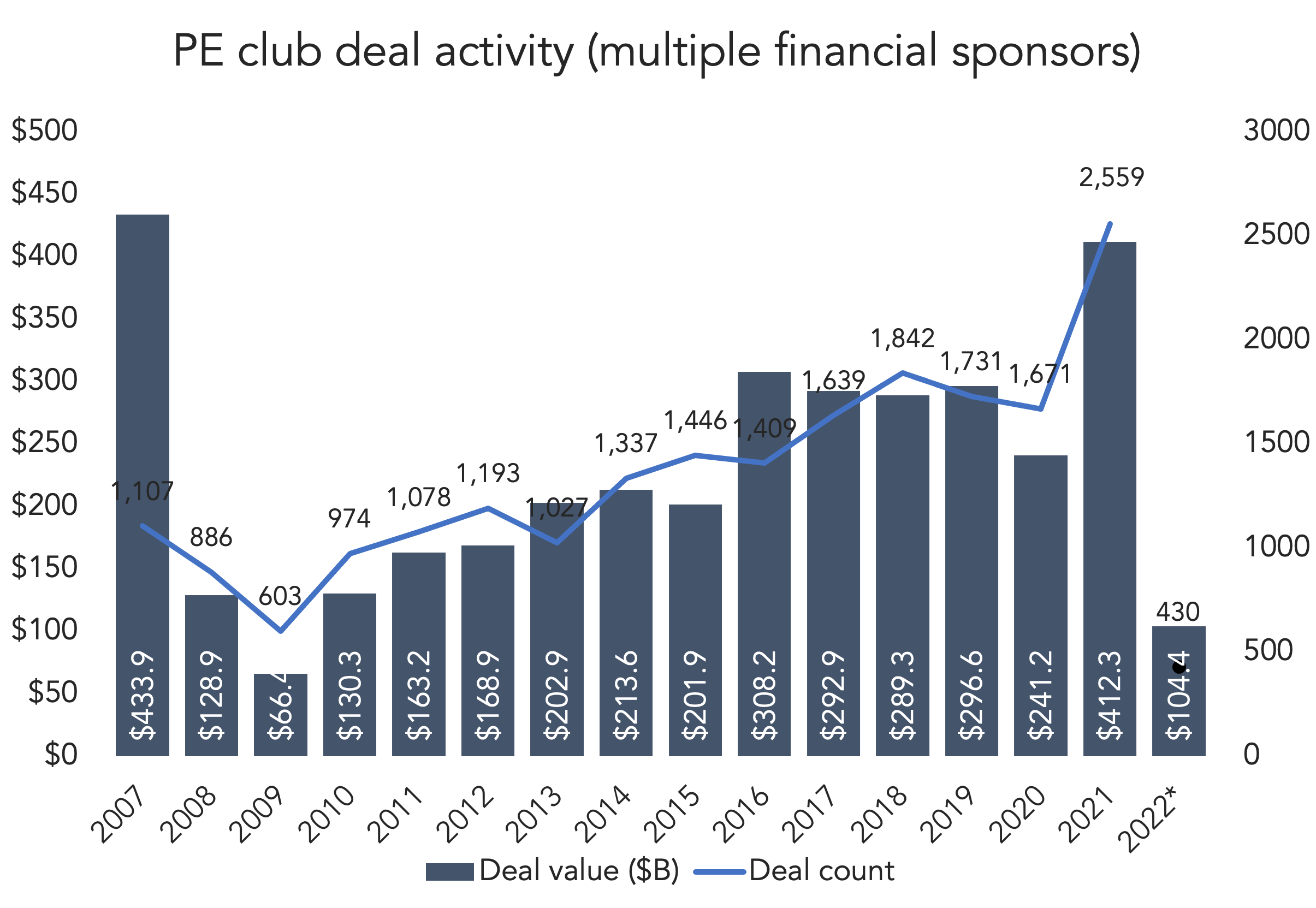
But PitchBook’s Q1 US PE Breakdown Report found a resurgence of them in 2021. For the first time since 2007, club deals were responsible for at least $400 billion of aggregate deal value. Moreover, there more than 2,500 club deals for the first time. That number is markedly different from the buyout boom era, when just as much capital was being invested in far fewer transactions. Among other things, that means the typical club deal of 2021 was much smaller than it was 15 years ago.
Even if club deals are smaller than they used to be, LPs have expressed hesitation once they’ve experienced them. “As an LP, you’ve now entered into secondary relationships with GPs that you may not want to be associated with…You have to be comfortable that that’s not within your control anymore,” one investor told Institutional Investor. She likened it to multiple people buying a house together. That sounds like a good idea for a Netflix series, actually; it’s not “drama,” it’s “deal complexity.” It also sounds like a show that many LPs wouldn’t care to watch.
(Past performance is no guarantee of future results.)


Latest news

Share of PE middle-market deal count by backing type
Add-ons remain the workhorse for middle-market deployment, accounting for 67. 1% of all middle-market transactions YTD, in line with activity seen in recent years.

Software deal share falls in middle markets, rises in large caps
In Q3’26 software’s share of total deals fell in both the Lower Middle Market (to 7%) and Upper Middle Market (to 9%), while Large Cap saw a modest uptick in share to 8%.

Secondary loan prices stabilize following steep declines
Secondary loan prices came under significant pressure through September and October, with the Bloomberg U.S. Leveraged Loan Index declining 119…