Markit Recap – 6/1/2015

Many expect the European economy to perform better this year – not difficult, come might say – but recent spreads movements suggest the credit markets are sceptical.
Since the index roll on March 20, the Markit iTraxx Europe has widened by 10bps to 65bps. Contrast this with the performance of the North American investment grade equivalent, the Markit CDX.NA.IG. The index was trading at 64bps this week, less than 1bp wider than its closing level on March 20. It is the first time that the European index has traded wider than its North American counterpart since November 2014.
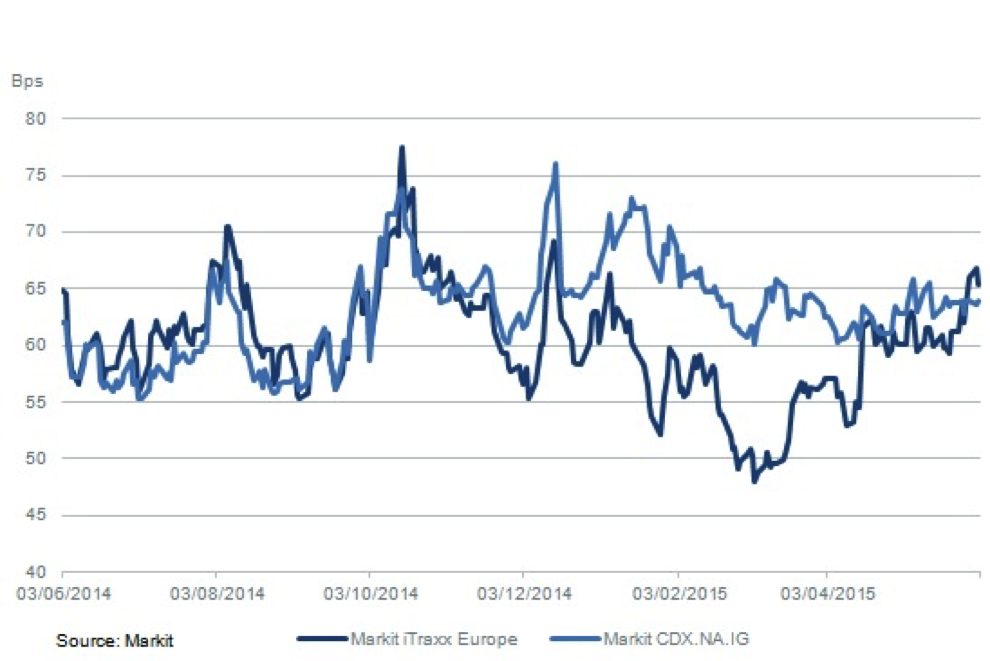
The composition of the Markit iTraxx Europe probably accounts for some of the underperformance. Banks make up 30 of the 125 names in the index – a share that increased at the last roll – while the Markit CDX.NA.IG doesn’t include banks at all. This means that when there are fears over the stability of the eurozone -as there are now due to the ongoing saga around Greece – banks are often viewed as the most vulnerable sector. The underperformance of the Markit iTraxx Senior Financials index – a subset of the iTraxx Europe – supports this view.
Macro investors often use the index as their preferred tool for hedges and defensive positions. Index liquidity is all but guaranteed, whereas trading in large size at reasonable bid-offer spreads in the single name market can sometimes be a challenge. We can see that the index is the weapon of choice by looking the basis between the traded index level and its theoretical level, sometimes known as the skew. The index widened from 59bps to 67bps fromMay 21 to June 1, while its theoretical level moved from 61bps to 65bps, thus reversing the direction of the basis. The Markit CDX.NA.IG experienced a stable skew over the same period.
So it seems that the uncertainty over Greece’s status in the eurozone – it faces an IMF payment on June 5, with more to follow – is affecting European credit disproportionately. We have also seen significant volatility in the government bond market, with German Bund yields rising sharply. This may indicate that the markets are pricing in higher expected inflation and higher rates, suggesting that the ECB’s QE medicine is working. Inflation figures did exceed expectations, but it is far too early for victory declarations. What is certain is that the combination of central bank intervention and poor secondary market liquidity will continue to distort relationships between asset classes.
Contact: Gavan Nolan
Gavan.Nolan@markit.com


Latest news

US leveraged loan issuance stalls in October amid secondary market rout
US leveraged loan issuance took a significant hit in October amid deteriorating secondary market conditions. Approximately $41.3b of loans have…