



The influence of the payment-in-kind option in private debt transactions is on the rise.
There was a time when a company seeking a payment-in-kind (PIK) option was a surefire sign of trouble. Think of the credit bubble that led to the global financial crisis. After all, PIK loans allow a borrower to pay some part of the interest not with cash, but by adding more debt into the principal to be paid later – arguably a risky proposition, particularly in times of economic stress.
Whether PIK features still signal distress depends on who is negotiating them and when, where they sit in the capital structure and whether they are mandatory or being paid at the borrower’s discretion.
One thing is clear. The use of PIK features is on the rise, and in rated companies is often identified as a default. Given the more limited disclosure in private funds, investors may be unaware that a manager is employing PIK until a company defaults.
Corporate defaults are surging, with Moody’s Investors Service noting in a late July report that these jumped 30 percent in the second quarter on Q1, and that private equity-backed distressed exchanges, which included the PIKing of cash interest, dominated other forms of defaults.
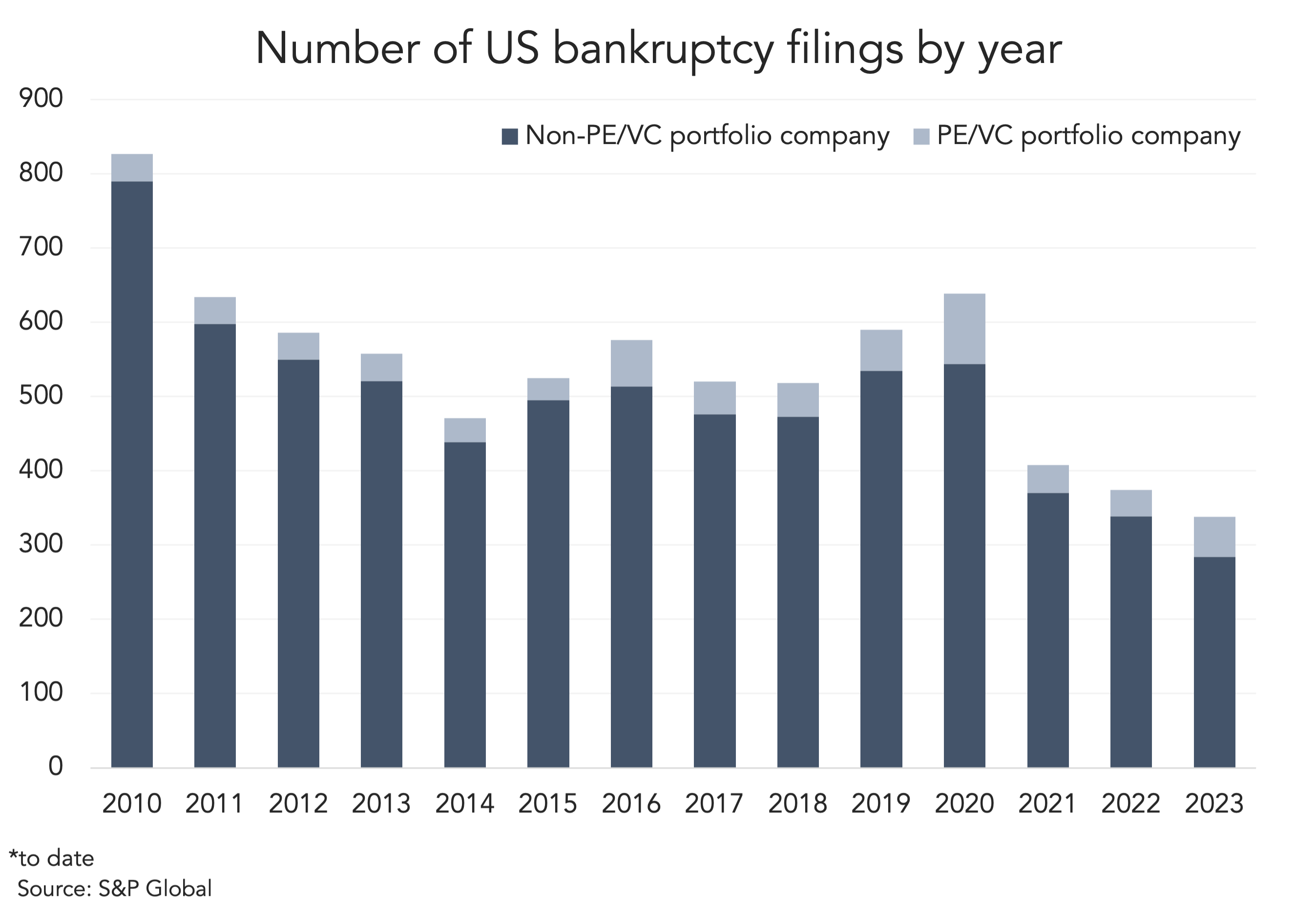
S&P Global Market Intelligence reports that bankruptcy filings among private equity portfolios are on track to reach their highest annual level since 2010 (see chart). US corporate bankruptcies overall rose in July – with the latest filings pushing the tally so far this year past the total for 2022, per S&P Global.
Still, some managers are employing PIK options in growing companies. The position in the capital structure matters. Some say PIK options are extremely rare for senior loans, although they are increasingly being used for performing businesses facing a doubling of interest expense because of the Fed’s steep rate increases.
Some lenders are offering PIK features on senior debt to provide higher leverage on deals, with an additional yield on the PIK portion to compensate for the risk. However it’s used, PIK is certainly becoming a major talking point in private debt.
(Past performance is no guarantee of future results.)




Latest news

US leveraged loans returns turn negative in October
The Bloomberg US Leveraged Loan Index (Ticker: LOAN) has returned -0.26% this month through October 21, reducing its year-to-date return…

M&A activity begins to tick upward
In the third quarter of 2026, acquisition-linked loan volume across North America and Europe reached about $47 billion, up from $30.6 billion in Q2 and $29.5 billion a year ago.
