



PDI’s Germany Forum examined the upcoming opportunity set for distressed and special situations as a refinancing wave looms.
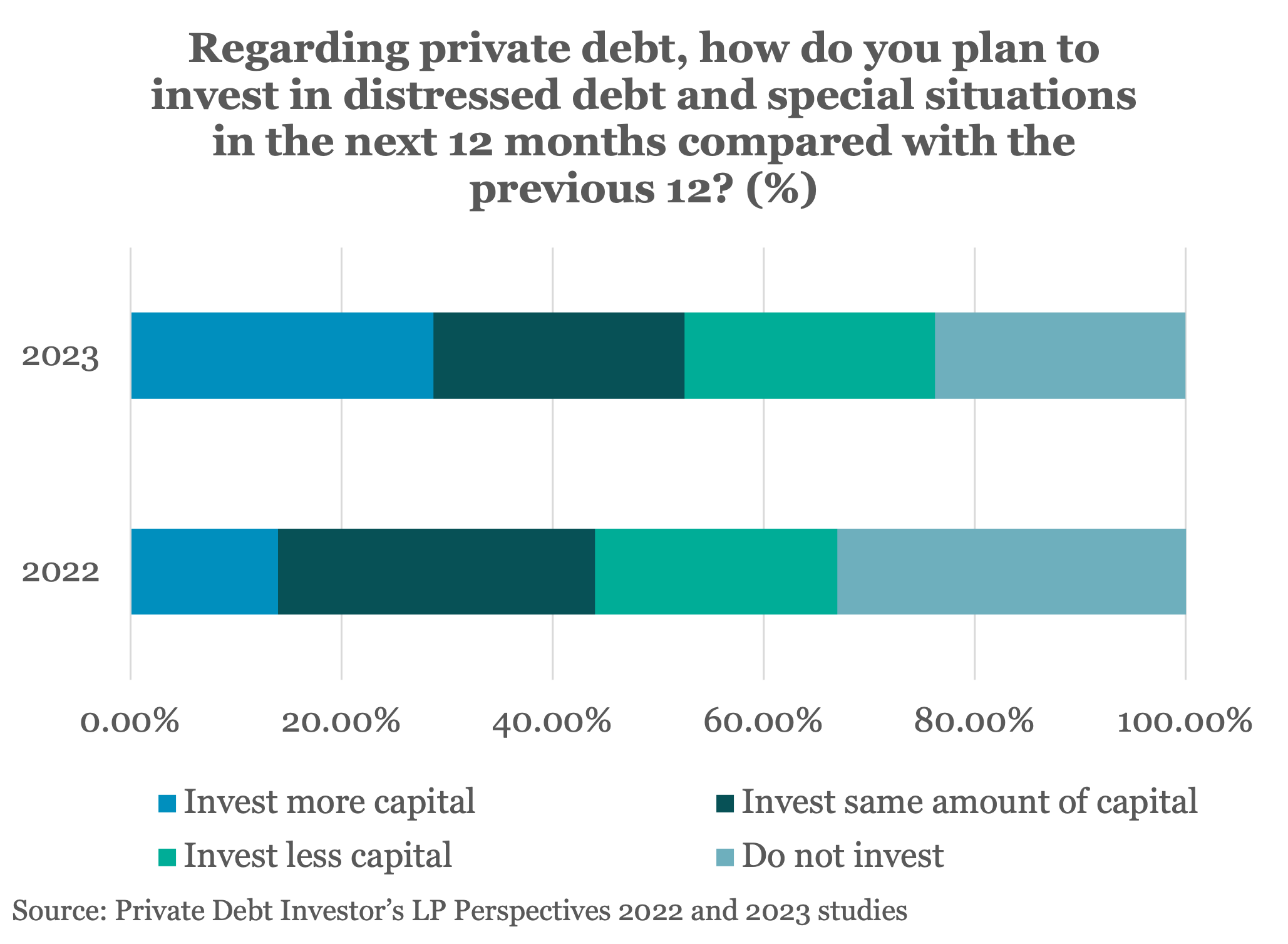
“This is the best [distress] opportunity we’ve seen in a decade,” said a panellist at the PDI Germany Forum last week, referring to what he described as around 30 percent of the total outstanding bonds and loans market coming to maturity at a time when interest costs will be twice as high as when the loans were taken out. This will come as a relief to those investors pledging to increase allocations to this part of the market (see chart).
It was noted that the host country of Germany was likely to be something of a reluctant flag-bearer for distress given that, as one panellist observed, “the German economy is struggling on both a relative and absolute basis.”
So, 2008 all over again? No one was going that far. “I don’t think it will be a huge wave due to ‘amend and extend’ provisions,” said one participant. “The vast majority of issues will be dealt with by extensions rather than defaults or comprehensive restructurings.”
One panelist made the point that, when it comes to distress, it’s important to deploy consistently throughout the cycle as it’s not a market you can time easily. “Diversify and don’t favour a particular strategy,” they urged.
The point was made that, due to idiosyncratic developments such as Brexit in the UK or the global pandemic, much of the opportunity in recent years has been due to brief periods of dislocation. But, in what looks likely to be a “higher for longer” rate environment and with that refinancing wave in prospect, the nature of the opportunity may be very different going forward. “The playbook that worked last year won’t work next year,” as one industry professional noted.
Another observation made was that, among what is estimated to be around €120 billion of distressed loans and bonds outstanding in Europe today, some sectors that have traditionally been seen as highly favoured by private market investors are experienced signs of stress. “But in many cases, these are good companies with bad balance sheets due to the circumstances,” it was noted. “You have to sort out the balance sheets, not the company fundamentals.”
One thing’s for sure: distressed and special situation investors are likely to be kept busy in the period ahead.
(Past performance is no guarantee of future results.)


Latest news

Share of PE middle-market deal count by backing type
Add-ons remain the workhorse for middle-market deployment, accounting for 67. 1% of all middle-market transactions YTD, in line with activity seen in recent years.

Software deal share falls in middle markets, rises in large caps
In Q3’26 software’s share of total deals fell in both the Lower Middle Market (to 7%) and Upper Middle Market (to 9%), while Large Cap saw a modest uptick in share to 8%.

Secondary loan prices stabilize following steep declines
Secondary loan prices came under significant pressure through September and October, with the Bloomberg U.S. Leveraged Loan Index declining 119…