
Read PDI’s Report: LP Perspectives 2024 report
Read PDI’s Report: LP Perspectives 2024 report
Capital allocations can be expected to increase as many LPs seek to back up their faith in private markets with greater commitments.
After a fallow couple of years for fundraising (as well as exits and distributions) in private markets, optimism is returning among LPs, according to Schroders’ latest global investor insight survey.
The survey found that around seven in 10 institutional investors globally (69 percent) invest in private markets. A further 25 percent do not, but plan to do so within the next two years.
A little over half (52 percent) of institutional investors and gatekeepers expected to increase allocations to private equity. Private debt (45 percent) and renewable infrastructure equity (42 percent) were the next most popular asset classes.
Schroders’ findings are similar to fresh research from Goldman Sachs, which found that while many LPs are over-allocated to private equity, they are under-allocated generally across private markets.
“Investors broadly remain under-allocated across private markets and continue to show strong appetite for new access points, including co-investments, secondaries and semi-liquid vehicles,” Stephanie Rader, global co-head of alternatives capital formation with Goldman Sachs Asset Management, said in the survey report.
It appears that LPs are still very supportive of PE and private credit, despite tepid fundraising numbers recently. The most recent quarter did show something of an uptick in support for private debt, however.
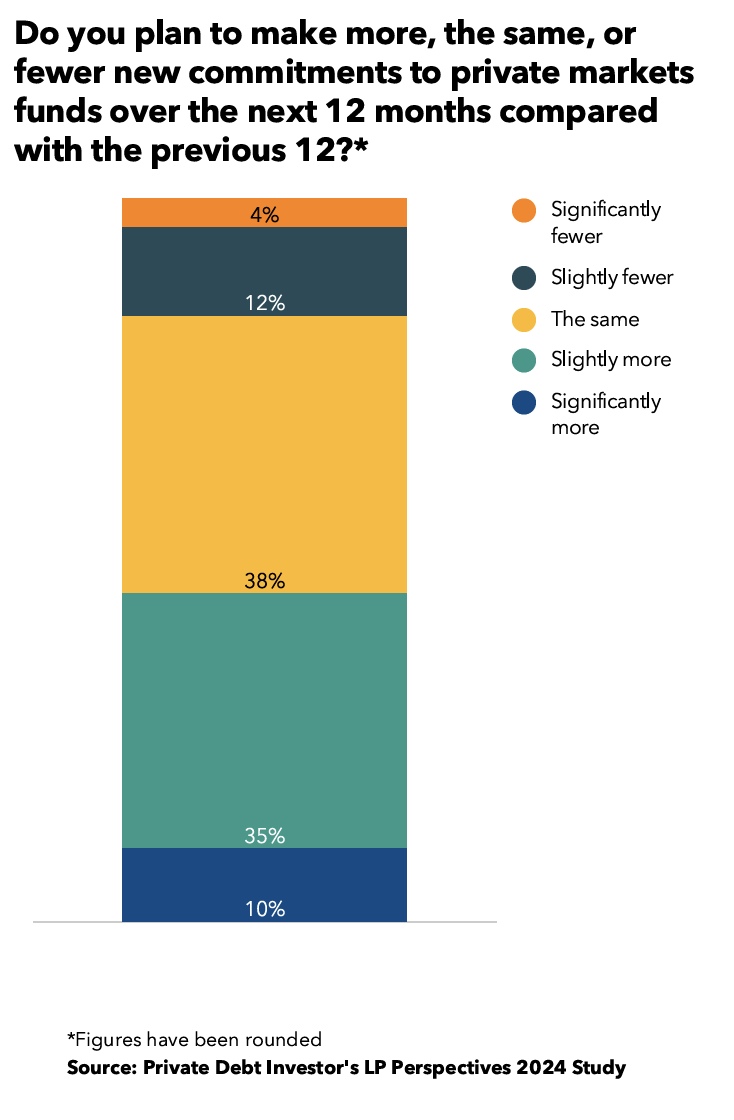
The positive sentiment in the Schroders and Goldman Sachs studies is supported by Private Debt Investor’s own research. In our LP Perspectives 2024 report, we found 45 percent of LPs wanting to commit “slightly more” or “significantly more” to private debt over the following 12 months while only 16 percent were expecting their commitments to be “slightly lower” or “significantly lower” (see chart).
We also found under-allocation to be widespread, with more than half (52 percent) indicating their private debt exposure was not at the desired level. Only 9 percent considered themselves over-allocated to the asset class.




Latest news

US leveraged loans returns turn negative in October
The Bloomberg US Leveraged Loan Index (Ticker: LOAN) has returned -0.26% this month through October 21, reducing its year-to-date return…

M&A activity begins to tick upward
In the third quarter of 2026, acquisition-linked loan volume across North America and Europe reached about $47 billion, up from $30.6 billion in Q2 and $29.5 billion a year ago.