


Resilient secondary loans, light primary calendar carry repricing trade through October

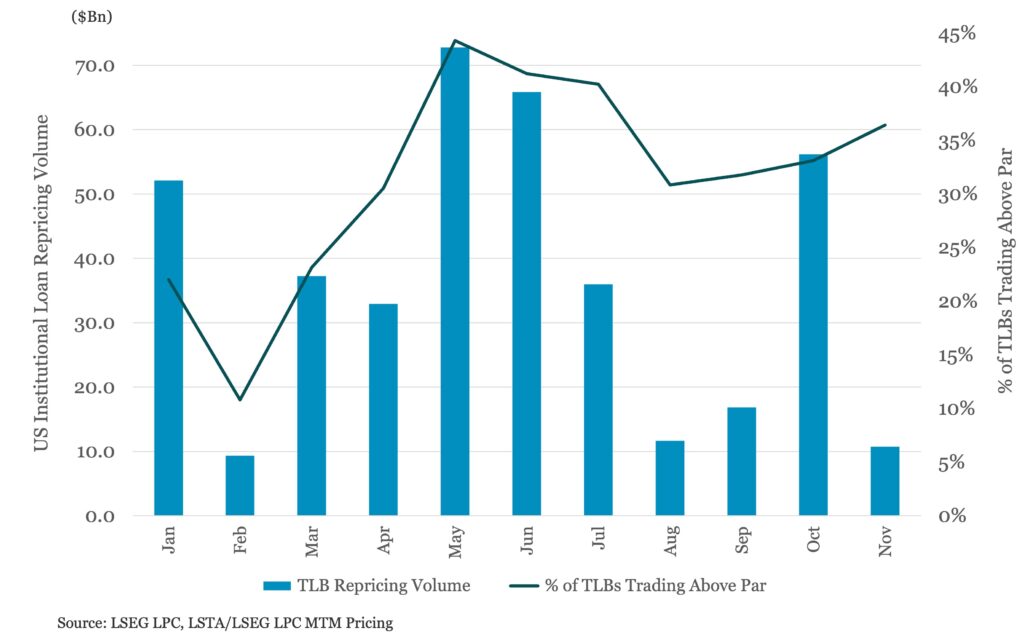
The share of institutional term loans trading above par averaged 33% in October, advancing atop 31% in August and 32% in September. And secondary loans have traded nowhere but up through the first two weeks of November, with par-plus loans now accounting for 43% of the secondary market, a level not sustained since July. This persistent trading support, coupled with a relatively thin new money forward calendar, continues to carry the largest repricing wave in the history of the leveraged loan market. At least 43 issuers collectively repriced more than US$56bn of existing term loans in October, marking the third busiest month of the year for repricings, behind only May (US$73bn) and June (US$66bn). Single-B issuers extracted 50bp of spread savings on average, while double-B issuers obtained approximately 25bp; at least three issuers had lingering CSA provisions, which were ultimately stripped from the credit agreement in conjunction with the repricing to yield the borrower some additional cost savings in those cases. And with the broader secondary pricing move higher, repricing activity in November has simply been a seamless continuation from October, with at least 6 issuers having already closed on a combined US$5.3bn of institutional loan repricings and at least eight more executions totaling US$16.5bn just announced and/or still working through syndication. Among the six repricings already signed, which were evenly split between single-B and double-B issuers, the average spread reduction was 50bp.

Latest news

Software, technology and consumer sectors lose deal share in 9M’26
The software and technology sector, the second most active sector in 2025 at 17% of total deal activity, slid to fifth place in the first nine months of 2026.


Leveraged loan investors see gains in November
Following a 0.25% decline in October, the Bloomberg US Leveraged Loan Index (Ticker: LOAN) has returned 0.60% this month through…