
It’s been boom time in the leveraged loan market but now that market has eased off, what are the implications for CLOs?
After two straight years of record issuance, managers of collateralized loan obligations are having to deal with a lull in the supply of leveraged loans, which serve as the lifeblood of the structures.
According to July data from Fitch Ratings, leveraged loan issuance in the first half of 2026 was roughly $444 billion, down considerably from the $544 billion in the latter half of 2025, but still elevated when compared to historical levels.
Total leveraged loan issuance in 2024 was $1.34 trillion, per Fitch data and $980 billion in 2025.
While in the immediate term, the break in the action is giving some managers a chance to reset their liabilities, sources that spoke with Private Debt Investor say that the episode unfolding in leveraged loans has the potential to serve as a differentiator between the best managers and their peers in the long run.
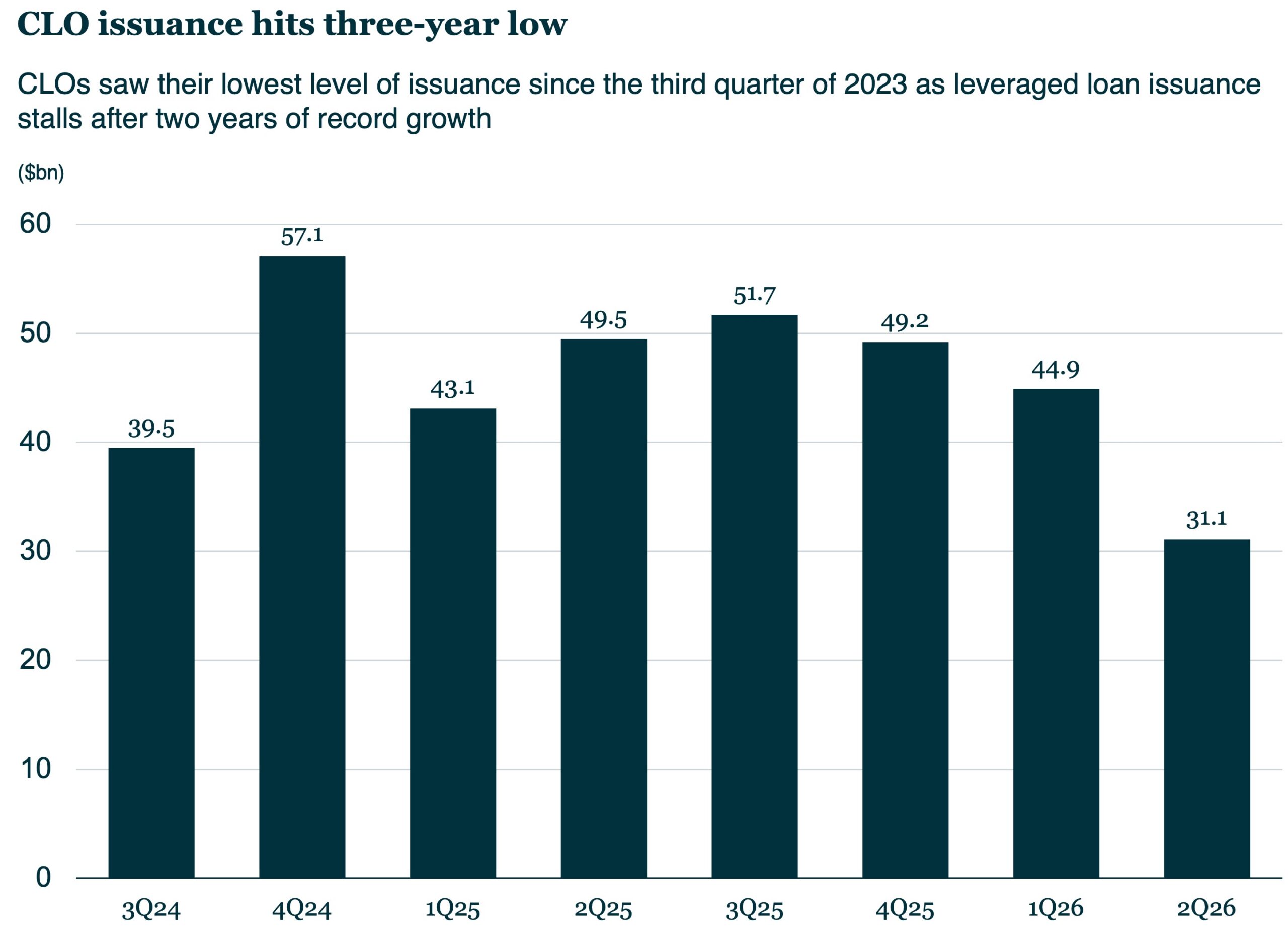
“The primary driver of [CLO] issuance tends to be leveraged loan issuance, and so with that slowing down, CLO issuance has slowed down,” said Erik Miller, co-head of Canyon Partner’s CLO business.
A separate report from Fitch Ratings from mid-May said that through 30 April the market priced 258 broadly syndicated CLOs totaling $114.5 billion and 41 middle market CLOs totaling roughly $19.3 billion, representing year-over-year volume declines of 24.2 percent and 38.7 percent respectively.
As of mid-July Fitch Ratings says that net portfolio losses among Fitch-rated US CLOs were just 0.5 percent, which while not a holistic metric in and of itself, still suggests that there is no need for alarm bells currently.
However, with the software sector coming under increasing pressure from advances in generative AI and homebuilding companies under stress from high interest rates – the loans of both sectors generally seeing changes in the level of risk and pricing – questions are emerging about their eventual impact on the health of CLO portfolios.


Latest news

US leveraged loan launches reach five-month high in September
The US leveraged loan market recorded $93.6b of launches in September, marking the busiest month of primary market activity since…
Information technology topped nonaccruals on a cost basis
The information technology sector moved from second place in the first quarter to the top of the list in the second quarter