
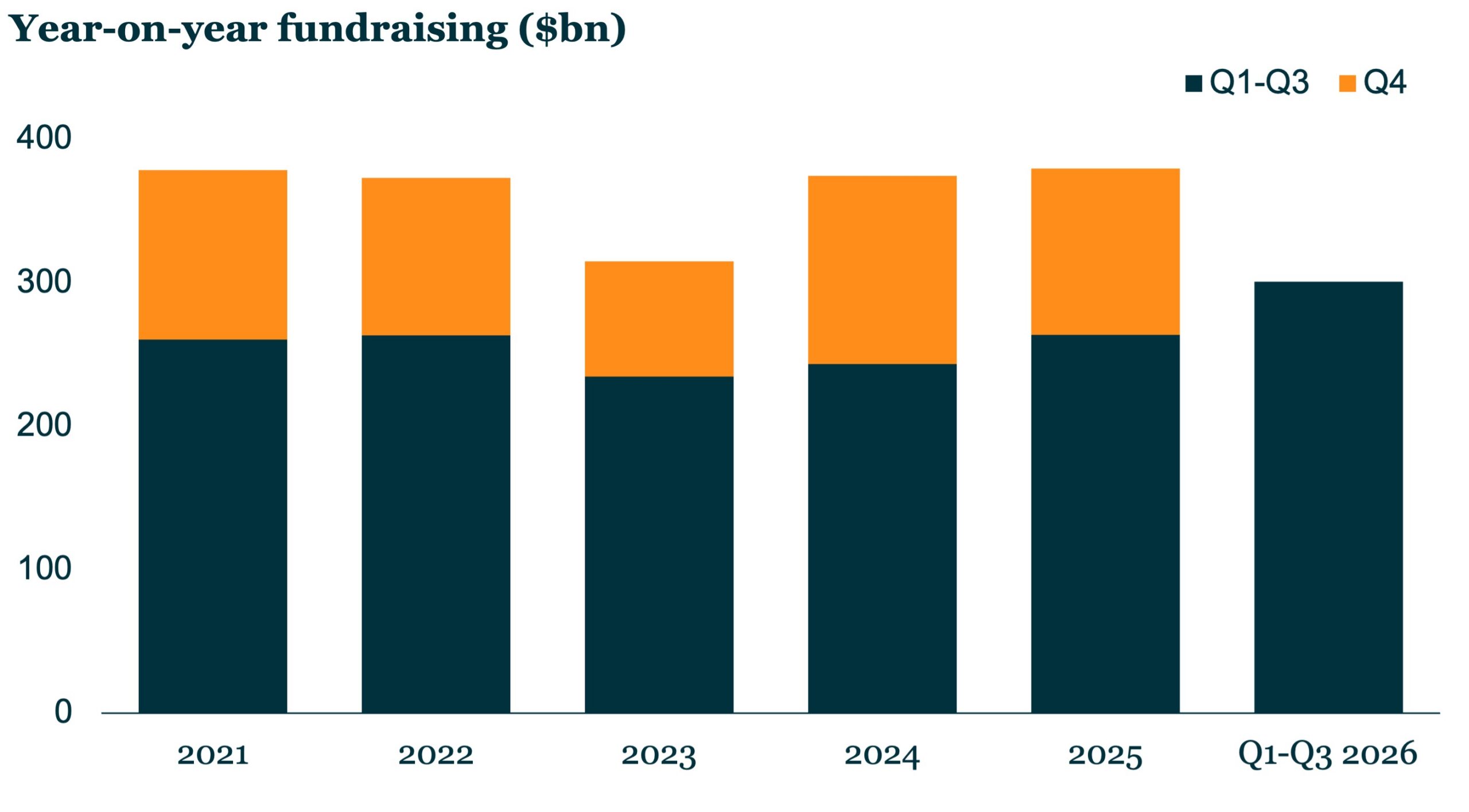
PEI Private Credit’s latest fundraising data shows a slowdown in Q3 in a year with huge momentum in the first two quarters.
Our latest fundraising quarterly report indicates that 2026 is on course to be a record-breaking year for private credit, with just over $300 billion raised in the first nine months, well ahead of any previous year. The nearest to this was 2025, when the first three quarters saw a total of $263.4 billion raised.
However, fundraising did slow in Q3, with just $68.7 billion raised, down from more than $100 billion in both Q1 and Q2. The Q3 total is well below equivalent figures in previous years.
Senior debt has always been a popular strategy but is particularly in demand in 2026, making up almost 60 percent of capital raised. Distressed debt seems to be the major loser from this, accounting for just 8 percent of capital, but the strategy is highly cyclical by nature and will likely bounce back in future.
Credit secondaries fundraising also fell back – though this is from the historic high seen in 2025 and it remains well ahead of 2022-24 totals.
As usual, North America dominates private credit fundraising, making up more than half of all capital raised in 2026, at $162.9 billion.
Europe continues to lag the US, following a period when looked like it might gain ground, with $82.6 billion – only a little over half of that raised in North America. Outside the West, private credit remains a fairly niche phenomenon despite some managers’ growing focus on Asia-Pacific.
The big driver of this year’s record-breaking figure so far has been the trend for mega-funds worth $1 billion or more, which has driven average fund size to a new high.
In the first nine months, average fund size reached $1.27 billion, the largest figure ever seen in a PEI Private Credit Fundraising Report.



Latest news
Information Technology Topped Nonaccruals on a Cost Basis
The information technology sector moved from second place in the first quarter to the top of the list in the second quarter
Information Technology Topped Nonaccruals on a Cost Basis
The 50 largest BDCs, on the basis of total debt investments as of the second quarter of 2026, accounted for 75% of the total aggregate reported value of nonaccrual debt at cost and fair value.