



Investors in private credit are easing off on new commitments as more find the asset class coming up short of expected benchmarks.
In last week’s column, we found evidence within our Investor Perspectives survey that LPs were planning to commit less capital to private credit over the coming 12 months and that – compared with prior years – a greater proportion considered themselves overallocated to the asset class.
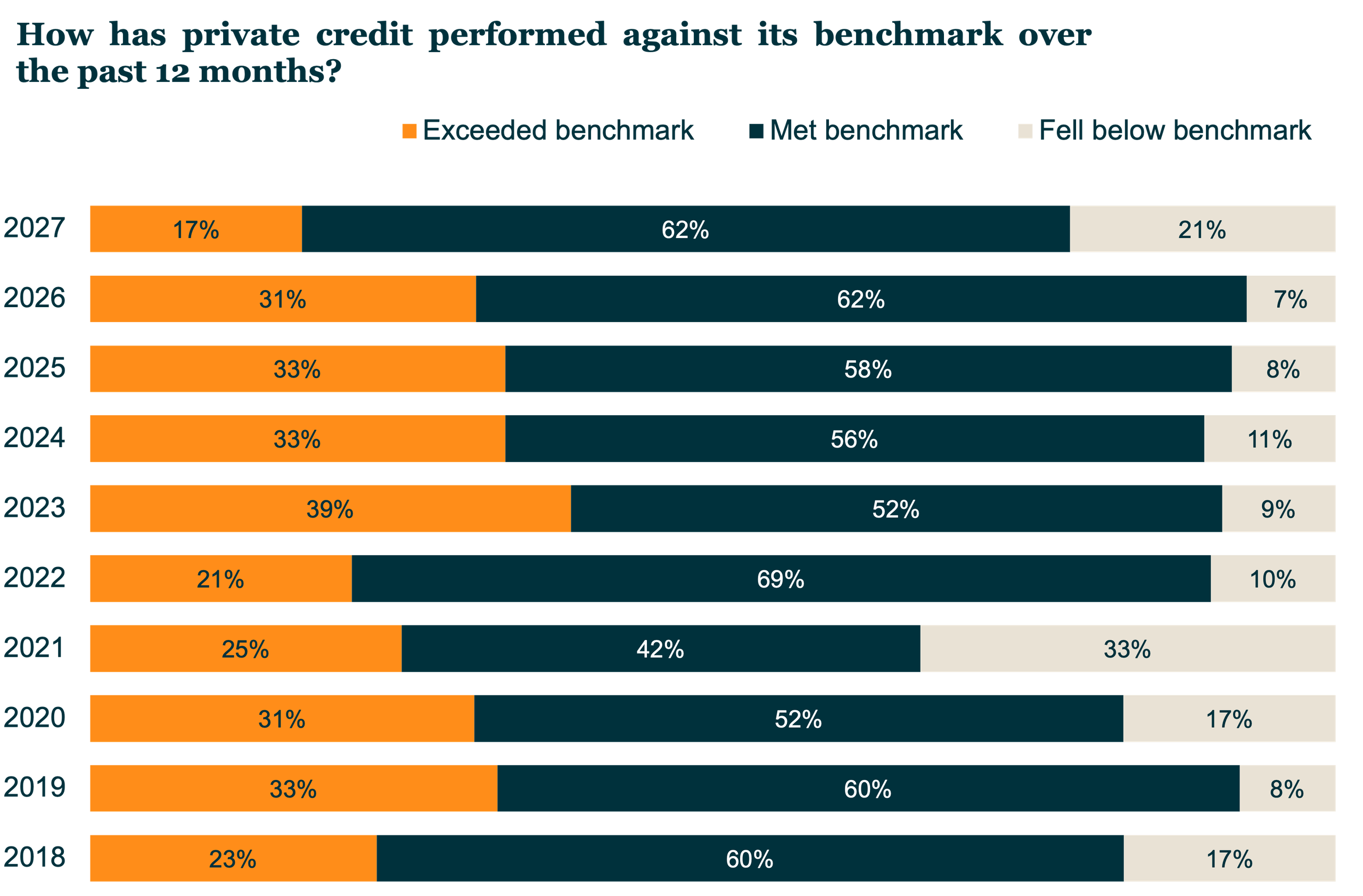
We also found that the biggest concern investors had was around a lack of suitable opportunities. But another factor, also evident in the survey, has to do with performance. When asked how private credit had performed versus its benchmark over the last 12 months, only 17 percent of investors said it had exceeded that benchmark – the lowest figure of the last decade and comfortably below the previous low of 21 percent in 2022.
Furthermore, 21 percent said it has fallen below that benchmark – the largest number saying this since the pandemic-affected year of 2021 (33 percent). Nearly two-thirds (62 percent) said private credit had met its benchmark.
When asked to look forward over the next 12 months, the picture remains much the same. Twenty-one percent say they expect private credit to exceed its benchmark over that period – the lowest amount since 2022, when the figure was also 21 percent. Meanwhile, 27 percent expect it to fall below the benchmark over the next year, which is the highest figure since records began for this metric in 2019.
In terms of benchmark used, the most popular – both on 28 percent – were peer universe/quartile ranking (e.g. IRR, TVPI and DPI-based) and absolute return/fixed hurdle rate. Views on which benchmark to use appear to be fairly fixed, with 72 percent saying they have not changed the benchmark and are not considering doing so.

Latest news


U.S. Private Credit Default Rate Remains Elevated in 3Q26
Fitch Ratings’ U.S. Private Credit Default Rate (PCDR) reached 6.3% for the trailing 12 months (TTM) ended 3Q26, the highest quarterly default rate on record, up from 6.0% in 2Q26 and flat from August.

Average sponsored TLB tenors fall to six-year low
The maturity runway is shrinking for newly originated US sponsored term loan Bs. Average tenor fell to roughly 76 months…