


Private Debt Intelligence – 2/27/2017

Private Debt Management Fees Drop to Eight-Year Low
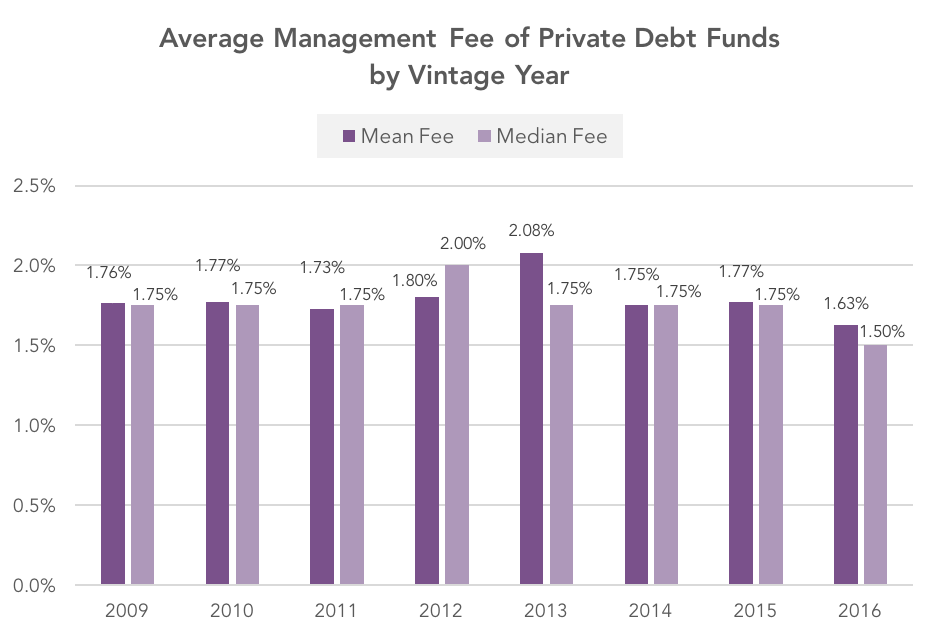
Fund terms within the alternative assets industry have been of particular focus over the last few years as investors have largely united to push managers for greater transparency and improved alignment of interest.
Within the private debt industry, this approach appears to be paying dividends with the average management fee reaching an eight-year low for 2016 vintage funds which charge a mean fee of 1.63%. This marks a decline from the 1.77% charged by 2015 vintage funds and the 2.08% average fee of 2013 vintage funds, while the average management fee had not sunk below the 1.73% that 2011 vintage private debt vehicles charged.
While fees across the private debt industry have largely seen a diminution, individual strategies must assess the cost of management and the size of vehicle in order to tailor their fund structures accordingly. As such, it is unsurprising that for vintage 2009-2016 vehicles, direct lending strategies have the lowest mean management fee (1.44%), as debt investments without an equity strategy are less costly for a manager. Due to their size and resulting economies of scale, distressed debt funds also charge a relatively low management fee of 1.81%.
Conversely, venture debt vehicles require intensive resources during the investment period as the diligence and expertise needed to deploy early stage funding is significant and is evident in the high mean fee charged by 2009-2016 vintage funds (2.17%). Mezzanine and special situations funds also charge an average management fee above the industry benchmark of 1.95% and 1.88% respectively.
The majority of private debt investors (63%) surveyed by Preqin in December 2016 believe that their interests are aligned with those of their fund managers’, which indicates that investor pressure is beginning to pay off. Furthermore, a quarter of investors stated that fund terms have changed in their favour over the past 12 months in another indication that fund managers are working harder to attract investor capital in the intensely competitive private debt fundraising market.







Private Credit Defaults 101: Back to School
As Labor Day approaches, the unofficial end of summer is upon us. But, before we get too sad, there is also the familiar back-to-school energy.