



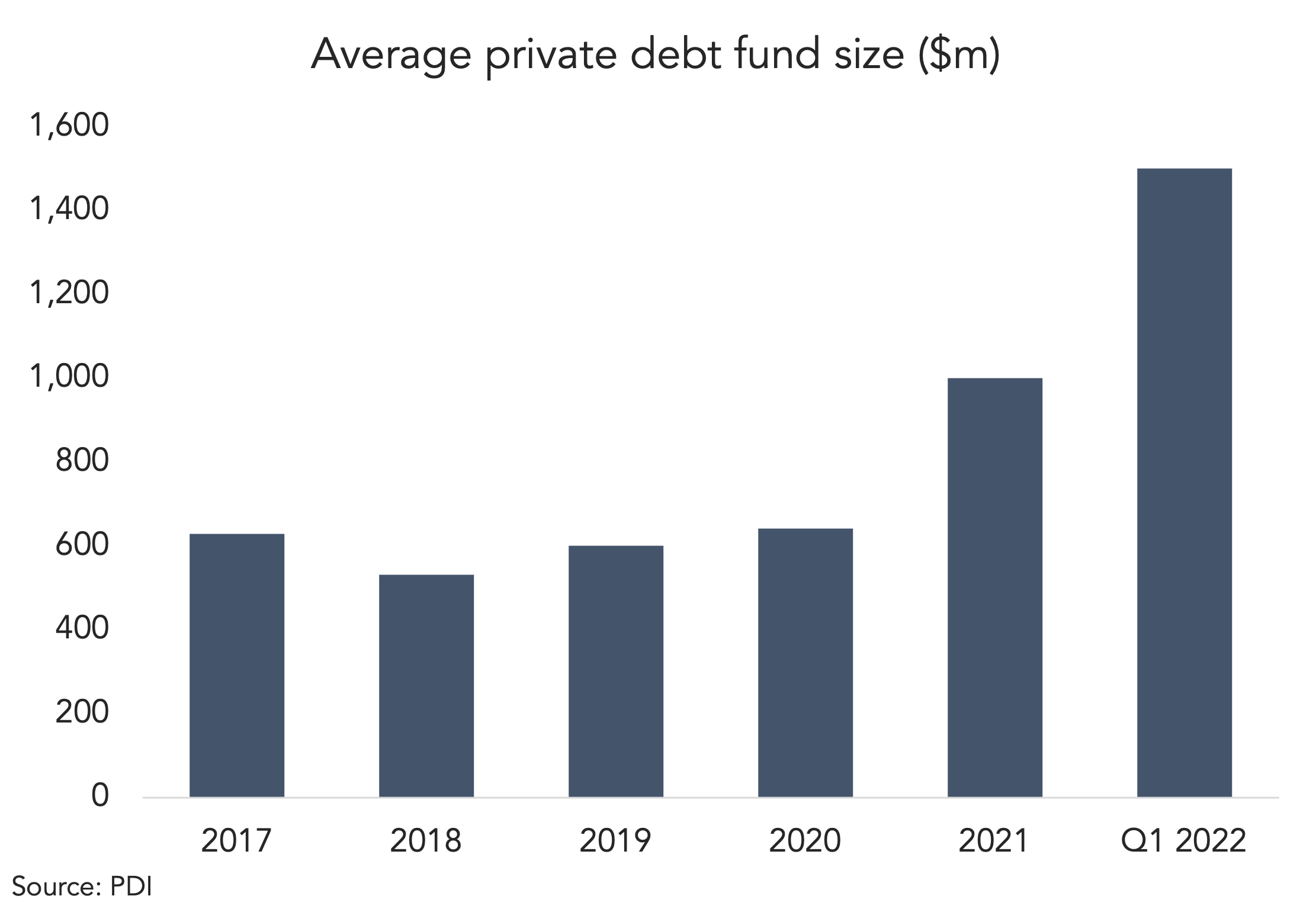
A new average fund size record was set in Q1 2022, as private debt managers become more ambitious at the larger end of the market.
We’re in the era of the private debt mega-fund. Last year, according to Private Debt Investor data (see chart), the average fund size breached $1 billion for the first time. In the first quarter of this year, a new landmark was reached as the average moved past $1.5 billion.
This is enabling private debt funds to become lead arrangers in some hefty multi-billion-dollar transactions and take on the banks in the syndication market in much the same way that they’ve already taken them on in the middle-market.
Indeed, many of the arguments in favour of private debt at the larger end are the same as they are for more modestly sized transactions. The main, overarching one is that sponsors have by now grown accustomed to the private debt option – they like its sophistication, its flexibility and its certainty. These are all very important qualities in the kind of volatile market situation we see today.
The relationship aspect is also important to note: covid was seen as a big test of how lenders would respond to borrowers coming under pressure. Overall, the conclusion is that sponsors and lenders worked amicably together to steer companies through whatever difficulties they faced. Some sponsors may have drawn the conclusion that they wouldn’t necessarily experience the same thing when sitting across the table from the banks.
There are challenges for private debt funds, however, as they entertain the prospect of ever-larger deals. Are they in danger of breaching concentration risk limits? Might be they exposing their investors to the prospect of hung syndications? Will they attract the attention of regulators if they begin to look and act like banks? And might they sacrifice middle-market investor protections in an environment where those protections were eroded long ago?
One thing’s for sure: some very interesting dynamics are at play as banks and private debt funds once again find themselves operating on the same turf.
(Past performance is no guarantee of future results.)






Private Credit Defaults 101: Back to School
As Labor Day approaches, the unofficial end of summer is upon us. But, before we get too sad, there is also the familiar back-to-school energy.