



In the face of the global headwinds, this is one part of the world that appears to be looking relatively attractive.
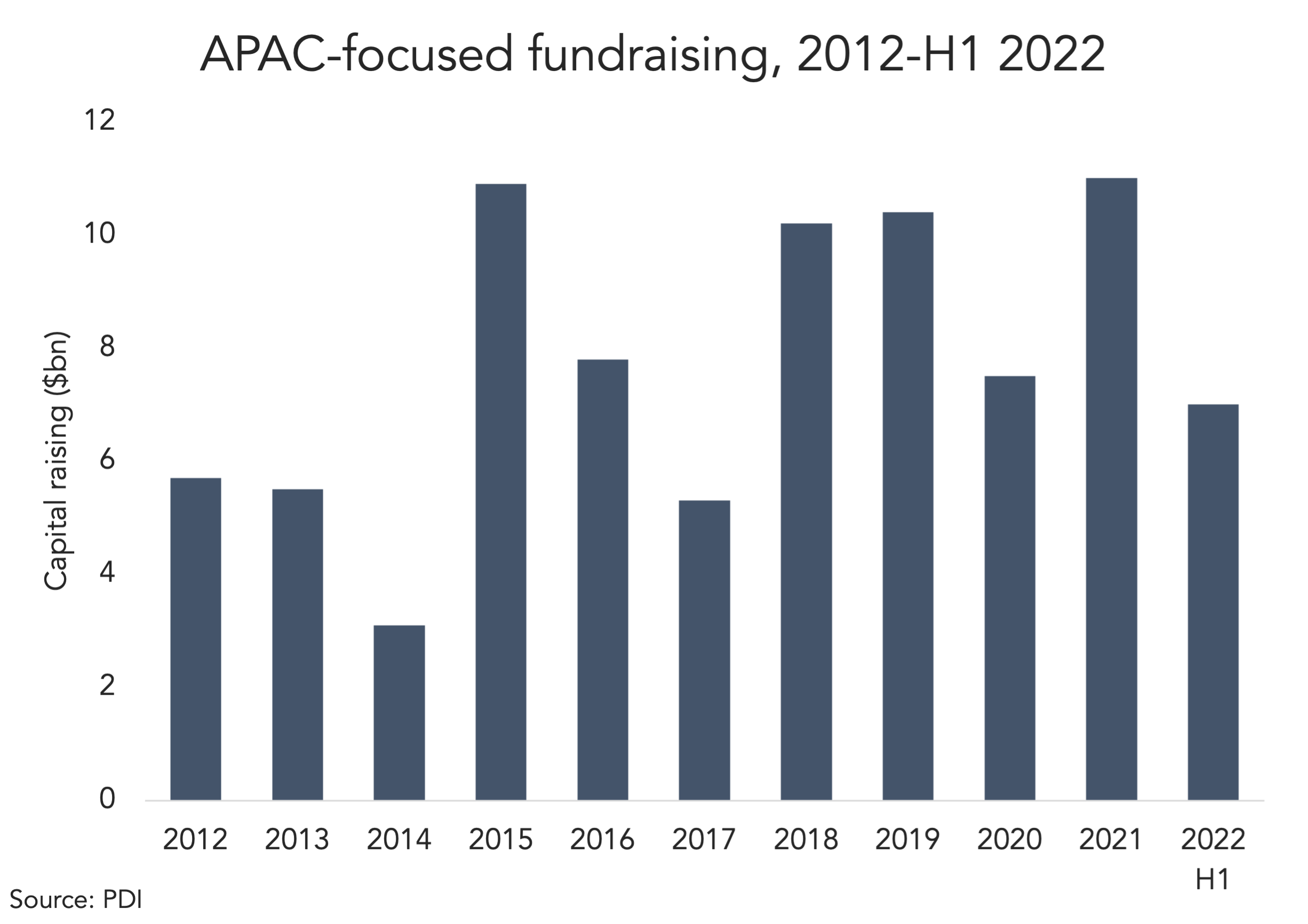
Since beginning to gather momentum in the aftermath of the global financial crisis, fundraising for Asia-Pacific private debt reached a record high last year of $11 billion. Although this is only slightly ahead of the totals reached in 2015, 2018 and 2019, it may be a sign that fundraising is beginning to take off when considered alongside the $7 billion raised in the first half of this year. As the US and Europe encounter multiple economic and political headwinds, investors may be seeing Asia-Pacific as relatively attractive.
While senior debt has been the dominant strategy in the US and Europe – a trend that has been exacerbated over the last year or two – in Asia-Pacific it’s subordinated debt that ruled the roost in the first half of this year as investors opted for higher risk/return options. This may be because LPs get their fill of senior debt from the more mature markets and don’t need more of the same in Asia-Pacific. Distressed debt has always formed a substantial portion of the region’s private debt strategies, and this has continued to be the case in 2022.
The largest Asia-Pacific funds have been capable of reaching $2 billion or more over the last decade. This compares with the largest US and European funds exceeding $10 billion and heading towards $15 billion. Even the largest funds in the region would be considered of mid-market size by Western standards, showing the growth potential for Asia-Pacific private debt. Many Asia-Pacific funds are managed by Western GPs look to expand their franchises.
PDI data shows the largest funds currently being raised are also of a relatively modest size, headed by a $3.1 billion real estate debt fund being raised by Mumbai, India-based SBICAP Ventures, which has so far collected $1.8 billion. The only other fund targeting more than $1 billion today is a $1.5 billion distressed fund managed by another Mumbai-based firm, Kotak Investment Advisors. That fund has so far reached $1 billion.
(Past performance is no guarantee of future results.)






Private Credit Defaults 101: Back to School
As Labor Day approaches, the unofficial end of summer is upon us. But, before we get too sad, there is also the familiar back-to-school energy.