



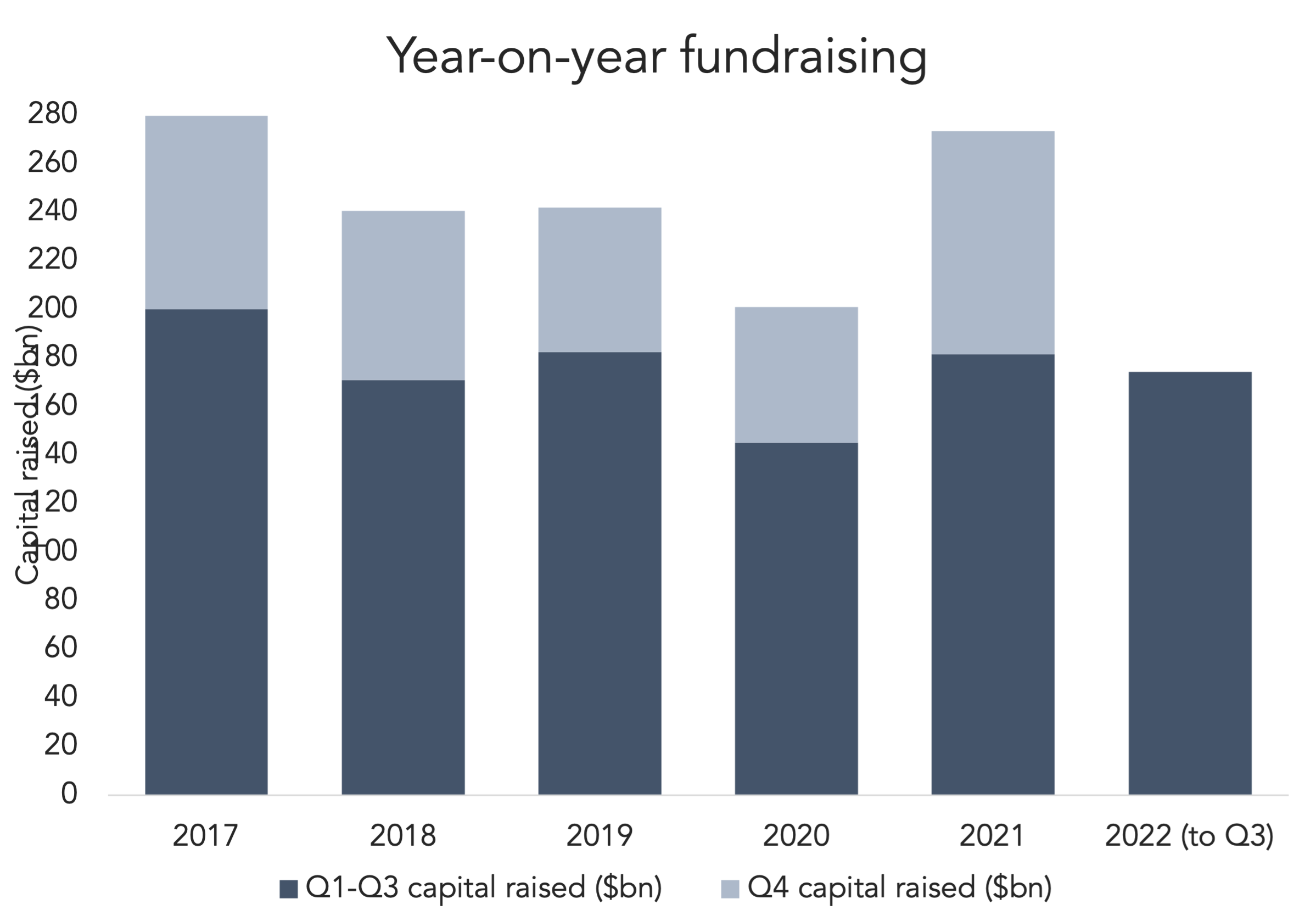
Our latest data shows capital raised by private debt fund managers continues at a consistent level, despite multiple headwinds.
It’s now an uncertain time for private debt fundraising as investors confront the volatility of the economic and geopolitical climate as well as, in many cases, overallocations to private markets due to the public market turmoil. In addition, there are plenty of LPs that have already made all the commitments they can in 2022 and now have their sights set on next year.
If this adds up to a challenging situation for those with funds currently in the market, it’s not yet coming through in PDI’s fundraising data. As you can see from the chart above, private debt funds globally collected more than $174 billion through the first three quarters of this year, which is very much in line with the averages of recent years and comfortably ahead of the covid-hit year of 2020.
In terms of strategies, 2022 is again giving us few hints of change. It was last year that senior debt strategies significantly increased their share of capital raised, accounting for around 40 percent of the total. This share has thus far been maintained in 2022 as investors continue to adopt a safety-first stance. Distressed debt is not yet showing signs of taking off, though that may be expected to change in the turbulent period ahead.
The third quarter represented something of a revival for fundraising in Europe, which had fallen behind Asia-Pacific in the early months of the year. Beset by economic and geopolitical headwinds, Europe has borne the brunt of investor caution but appears to have begun turning the tide. Europe’s temporary decline has allowed North America to claim an even larger slice of the fundraising pie than it has traditionally held.
While the overall picture is one of normality based on the Q1-Q3 2022 period, it remains to be seen whether this can be maintained as rising rates, surging inflation and war in Europe continue to pose huge challenges for those raising capital in the period ahead.
(Past performance is no guarantee of future results.)






Private Credit Defaults 101: Back to School
As Labor Day approaches, the unofficial end of summer is upon us. But, before we get too sad, there is also the familiar back-to-school energy.