



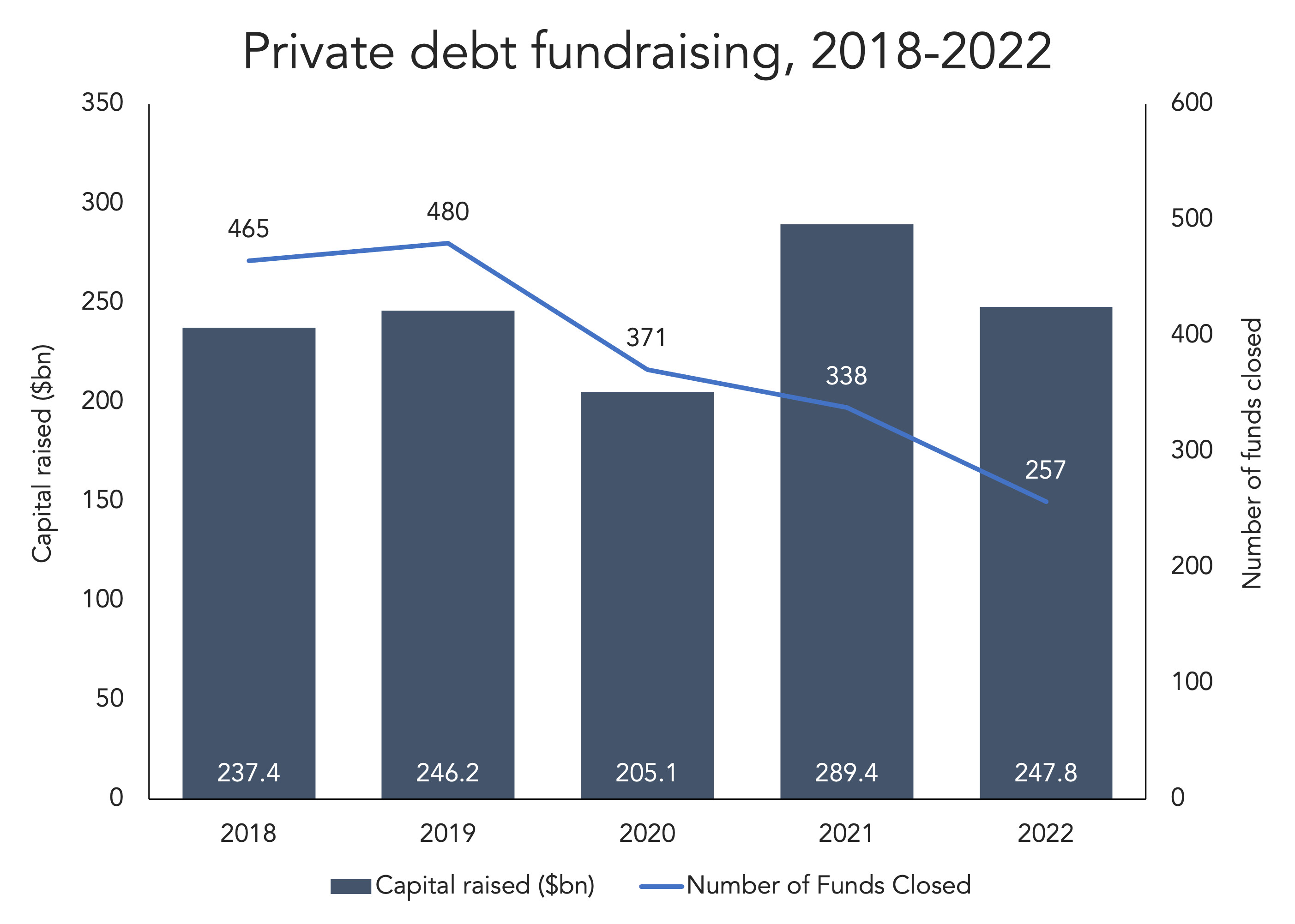
The volume of capital gathered remained at healthy levels last year, although the number of funds closed sank to new lows.
It wasn’t a record-breaking fundraising year for private debt in 2022 but, with concerns about the economy growing, there were few signs of limited partners changing their positive view of the asset class. Mezzanine funds gained market share while Europe appeared to be regaining investor confidence in the latter months of the year. Here are four of our key data points:
1. After private debt fundraising set a new annual record in 2021 with almost $290 billion raised, it was always going to be a hard year to follow. However, fundraising in 2022 held up well and remains higher than fundraising totals seen from 2018 through to 2020.
The reduction in the number of funds raised, however, has continued to decline sharply, with just 257 funds closing in the year – almost half the number seen in 2019.
2. While senior debt funds dominated in 2021, making up almost half of all capital raised, the strategy fell back a little in 2022 but was still the main destination for capital with 41 percent of all dollars raised by private debt funds.
Mezzanine increased its market share to 33 percent of funds raised, while distressed debt settled into its typical pattern after seeing a glut of fundraising activity in 2019.
3. North America continues to be the dominant region for private debt investment, owing both to being a more developed market and having a larger and more robust economy than Europe or the rest of the world.
European fundraising had a more difficult year, particularly in Q1 when only a handful of funds reached final close. However, the region has been able to catch up as inflation has started to come down and fears about a major recession begin to subside. Asia saw relatively healthy fundraising but remains a small market.
4. The number of funds raised has been steadily falling since 2019 and this, coupled with healthy fundraising numbers, means average fund size has increased drastically since 2020, exceeding $900 million in 2021 and now breaching $1 billion for the first time in our annual fundraising figures.
(Past performance is no guarantee of future results.)







Private Credit Defaults 101: Back to School
As Labor Day approaches, the unofficial end of summer is upon us. But, before we get too sad, there is also the familiar back-to-school energy.