


Markit Recap – 1/11/2016

If European credit investors had to name two names damaged by the precipitous fall in commodity prices, it is likely that Glencore and Anglo American would top the poll.
The two mining firms have seen their credit spreads widen dramatically and are now quoted upfront, the only credits in the Markit iTraxx Europe that have this dubious distinction. But the past week has produced casualties of the commodity crash that are typically associated with robust investment grade profiles.
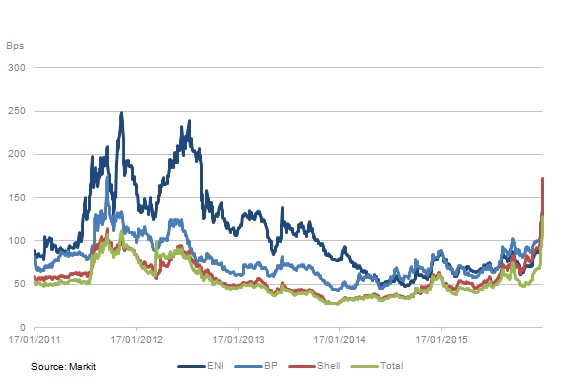
The catalyst? The price of oil falling sharply – it dipped below $30 a barrel on January 14, the lowest level for almost 12 years. Integrated oil and gas firms have shown remarkable resilience over the past six months but they finally capitulated this week. Royal Dutch Shell, a AA name that was trading at 50bps in the middle of 2015, was quoted at 170bps, 80bps wider than where it started the year. It was a similar story with Shell’s peers – BP, Total and Eni.
The extent of the widening was no doubt a product of the negative sentiment permeating the market, and there was further evidence of fearfulness in the performance of the auto sectors. Car makers are normally natural beneficiaries of falling oil prices, as are other consumer cyclical names. But the positive effects were outweighed by reports that Renault was being investigated by French anti-fraud authorities as part of a probe into emissions cheating.
Renault is a solid BBB-/Ba1 name, and its recent performance suggests that credit investors see it as a possible Rising Star. But its spreads widened from 117bps to 160bps on the news, and there was a significant contagion effect across auto credits. The sector had recovered from the Volkswagen fallout last year, and spreads were relatively immune to subsequent negative headlines on this issue. But in 2016 the mood has changed, and it doesn’t take much to send spreads spiralling wider.
The Markit iTraxx Europe is now trading at 90bps, and in North America the Markit CDX IG broke through the 100bps barrier for the first time since 2012. Even more disturbingly, both indices are trading with a large skew to underlying constituents – in the case of CDX IG, as much as 15bps. Perhaps the inferior liquidity in single names is the driver of the basis, but it is possible that the indices have some catching up to do.
Contact: Gavan Nolan
Email: Gavan.Nolan@markit.com







Private Credit Defaults 101: Back to School
As Labor Day approaches, the unofficial end of summer is upon us. But, before we get too sad, there is also the familiar back-to-school energy.