



In 1927, Macy’s debuted its first giant balloon, Felix the Cat. Filled with regular air, he couldn’t fly. Helium arrived the next year, and organizers celebrated by letting five balloons go over Manhattan. Anyone who found one and sent it back collected $150. That tradition didn’t last.
Today’s balloons are a far cry from Felix. They don’t move without dozens of trained handlers. If sustained winds top 23 mph or gusts hit 34, they don’t fly at all. These crews don’t plan for calm mornings. They plan for gusts.
For most of the last decade, private credit enjoyed calm skies. Cheap money kept almost everything aloft. Then the wind picked up. Tariffs, inflation, aggressive rate hikes, and geopolitical uncertainty all added gusts of their own.
But a headwind for one lender can be a tailwind for another. Over this series, we’ve covered how we define capital solutions, where it fits in a portfolio, and how the 2021 vintage and PE’s zombie problem have put the wind at the strategy’s back. Tailwinds help, but you still need to know how to work the ropes.
Capital solutions is built to be all-weather. Even so, good companies can get caught in a gust. Maybe the business didn’t go up and to the right after the buyout and spent 12 to 18 months stuck. To return to growth, it needs new capital to extend the runway. That could mean a refinancing, a complex acquisition, or a bridge through an operating dislocation. Each is a matter of letting out a little rope or reeling some in.
Rough weather can also create opportunities. Because these situations are often countercyclical, they tend to pick up when markets or industries are dislocated. That gives the strategy a different return profile than the sponsor-driven flow behind senior and junior lending. Added to a private capital portfolio, it can provide a less correlated return stream.
Handlers aren’t out for a leisurely stroll. Their job is to get the balloon to Herald Square. Capital solutions works the same way. It’s transition capital, built to get a company to its next stop. Because it’s a bridge rather than a destination, hold periods typically run two to four years, shorter than senior or junior lending. That matters to LPs still waiting on distributions.
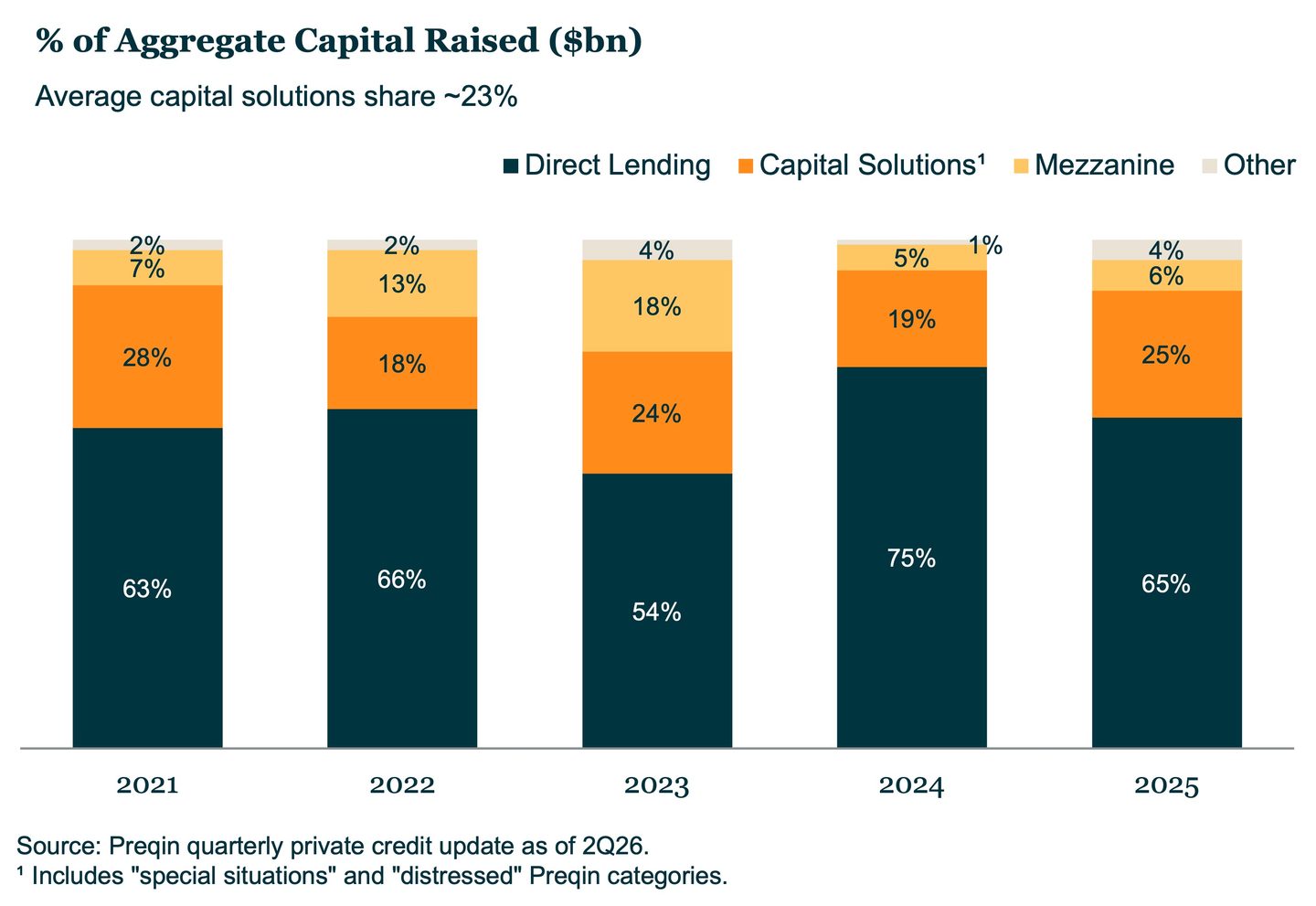
There’s no shortage of companies needing capital. Capital solutions has drawn nearly a quarter of all global private debt raised over the past five years (see Chart). But that figure includes funds more aligned with distressed and special situations. As we noted in Framing the Picture, for us, capital solutions means staying senior and focusing on good companies with complex problems. And just as handlers know when not to fly, lenders know when to pass. An equity cushion may be too thin. Or a business, not the balance sheet, is a problem.
Nobody sets the balloons free over Manhattan anymore. They make it to Herald Square every year, gusts and all. No miracle on 34th Street is required. Just experienced hands on the ropes.
Happy Thanksgiving.


Latest news
Software, technology and consumer sectors lose deal share in 9M’26
The software and technology sector, the second most active sector in 2025 at 17% of total deal activity, slid to fifth place in the first nine months of 2026.


Leveraged loan investors see gains in November
Following a 0.25% decline in October, the Bloomberg US Leveraged Loan Index (Ticker: LOAN) has returned 0.60% this month through…