



Stand in front of a Jackson Pollock long enough and you’ll hear someone mutter, “My kid could have done that.” However, the person next to them might call it a masterpiece. Same canvas, two very different verdicts. That’s the thing about art. It has never had a universal definition. It can be a chapel ceiling, a can of soup, or even a canvas covered in drips. Pretty much anything goes.
Capital Solutions has the same problem. As we noted last week, there’s no universal definition, and each manager draws the lines a little differently. For us, it means staying senior in the capital structure. For others, it means going further down the stack into mezzanine and even equity. Think special situations. Even with those differences, we think four categories frame the strategy.
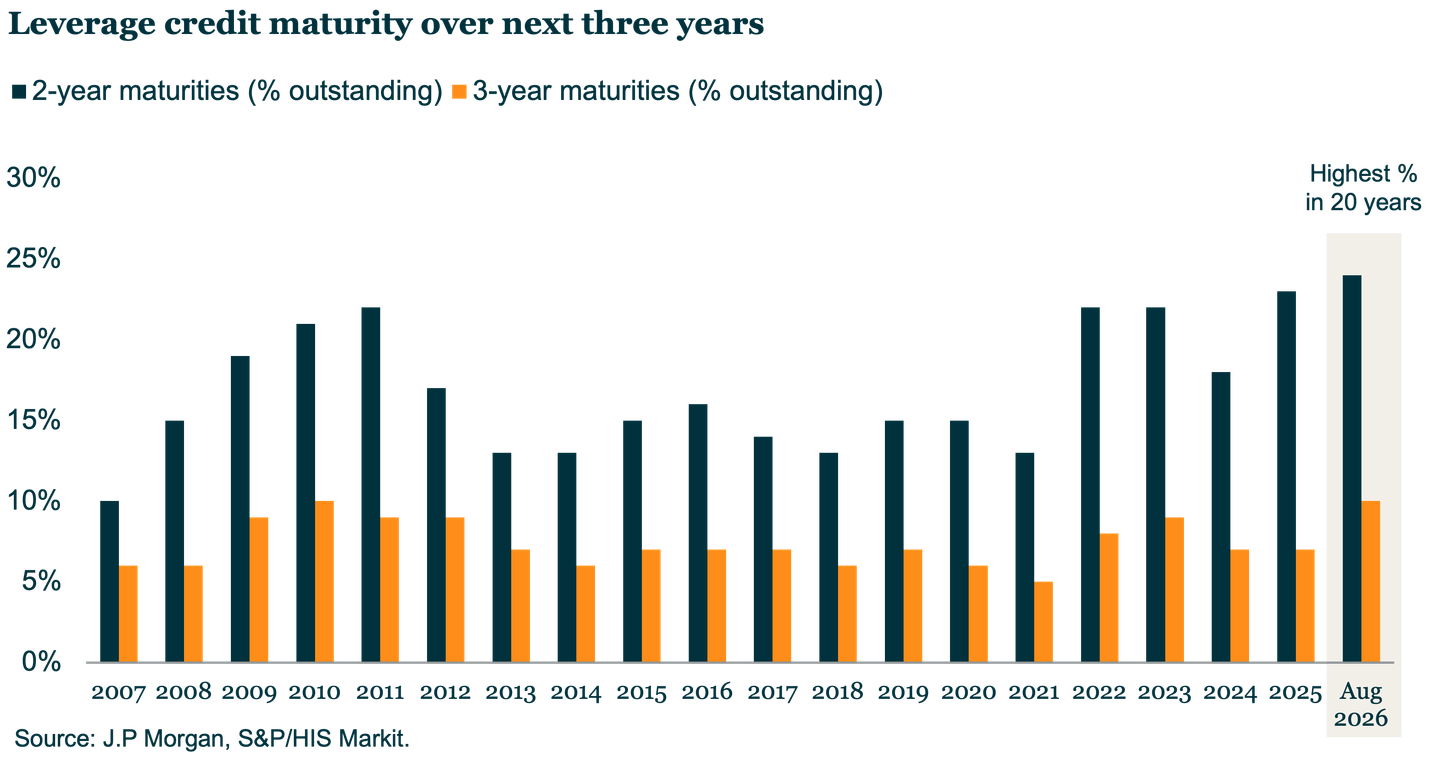
First, strained or complicated balance sheets. These are convoluted structures that need optimizing. With longer hold periods (more on that in the coming weeks), many of these businesses need to refinance. Tariffs, rate hikes, rate cuts, COVID, the inflation shock, and geopolitical uncertainty haven’t made the exit door any wider. And the maturity wall is closing in, with 24% of leveraged credit due within two years, the highest share in 20 years (see Chart). By our math, about $66 billion of middle market PE-backed debt is either facing a complex refinancing or simply stuck. The maturity wall has been a threat for two decades, only to fade each time. This time, it’s arriving in a rising rate environment, which could potentially change the outcome.
Second, complex buyouts and add-ons. This could range from a profitable first-time issuer with no existing debt that needs capital to expand, to an add-on acquisition during a period of market disruption. Different situations, but the same need for financing. Go further out the spectrum and you find niche or hard-to-understand business models whose complexity can also shut them out of capital markets.
Third, out-of-favor sectors. This is the most straightforward, with countless examples throughout history. A sector runs hot, then it doesn’t. Today, think software and logistics. Deal activity has slowed broadly but is bifurcated. In Q2, tech deal volume fell 65.7% year-over-year and sits 90% below its Q3 2025 peak. There are good businesses in these industries, but they’re being priced as if the headwinds will last forever. Sentiment always has a way of throwing the baby out with the bathwater.
Fourth, flexible financing. Like any strategy, flexibility matters. We view this as senior risk, but select junior opportunities do come up, largely from knowing a sponsor, industry, and company for a long time. As these borrowers mature and operating momentum improves, middle of the balance sheet solutions, such as second lien, subordinated payment priority, previously unencumbered collateral, and PIK, could start to look more compelling.
The best reply to someone saying their kid could have painted that is, “Then your kid is Jackson Pollock.” For Pollock the act was the art. Capital solutions redefines private credit as filling the space between traditional senior lending and distressed. How that actually works is where we’re headed next week.


Latest news

Share of PE middle-market deal count by backing type
Add-ons remain the workhorse for middle-market deployment, accounting for 67. 1% of all middle-market transactions YTD, in line with activity seen in recent years.

Software deal share falls in middle markets, rises in large caps
In Q3’26 software’s share of total deals fell in both the Lower Middle Market (to 7%) and Upper Middle Market (to 9%), while Large Cap saw a modest uptick in share to 8%.

Secondary loan prices stabilize following steep declines
Secondary loan prices came under significant pressure through September and October, with the Bloomberg U.S. Leveraged Loan Index declining 119…