



Remember HBO GO? It launched in 2010, letting cable subscribers stream HBO content online. Since then, it’s been rebranded more times than anyone can keep track of. HBO Now, HBO Max, just Max, then back to HBO Max again. Dizzying to keep up with. Through all of it, the service itself never really changed.
Capital solutions has had similar labels. Whether its called distressed, special situations, or even workouts, this strategy is built to provide creative financing to companies where traditional capital is otherwise unavailable. It may be industry headwinds, business model complexity, or even a challenging buy-out or add-on. Often, these pressures can be temporary, and that’s exactly where the opportunity lies. Throughout this series, we’ll unpack what makes this corner of private credit tick.
First, the definition. Some will go all the way down the capital stack to equity and preferred. Others, like us, focus on the top of the capital stack, where there’s an adequate equity cushion and a company isn’t overly levered. A business may have looked pristine at underwriting. But things change. These are still good businesses where the thesis hasn’t played out as planned. Often, the problem is a strained balance sheet or a convoluted capital structure in need of a rework. This strategy steps in with flexible financing that traditional senior lending would dismiss.
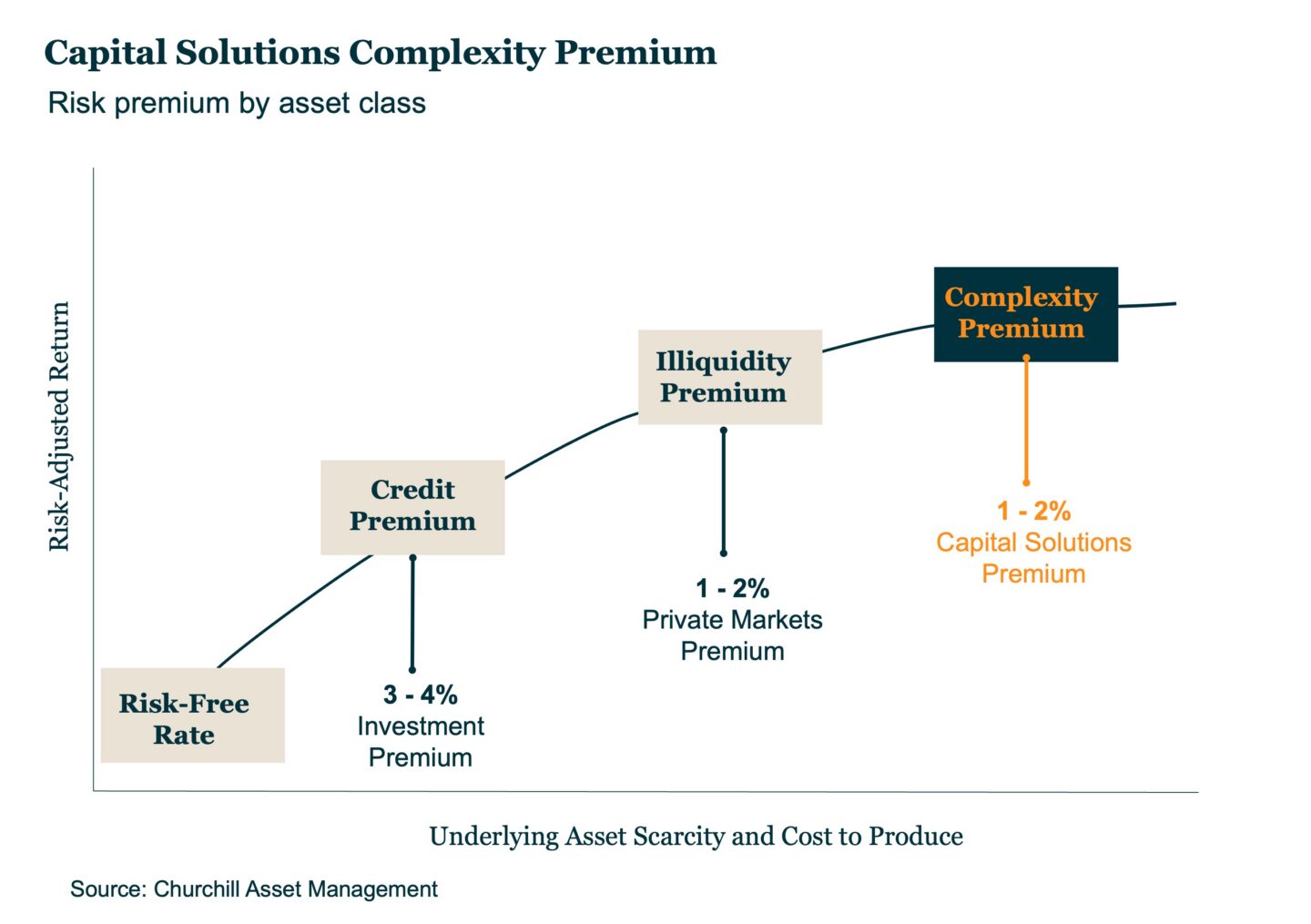
But where does capital solutions sit relative to other strategies? Much like middle market direct lending, capital solutions is an all-weather strategy, with a distinct countercyclical focus. When an industry or company falls out of favor, that’s exactly when the strategy leans in, capitalizing on the dislocation. But unlike going complete bargain hunting for distressed paper which may have to be restructured, this strategy can offer senior-level risk with the potential for junior-like returns. Call it a complexity premium – see chart.
Knowing the definition and its positioning is one thing; understanding the opportunity set is another matter entirely. There’s no shortage of tailwinds right now, but two really stand out. First, there is stress building in the 2021 and 2022 vintages, which together account for about 50% of trailing 12-month non-accruals. Second, the slowing exit environment has left private equity sitting on portfolio companies well past their intended shelf life – PE’s zombie problem. Currently, there’s $520 billion of U.S. middle market PE deals sitting in the 3-to-8-year range. Roughly 20% of the 3-to-5-year cohort is facing a complex refinancing, and about half of the 6-to-8-year cohort is effectively stuck. That’s a lot of portfolio companies that need financing just to get to the exit.
Platforms, products, and strategies may all get rebranded. But what they were built to do rarely changes. In this series, we’ll cover the service capital solutions has always provided, no matter what it was called along the way.




Latest news

US leveraged loans returns turn negative in October
The Bloomberg US Leveraged Loan Index (Ticker: LOAN) has returned -0.26% this month through October 21, reducing its year-to-date return…

M&A activity begins to tick upward
In the third quarter of 2026, acquisition-linked loan volume across North America and Europe reached about $47 billion, up from $30.6 billion in Q2 and $29.5 billion a year ago.
