Source: Debtwire Par
Institutional leveraged loan issuance has plummeted 68% from levels seen just last year, to USD 233.2bn through September. As the macroeconomic headwinds beleaguering the market have remained persistent – inflation remains sticky, the Federal Reserve is expected to keep on an aggressive rate hiking expedition, and global volatility and supply chain constraints stemming from the coronavirus pandemic and ongoing war in Ukraine continue unabated – the market has largely shut down. With many investors choosing to sell out of holdings in the face of declining prices and a potential recession on the horizon, loan secondary market prices have tumbled nearly seven points this year, to 91.07, adding to the downward pressures on the market.
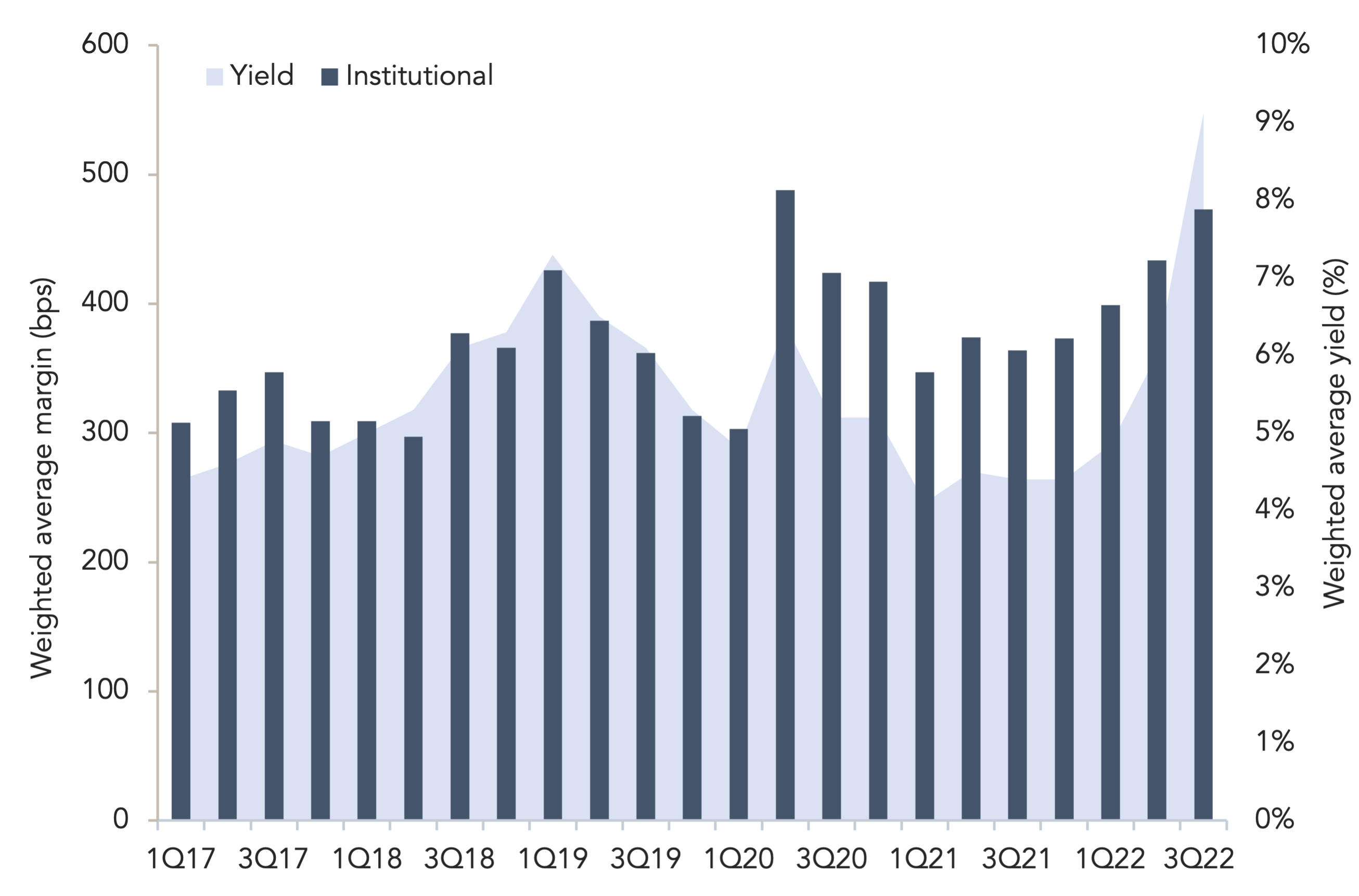
Another dynamic keeping borrowers sidelined of late – in the third quarter, institutional loan issuance totaled just USD 28.6bn, roughly half of the USD 52.1bn volume seen in January alone – has been historically high pricing in the primary market. At 473bps, the weighted average bid on first lien institutional loans sits at its highest point since 2Q20, when the pandemic was at its worst and the global economy was brought to a halt. Cardenas Markets priced the highest-margin first lien loan of the quarter with its USD 435m TLB due 2029. The facility, supporting the company’s secondary buyout by Apollo Global Management, priced at SOFR + 675bps with a 75bps floor and 94 OID. As has been the case for much of the year, committed financings have dominated the primary landscape, with buyouts accounting for 77% of issuance in September.
Issuers have also been forced to offer steep discounts on new loans to entice investors who could otherwise find yield in the secondary market. With secondary prices depressed, the average OID, or original issue discount, on new loan issuance shot to 93.69, or an average discount of 631bps, up from just 96bps in the first quarter. BBB Industries offered the steepest discount of the quarter – 1000bps – on its USD 1.225bn TLB to support its SBO by Clearlake Capital.
Finally, with interest rates rising, interbank lending costs have also been creeping upwards, as demonstrated by average three-month SOFR increasing to 3.75% in September from just 0.25% in January. The combined effect has been record high yields in the loan market, topping 9.32% in the third quarter, up from just 4.96% in the first quarter. With a recession looming and cash flows and credit health in question, it could be a tough price to pay to access capital for many borrowers.
(Past performance is no guarantee of future results.)



Latest news

US leveraged loans returns turn negative in October
The Bloomberg US Leveraged Loan Index (Ticker: LOAN) has returned -0.26% this month through October 21, reducing its year-to-date return…
M&A activity begins to tick upward
In the third quarter of 2026, acquisition-linked loan volume across North America and Europe reached about $47 billion, up from $30.6 billion in Q2 and $29.5 billion a year ago.