



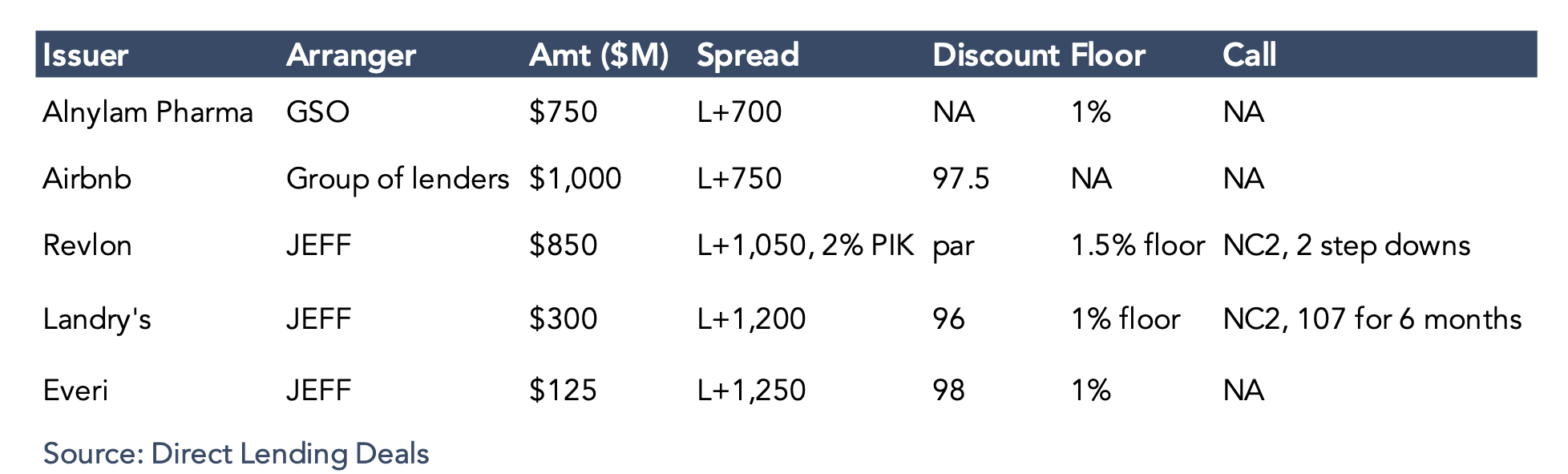
Two jumbo direct lending deals surfaced this week— Alnylam Pharmaceuticals and Airbnb —as the first comps to guide new issue underwriting since the Covid-19 pandemic shut credit markets a month ago.
Alnylam obtained a $750 million 1L term loan at L+700, while Airbnb booked a $1 billion 1L at L+750 at a 97.5 issue price. With discounts and LIBOR floors, the all-in yields for both are probably between 10% to 11%.
Airbnb used proceeds to boost liquidity further after lining up $1 billion in second-lien debt and equity from Silver Lake and Sixth Street Partners last week. The home-sharing company had previously planned to go public.
Proceeds for Alnylam’s $750 million term loan back an investment in the drug developer by Blackstone Group.
In the syndicated market, three deals emerged over the past week, yet lenders don’t see them as templates that would lead to a wider reopening of syndications, but rather highly situational credits that are forced to come to market now. M&A financing that was on the launch pad prior to March remains shelved.
Jefferies is lead arranger on all three: Landry’s (L+1,200, 96 discount), Everi (L+1,250, 98 discount) and Revlon (L+1,050, plus 2% PIK, at par).
Revlon is obtaining a comprehensive recapitalization, while Landry’s and Everi are gaming-related companies seeking liquidity.
Pricing differences between the two groups reflect their distribution strategy, specific circumstances and sensitivity to depressed secondary prices, a measure that direct lenders might take into account but with far less rigidity.
Alnylam’s $750 million term loan is held entirely by GSO Capital; and the group of 20+ lenders in Airbnb’s $1 billion term loan includes many heavy hitters in direct lending such as Apollo Global, BlackRock, Blackstone, Owl Rock, Benefit Street Partners and Oaktree Capital. Traditional institutional investors include Eaton Vance, Fidelity Investments and T. Rowe Price.
With few comps and today’s surreal market conditions, every deal that steps forward will seem like a novelty, but there are a few common themes, lenders note: 1) First lien spread conversations start in the L+600s and that’s for companies less affected by the pandemic, 2) Call schedules start with non-call periods and 3) Leverage is at least 1x to 1.5x lower than pre-Covid levels, even for add-on acquisitions.
That shouldn’t imply the new-issue pipeline is busy. Far from it. Opportunistic M&A is presenting itself but only in small pockets. Most activity continues to revolve around managing portfolios, for now.



Latest news

Rate hike expectations ease as term SOFR curve flattens
The CME six-month Term SOFR rate reached a recent high of 3.979% on July 28 before retreating to 3.837% as…
3Q26: New loan assets rise to 44% of total lending, a 3-year high
New loan assets as a proportion of total US loan volume make up 44% of the 3Q26 pipeline to date,…

North American GPs dominant as fundraising accelerates
Our PEI Private Credit 200 ranking also shows capital raising increasing overall – and accelerating especially fast for the largest…