



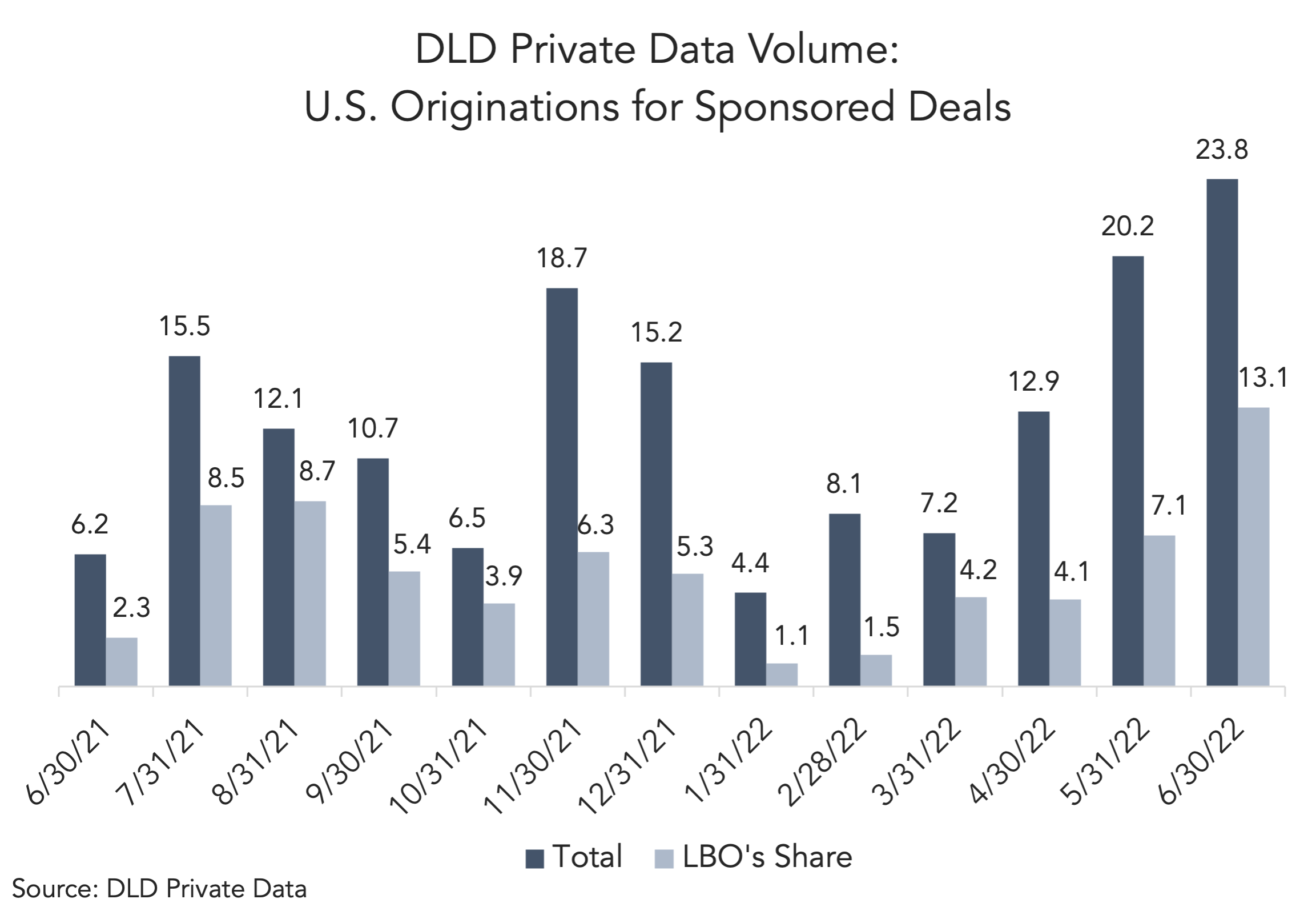
Direct Lending Deals’ Private Data set picked up $56.9 billion in sponsored U.S. loan volume during the second quarter, to rebound from a weak first quarter of $20 billion, and beat the $40.4 billion recorded during the private lending binge that drove the final three months of 2021.
For the first half, DLD’s Private Data volume stands at $76.6 billion, shy of the $78.8 billion in private loans DLD recorded in the second half last year amid 2021’s record M&A volume.
The second quarter surge was largely driven by a string of private jumbo loans, which accounted for 48.5% of volume, up from 27% in the first quarter.
Instability in the broader markets resulted in $9.8 billion of private jumbo (>=$1B) financings for June, which took over as the second largest monthly tally from May’s $8.6 billion, according to DLD. June’s tally is spread across five borrowers including Zendesk, which captured a set of new records: total size, at roughly $5 billion, as well as the largest recurring revenue structure.
The scale of private jumbos has reached new highs. Twenty transactions emerged for an average size of $2 billion in the first half this year, compared to the same number of deals in the second half last year, at an average of $1.8 billion apiece.
Volume is expected to cool in the second half on declining M&A. According to Bain & Co., global M&A volume is down 20%. The firm noted in a July 7 research brief, however, that the decline is coming off a record year in 2021, and 2022 is still on track for the second-highest on record.
Yet financing is getting expensive, and private lenders that supply jumbo credits are indicating more selectivity and reduced hold levels. Covenant-lite structures will be harder to obtain. Some that target small and large borrowers are leaning toward the latter because they would rather deploy larger commitments to companies that can better weather inflation.
Indications vary widely across managers, and it’s unclear yet whether they will stick to those claims. Larger platforms may walk back those assertions for favored credits and sponsors when competing for mandates.
Downmarket, in the traditional middle market arena, more consistency is found across managers, according to sources.
Fundraising has also dropped over inflationary concerns, with monthly inflows in 2022 slowing dramatically at some managers, sources say.
The syndicated loan market may be broken at present, which should direct more business to private underwriters, but there isn’t an infinite amount of capital across the private market.



Latest news

Open Tab
Leveraged loans keep running up a tab. Senior direct lending already knows what it owes.

Information technology topped nonaccruals on a cost basis
Maturities of loans switching to at least partial PIK tends to be longer-dated than Octus’ other stress trackers: nonaccrual and fair value write-down reports.