
Following a spike in volatility in October, investors remained cautious in November. Stronger credits caught investors’ attention and issuers were able to lower costs during syndication, but tougher credits had to sweeten terms to cross the finish line. In turn, flex activity on first-lien institutional tranches was a lot more leveled in November than the prior two months with 9 upward flexes and 8 downward price revisions.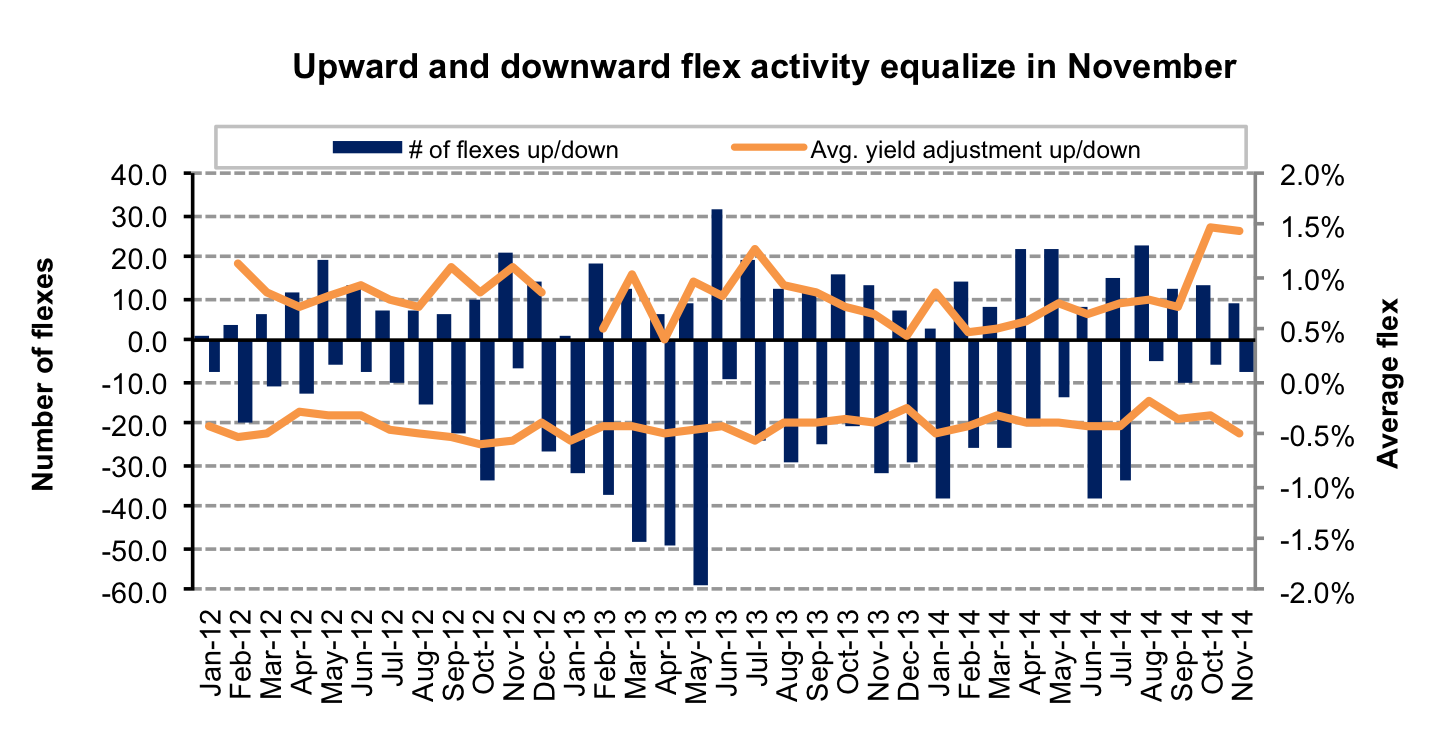 In October, upward price revisions more than doubled downward price flexes. However, the average upward price flex remained elevated at an average of 143bp, close to the high of 149bp recorded in October. Tibco Software, for instance, widened the yield on its $1.67 billion first-lien term loan by over 200bp. The spread was increased to LIB+550 from LIB+450 and the discount was widened to 95 from an originally proposed range of 98.5-99. On the other hand, stronger credits like B/E Aerospace, were able to reduce their costs during syndication. The company cut the spread to LIB+325 from a range of LIB+350-375 and tightened the OID to 99.5 from 99. Underliers




Latest news

US leveraged loans returns turn negative in October
The Bloomberg US Leveraged Loan Index (Ticker: LOAN) has returned -0.26% this month through October 21, reducing its year-to-date return…

M&A activity begins to tick upward
In the third quarter of 2026, acquisition-linked loan volume across North America and Europe reached about $47 billion, up from $30.6 billion in Q2 and $29.5 billion a year ago.