



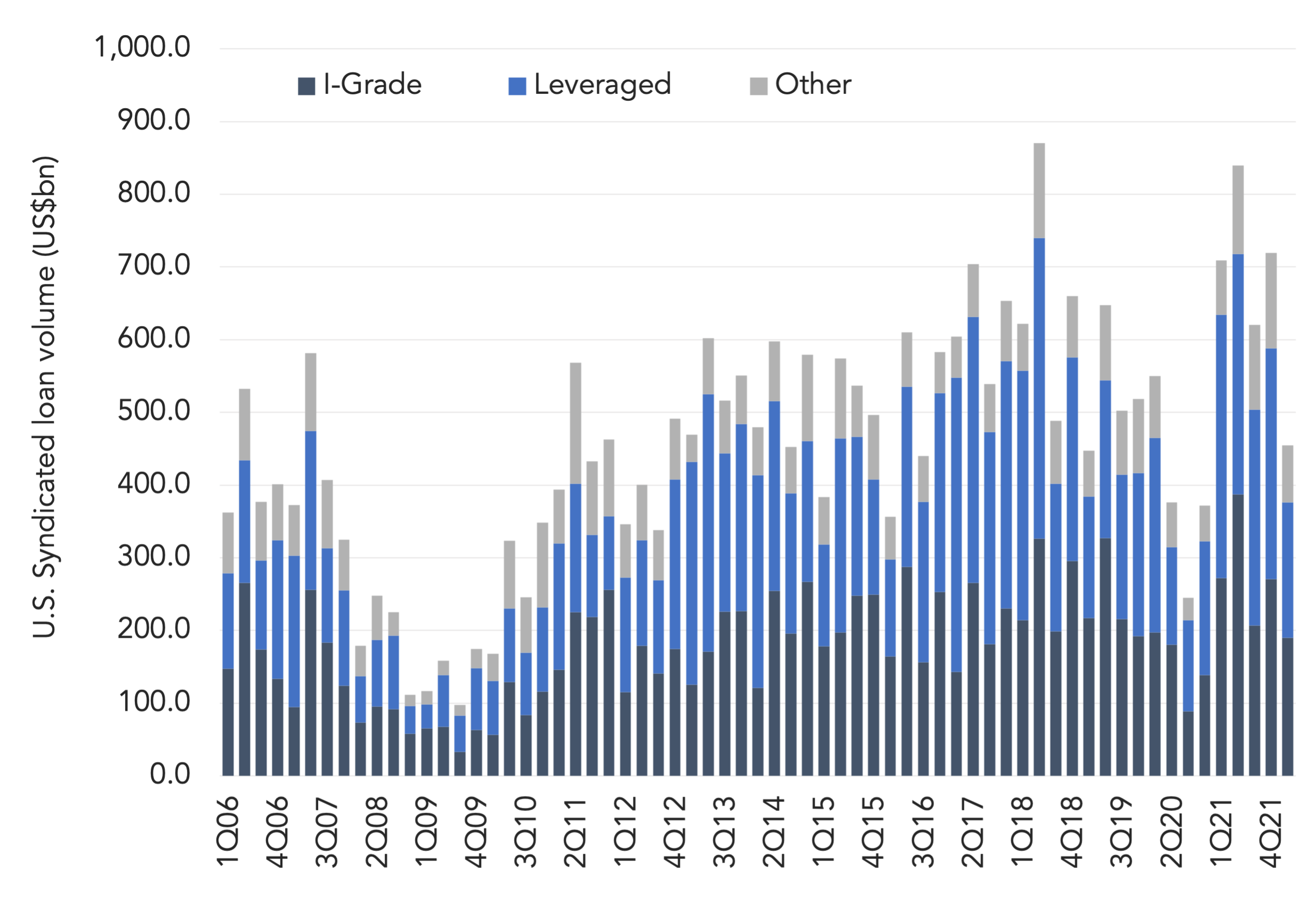
US lenders booked less than US$455bn of loan volume via retail syndication in 1Q22, a 36% decline year over year and a 37% drop quarter over quarter. The results marked the lowest quarterly totals since 4Q20 and the weakest 1Q results in three years. Uncertainty in the wake of inflationary concerns, ongoing supply chain issues and interest rate hikes as well as the global impact of the war in Ukraine all impacted market psyche to various degrees.
Loan specific factors came into play as well: Namely, the accelerated roll out of SOFR based credits and ongoing efforts to come to grips with appropriate methodology to account for market volatility when using a risk free rate and a thinner 2022 refinancing calendar on the heels of record 2021 issuance. At just under US$190bn, 1Q22 investment grade loan volume was down 30% on both an annual and quarterly basis. Lower refinancing volume played a role, but so too did the dearth of M&A deals requiring loan financing.
At US$186.3bn, leveraged loan volume was down 48% year over year and 41% compared to the prior quarter. While the war in Ukraine did not mmediately raise contagion fears over US credit risk, the loan market did embark on a period of price discovery for riskier, lower rated credits in general, and leveraged issuers which could be impacted by rising commodity costs in particular.
(Past performance is no guarantee of future results.)




Latest news


PE fund distribution rates
Following 2021, buyout distribution rates have fallen to roughly 10% to 15% below the 25-year average.

Sub line pricing flattens
A report on the topic also finds that investors are less concerned by leverage in NAV loans. Pricing for subscription…