


MARKIT RECAP

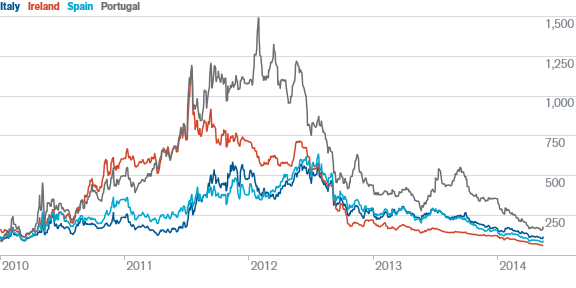
It’s been a while since the eurozone’s periphery had any meaningful impact on broader market sentiment. Mario Draghi’s “whatever it takes” pronouncement in 2012 put paid to the regular bouts of volatility emanating from Europe’s beleaguered sovereigns.
But on May 15, just over four years since the first Greek bailout, we received a reminder that peripheral CDS spreads still have the capacity to widen. And the movements weren’t insignificant – about a month’s worth of gains was wiped out in an afternoon.
The trigger? A circular issued by the Greek finance ministry in April belatedly grabbed the attention of investors and caused considerable consternation. The document raised the possibility of capital gains tax being applied retroactively to holders of Greek government bonds. But the finance ministry later issued a statement denying that the tax would be applied, and bondholders domiciled in countries with double-tax agreements with Greece could be exempt from existing arrangements.
Despite the clarification, peripheral spreads widened sharply. Greece, which is infrequently traded, was quoted at 18 points upfront, up 2 points. Italy gave up 14bps to trade at 117bps, while Spain was 11bps wide at 91bps. Portugal, due to exit its EU/IMF bailout on May 17, was the worst performer, widening 19bps to 179bps.
In percentage terms, these are undoubtedly large moves. But they need to be placed in historical context. Spain may have widened 11bps in one day – not to be sniffed at – but its 91bps level is still over 60bps tighter than where it started the year and more than 500bps tighter than the 624bps peak reached in July 2012. Portugal is at its tightest level since April 2010, as is Italy. Ireland’s spreads are at pre-financial crisis levels.
So there is clearly no need for panic. The ECB’s commitment to intervene if necessary is viewed as credible by the markets, and as long as that remains the case then spread widening will be limited. But the central bank’s reassuring presence masks the structural flaws in the eurozone, and first-quarter GDP figures published last week highlighted the persistent fragmentation threatening the currency bloc’s long-term health. Germany continued to grow at a solid rate, but the rest of the eurozone is struggling. France is stagnating and, while there are signs of life in the periphery, they are faint and their economies are still significantly smaller than their pre-crisis levels.
The poor figures could prove positive for bondholders, as they increase the chances of the ECB introducing QE later this year. But this week’s European parliament elections, where extremist parties are predicted to make large gains, will show that the eurozone’s chosen route of austerity is more unpopular than ever.
Contact: Gavan Nolan





Latest news

US leveraged loans returns turn negative in October
The Bloomberg US Leveraged Loan Index (Ticker: LOAN) has returned -0.26% this month through October 21, reducing its year-to-date return…

M&A activity begins to tick upward
In the third quarter of 2026, acquisition-linked loan volume across North America and Europe reached about $47 billion, up from $30.6 billion in Q2 and $29.5 billion a year ago.
