



Click here to learn more.
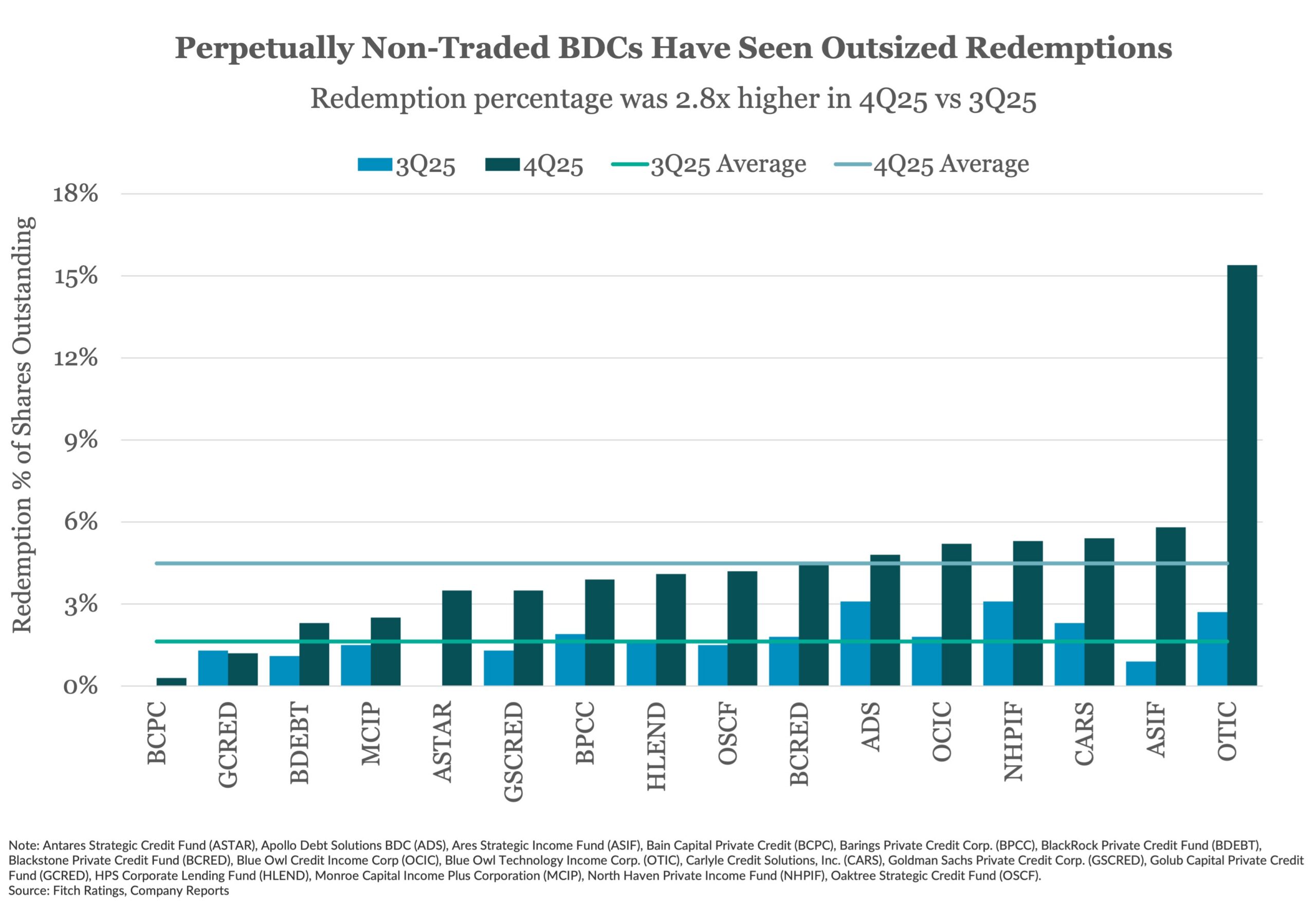
Investor sentiment has turned negative toward publicly listed U.S. business development companies (BDCs) with private-credit and software exposure, lowering valuations and limiting equity market access. That shift is now spilling over to perpetually non-traded BDCs, which have seen higher redemptions and slower fundraising in recent months. Fitch Ratings expects flows may remain under pressure in the coming quarters which, if sustained, could reshape the competitive landscape for BDCs.
Redemptions for the perpetually non-traded BDCs tracked by Fitch rose to an average of 4.5% of NAV in 4Q25, up from 1.6% in 3Q25. Five BDCs funded tenders above the 5% quarterly cap, and tenders at four others increasing to over 4% during the quarter. Liquidity and asset coverage cushions are sufficient to absorb a spike of elevated redemptions. Tenders in excess of 5% of NAV on a sustained basis could pressure the credit profiles of perpetually non-traded BDCs but are not in Fitch’s base case assumption.



Latest news


Information technology topped nonaccruals on a cost basis
Maturities of loans switching to at least partial PIK tends to be longer-dated than Octus’ other stress trackers: nonaccrual and fair value write-down reports.
US Broadly Syndicated Loan CLO Defaults in 3Q26 Driven by Distressed Debt Exchanges
Out of court restructurings drove nearly all default activity within Fitch-rated U.S. broadly syndicated loan (BSL) CLO portfolios in 3Q26, Fitch Ratings says.