



Senior debt strategies lead the way as capital accumulation manages to retain some forward momentum.
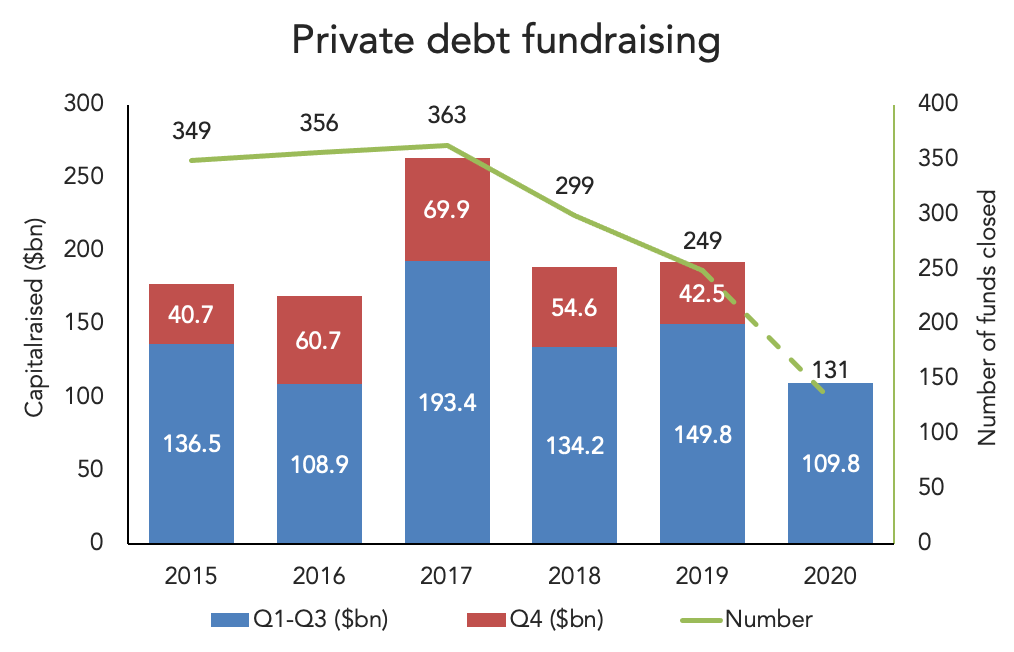
Private debt funds raised a total of $109.8 billion during the first nine months of 2020, the lowest figure since 2016, according to PDI data (see chart above).
However, given the backdrop of the coronavirus pandemic, which has curbed global travel and made it more difficult for fundraisers to meet potential investors, fundraising has been relatively robust.
The first quarter of 2020 was exceptionally slow as concerns about the impact of covid-19 grew with just $29.7 billion raised, according to Private Debt Investor’s Q3 2020 Fundraising Report. The second quarter saw a significant rebound to $42.8 billion despite ongoing restrictions to daily life imposed by governments as they attempted to control the virus. The third quarter also held up well with $37.3 billion raised.
It is however worth noting that much of the capital raised so far in 2020 will have already been committed before the pandemic hit and is only now appearing on the public record as funds reach their final close. That said, funds which launched since 1 March 2020 and closed by the end of Q3 accounted for a respectable $12.4 billion of commitments.
The total number of funds raised has dived again, part of a long-term trend seen since private debt fundraising peaked in 2017. In the first three quarters of 2020, 131 funds held a final close, compared to 249 for full-year 2019 and down from a high of 363 in 2017.
Unsurprisingly, in difficult times, senior debt has accounted for a larger proportion of fundraising than in previous years. In the first three quarters of 2020, it accounted for 37 percent of funds raised, up from 29 percent in 2019 and the highest proportion since 2015. Junior debt has also increased its market share to 38 percent, up from 35 percent last year.
The increase in market share for senior and junior debt appears to have been driven mainly by a decline in distressed debt fundraising, which accounted for just 12 percent of funds raised, down from 28 percent last year. This may be due to investors having filled up on distressed opportunities in 2019 and that part of the market now being in deployment mode due to market dislocation caused by the pandemic.




Latest news

PE fund distribution rates
Following 2021, buyout distribution rates have fallen to roughly 10% to 15% below the 25-year average.

Sub line pricing flattens
A report on the topic also finds that investors are less concerned by leverage in NAV loans. Pricing for subscription…

BDC AUM Hits Record US$577.8B in 2Q26
Despite growth slowing this year, BDC assets under management (AUM) rose by US$3.4bn in 2Q26 to a record US$577.8bn. By…