



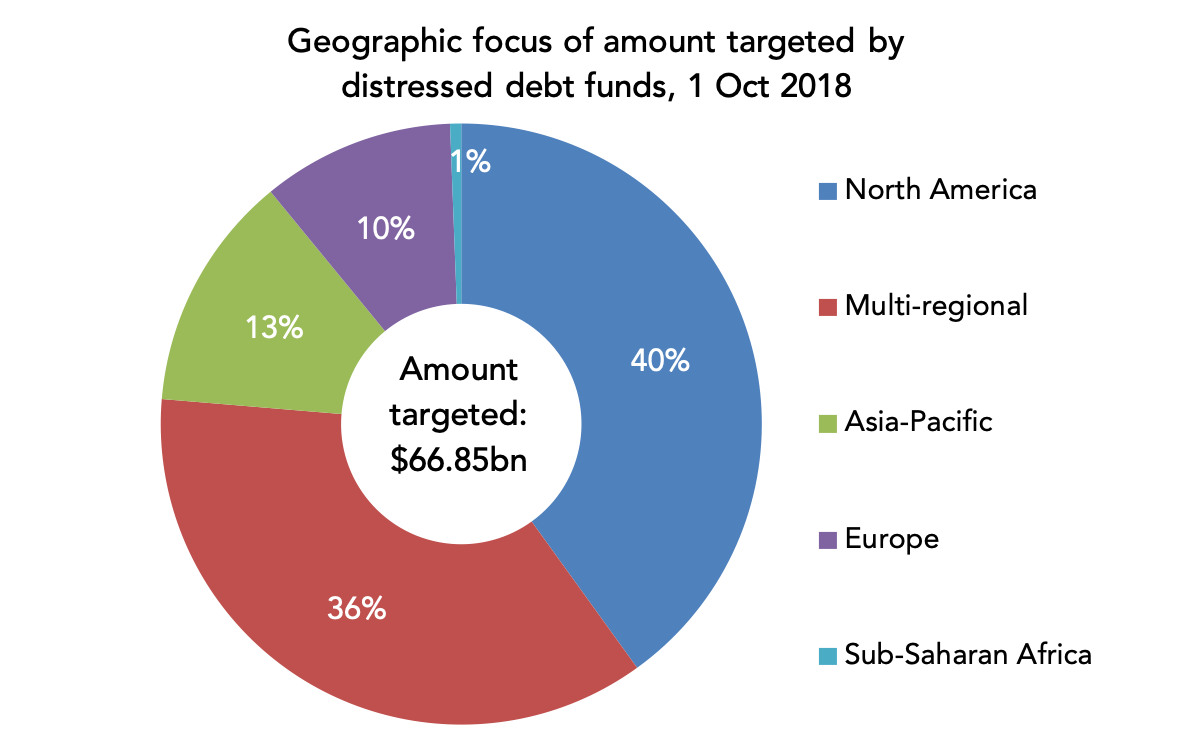
In Europe, talk of battening down the hatches for a change in circumstances seems at odds with a lack of appetite for European distressed strategies.
“The more you sweat in peacetime, the less you bleed during war.” Turnaround specialist Richard Thomson of RLT Advisory reached for this striking Chinese proverb when describing how European fund managers should be preparing themselves for a negative turn in the cycle at PDI’s recent Capital Structure Forum in London.
Thomson wasn’t the only one seemingly poised for battle. Much of the talk at the event revolved around the likelihood that circumstances would soon change. Specifically, market conditions would worsen – presenting challenges for some and opportunities for others. So presumably, one would think, a large proportion of fundraising is currently targeted at European distressed opportunities?
The answer to that question appears to be a resounding ‘no’. PDI’s Q3 2018 data show that just 10 percent of capital currently being raised for distressed debt is targeted at Europe (around $6 billion of the $66 billion total). This is less than the amount being targeted at the more fledgling Asia Pacific markets. Even if you reckon that around half of “multi-regional” strategies are aimed at Europe (which seems generous) then the European figure is still very far behind North America.
Perhaps the feeling is that Europe is still enjoying relatively benign economic conditions and there is no immediate sign of them coming to an end. But – with Brexit looming ever closer, nationalism rearing its head in parts of the continent and German Chancellor Angela Merkel stepping aside as leader of her party – the political situation appears increasingly volatile.
Maybe the economy can prove resilient to the shifting political sands, but the apparent lack of interest in European distressed strategies at this point does seem surprising. But then perhaps over the coming period we will see a material change on the fundraising front. If not, there may be a lack of capital when the fighting starts.





Latest news

Rate hike expectations ease as term SOFR curve flattens
The CME six-month Term SOFR rate reached a recent high of 3.979% on July 28 before retreating to 3.837% as…
3Q26: New loan assets rise to 44% of total lending, a 3-year high
New loan assets as a proportion of total US loan volume make up 44% of the 3Q26 pipeline to date,…

North American GPs dominant as fundraising accelerates
Our PEI Private Credit 200 ranking also shows capital raising increasing overall – and accelerating especially fast for the largest…