
Our latest test of investor opinion finds increased wariness to committing more to private credit.
It started as a small sign that institutional investor confidence in the asset class may be wavering – but the signal has now grown a little stronger.
The initial indication came from our latest fundraising data, as reported previously in The Lead, which revealed total capital raised of $68.7 billion in Q3 – well down on the first two quarters which both saw more than $100 billion raised, potentially setting up a record fundraising year.
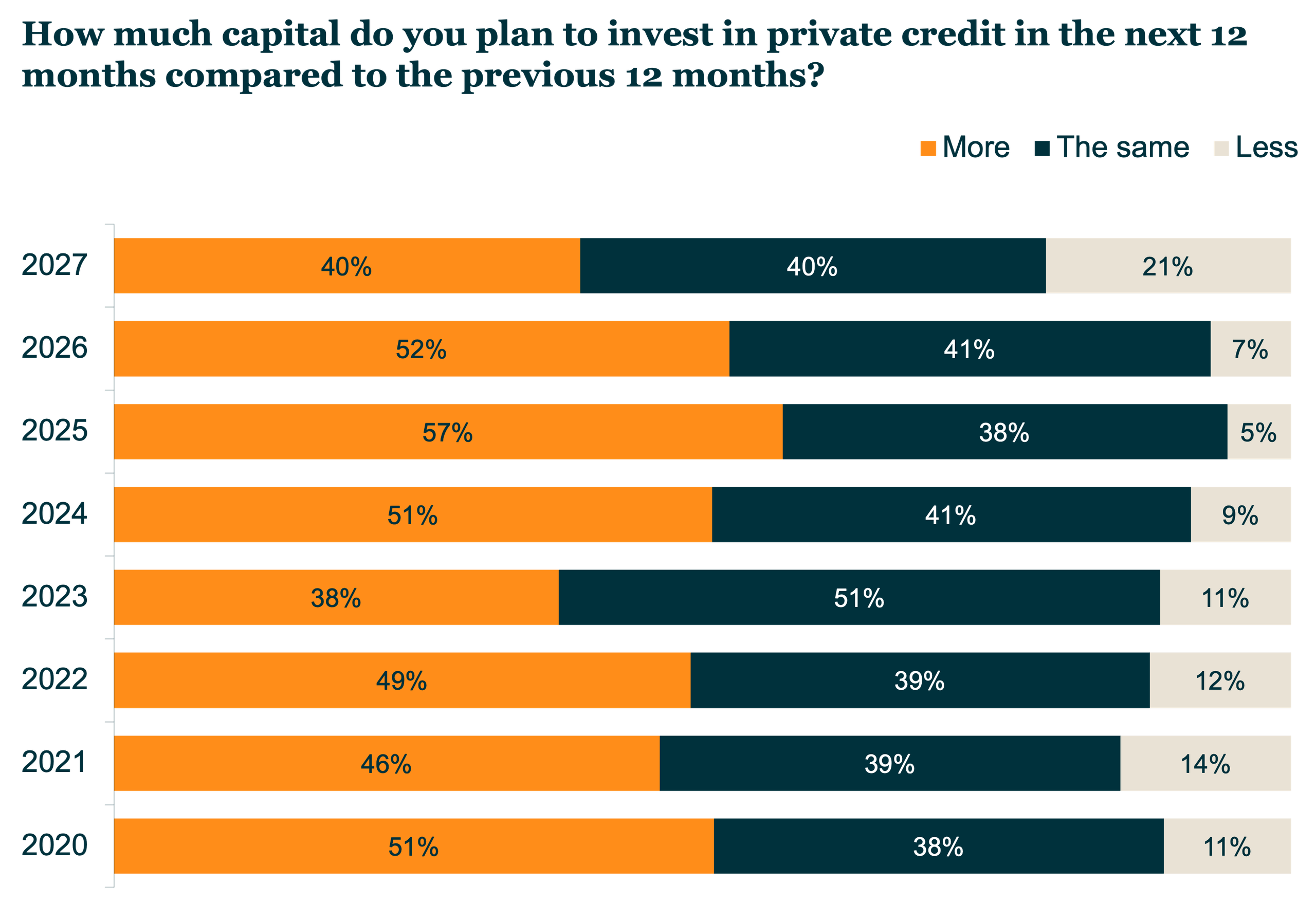
Now, further evidence emerges from our Investor Perspectives survey, soon to be published in full by PEI Private Credit. It finds that only 40 percent of investors are planning to commit more capital to private credit in the next 12 months compared with the previous 12 months (see chart).
This compares with equivalent figures of 52 percent, 57 percent and 51 percent for the prior three years respectively. Moreover, 21 percent of those canvassed said they would be investing less over the next 12 months – the highest figure recorded over the last eight years and well above the previous peak of 14 percent in 2021.
A further negative sign for fundraising can be found in the 19 percent of investors now considering themselves over-allocated to the asset class. This is the highest figure on record, edging past the 18 percent recorded in 2023. Only 35 percent now say they are under-allocated, compared with 49 percent 12 months ago.
While thoughts on over- and under-allocation may simply reflect target allocation policies that were put in place some time ago, current market conditions also appear to be influencing decision-making. Asked why they are under-allocated, 38 percent of relevant investors cited a lack of suitable opportunities.
The data is far from gloomy and sentiment still remains good in some respects – especially if you are a fund manager based in Western Europe, as 33 percent of investors say they will be taking a greater interest in that region over the next 12 months (compared with 20 percent for North America). Nonetheless, there are a few reasons for concern.


Latest news

Software deal share falls in middle markets, rises in large caps
In Q3’26 software’s share of total deals fell in both the Lower Middle Market (to 7%) and Upper Middle Market (to 9%), while Large Cap saw a modest uptick in share to 8%.

Secondary loan prices stabilize following steep declines
Secondary loan prices came under significant pressure through September and October, with the Bloomberg U.S. Leveraged Loan Index declining 119…