



After years of plenty, life has become much harder for fundraisers in Asia Pacific – especially for those with exposure to an ailing China.
The overall trend of recent years has been for Asia Pacific private debt to gain traction among investors. In all, 32 APAC funds collected a combined $15.7 billion in 2022, up 34 percent on a preceding record year in 2021, according to Private Debt Investor data. But that figure fell dramatically to just $1.6 billion raised by five funds in the first six months of 2023, the lowest first half number for more than a decade.
The average amount of capital raised by APAC private credit funds fell from $490 million in 2022 to $310 million in H1 2023, with two-thirds of those fundraisings failing to hit their target size. Vincent Ng, a Hong Kong-based partner with global placement agent Atlantic-Pacific Capital, blames a number of factors for the more challenging environment, including high inflation, the denominator effect, volatile foreign exchange rates and geopolitical issues “all of which have had a big impact across alternatives”.
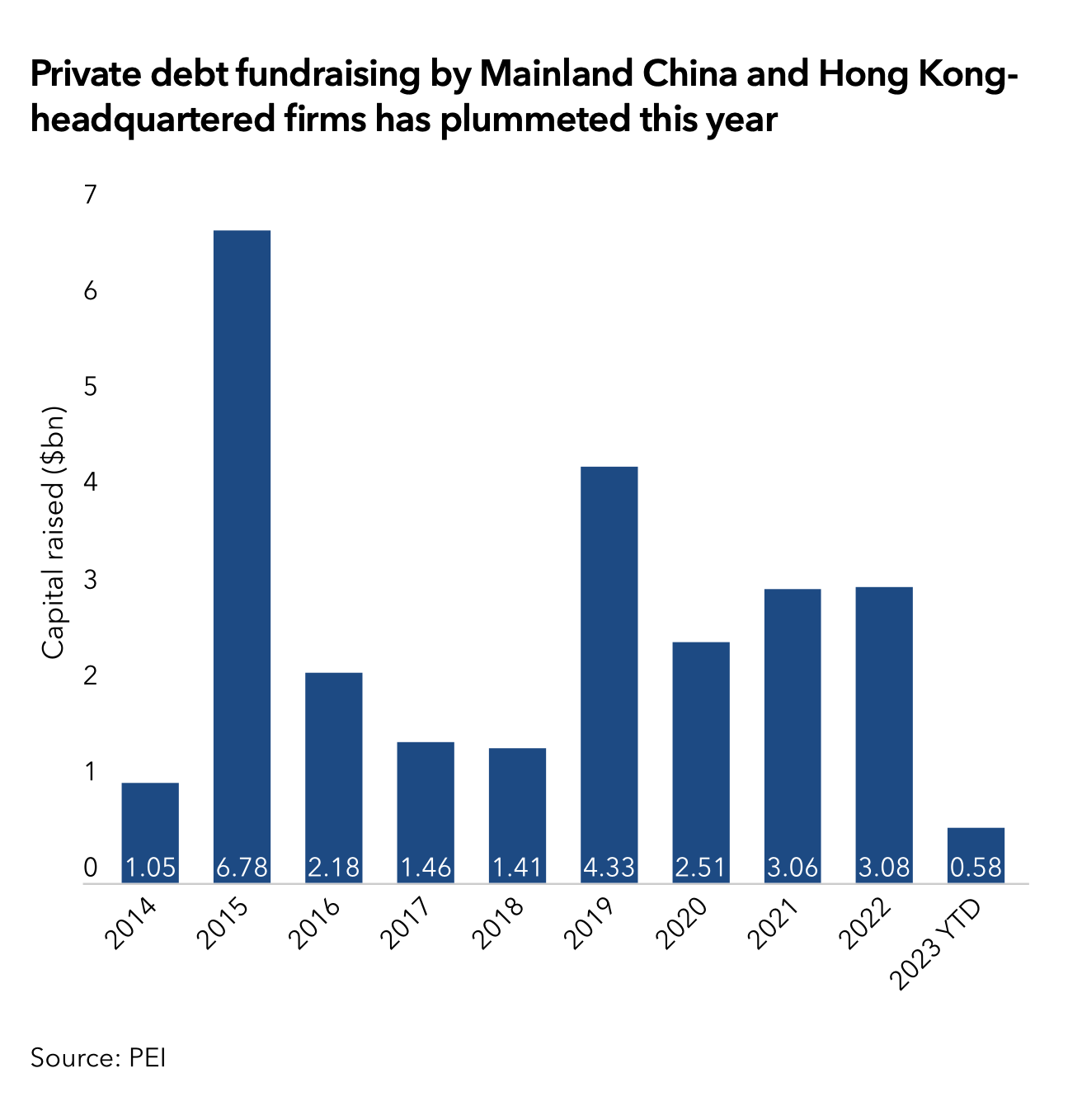
Another factor is that fund managers are shifting their attention away from China (see chart). “Clearly China is under tremendous stress, especially within the real estate space, but also with respect to other industries and capital flows,” says Chris Mikosh, co-founder and portfolio manager at Tor Investment Management, a private debt manager based in Hong Kong and Singapore. “In contrast, we don’t see the same type of collapse in other Asian economies; however, it is obvious that the credit capital flowing into the region has slowed, especially in the last two years.”
Eddie Ong, deputy CIO and head of private investments at Singapore-based SeaTown Holdings, part of sovereign wealth fund Temasek, says the investor focus has moved from the North Asia and China region. “Since the Chinese credit crisis, we see a lot less coming out from China simply because the borrowers there are now much more focused on deleveraging and converting their assets to cash,” he says.
The steady retreat of banks from the corporate lending space is likely to create a huge opportunity in the long run in Asia Pacific, following in the footsteps of the evolution already seen in North America and Europe. But the short-term picture is nuanced – and, in China, simply unfavourable.







Private Credit Defaults 101: Back to School
As Labor Day approaches, the unofficial end of summer is upon us. But, before we get too sad, there is also the familiar back-to-school energy.