



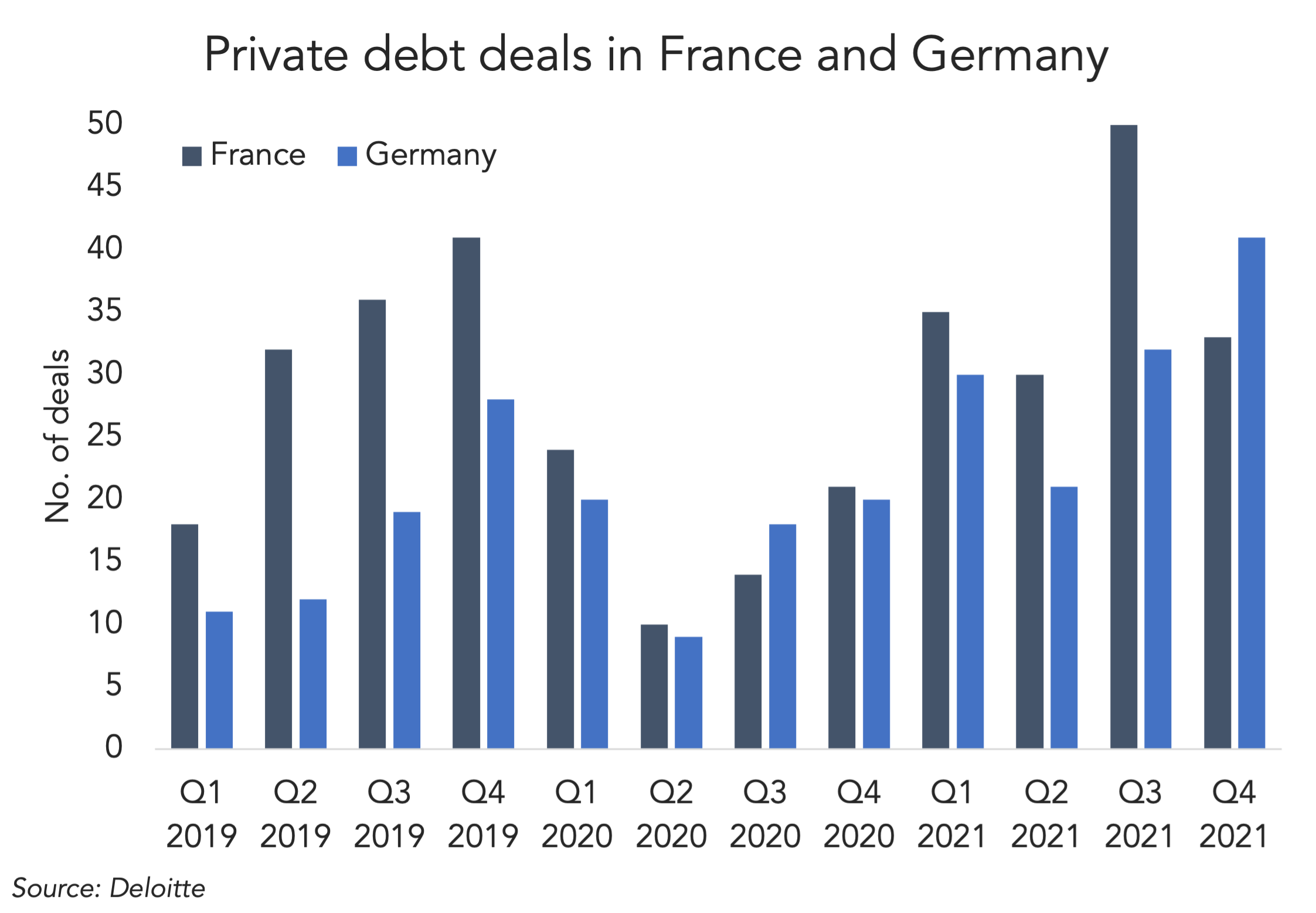
Once seen as a private debt laggard, Germany is now at the forefront of the asset class’s deal boom.
While the onset of the covid-19 pandemic saw private debt deal-doing take a rollercoaster ride through some of its lowest and highest points yet, Germany has consistently gained ground on its major continental rival France.
France has historically been Europe’s second-biggest market for private debt after the UK, with Germany lagging due to a more conservative approach among borrowers, but figures from the latest version of Deloitte’s Alternative Lender Deal Tracker suggest this is changing as the two countries reach a more equal footing (see chart).
Views of the ability of private debt to gain material market share in Germany were once sceptical. It was seen as the classic banking market, with relationships between traditional lenders and borrowers running deep. The fact that the German private debt market is now growing so fast is as clear a testament as any to the flexible and timely solutions that fund managers can offer.
What the latest survey also shows is the growing popularity of private debt right across the European region. While the UK still accounted for 35 percent of total European private debt deals in 2021, this represented a decline on the prior year.
The growing share in mainland Europe represents, in Deloitte’s views, further bank retrenchment and a warmer attitude from continental European borrowers to non-bank lending solutions. Between them France and Germany accounted for the same share as the UK last year at 35 percent, leaving the remaining 30 percent spread around Europe’s other markets.
In what was a remarkable year overall, Deloitte tracked 785 European private debt deals last year – an 89 percent increase on the covid-affected year of 2020 and 51 percent higher than the previous record-breaking year of 2019 since Deloitte began gathering its data in 2012. According to the firm, this reflected the building up of dry powder in 2020 and the “manifestation of rampant investor appetite”.
(Past performance is no guarantee of future results.)






Private Credit Defaults 101: Back to School
As Labor Day approaches, the unofficial end of summer is upon us. But, before we get too sad, there is also the familiar back-to-school energy.