



LPs appear to be happy taking their place at the top of the capital structure, but should not assume every manager’s approach is the same.
“An all-weather strategy”. That’s how one of the panellists on an LP panel at Private Debt Investor’s Investor Day this week described senior debt. The LP in question represented a European insurance company and went on to explain that senior debt is the foundational plank of the portfolio.
“Everything else completes the portfolio depending on where we are in the cycle,” the LP said. “When the market is down, we’ll be biased towards opportunistic and dislocation type strategies. When it’s up, it’s more likely to be mezzanine and other forms of junior capital.” But what always stays the same is that senior debt is right there at the heart of the allocation.
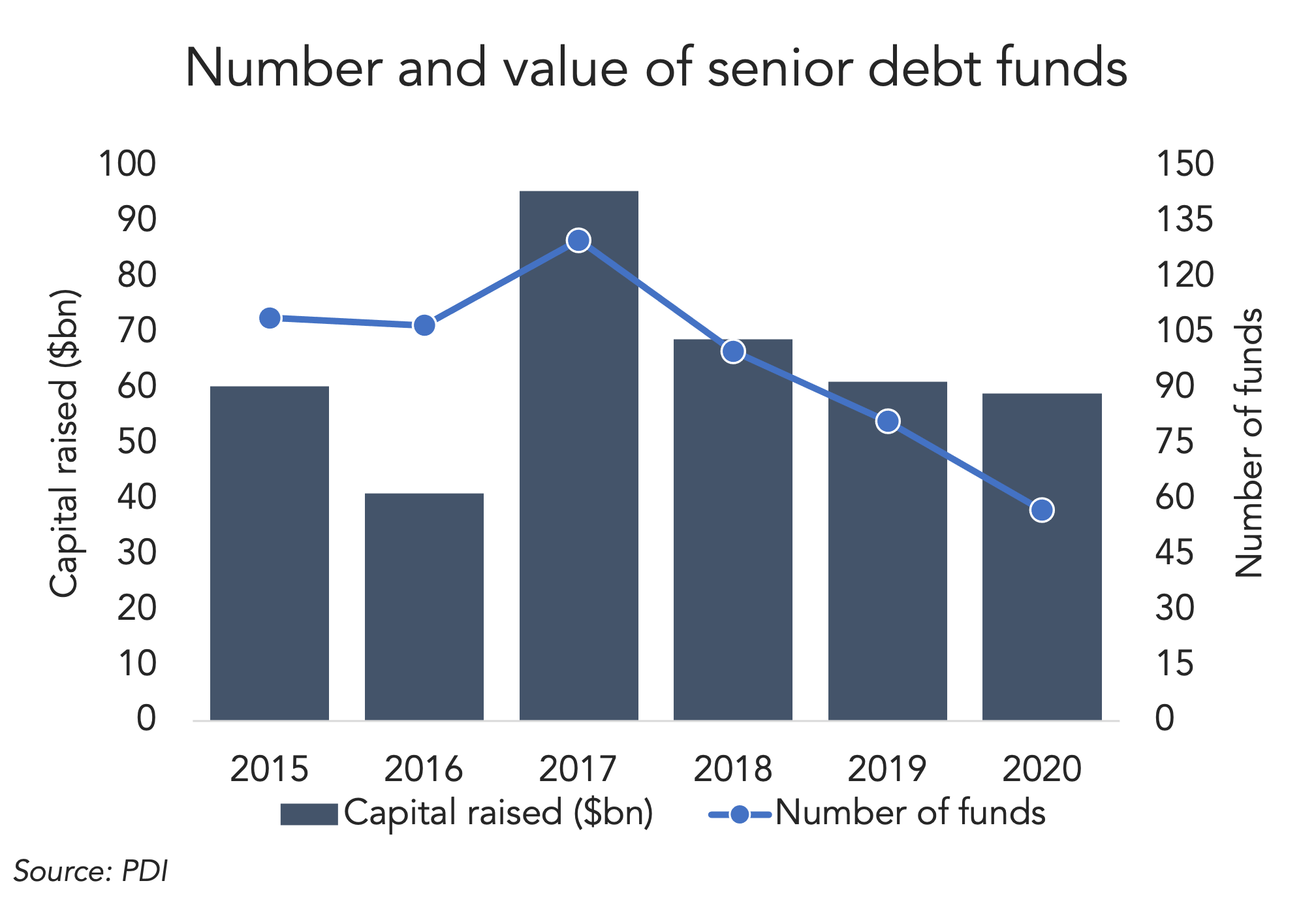
This faith in senior debt is borne out by our fundraising data (see above). Although the fundraising total has declined from its 2017 peak and the number of funds being raised has also dropped over that period, the relative share of senior debt strategies has grown. Last year, a tough fundraising year for private debt as a whole, senior strategies saw their share of the total rise to more than 40 percent – in a typical year, its slice of the cake is more like 30 to 35 percent.
In the latest issue of PDI, we took a close look at senior debt and were reminded that it actually covers a range of activities which – while all senior secured in nature – are nonetheless quite distinctive. Credit opportunities funds, for example, tend to be associated with distress or special situations but we found examples of this strategy targeted at the top of the capital structure. Real estate credit is another area that, while offering senior strategies, may also offer a different risk/return profile than that typically recognised in the senior space.
This distinctiveness can be seen as a strength in terms of offering diversity to investors. But those investors considering senior debt as the safest of all bets might do well to consider that not every available flavour is plain vanilla.
(Past performance is no guarantee of future results.)




Latest news

Q2'26 BDC analysis shows additional 184 bps of nonaccruals at cost
In a universe of 173 business development companies, or BDCs, Octus identified a total of $9.5 billion of debt (at cost) in nonaccrual status reported in the second quarter of 2026, a slight decline of 5% from $10 billion in the first quarter of 2026.

Reading the Board
The story changes depending on which numbers you’re counting.
Private Credit Defaults 101: Different Numbers, Different Stories
In Season 2 of Billions, Bobby Axelrod takes his lawyer Orrin Bach to an empty Yonkers racetrack in the dead of night.