



In July 2007, Citigroup’s Chuck Prince told the Financial Times, “When the music stops, in terms of liquidity, things will be complicated. But as long as the music is playing, you’ve got to get up and dance. We are still dancing.” Nearly two decades later, market participants still invoke that line when they think the cycle has turned. Today, that conversation is squarely focused on private credit.
With non-accruals rising, that alone has been enough to reignite the question. As one longtime lender recently put it, “We’re in a credit cycle. People denied it for a while. I don’t think there’s a lot of denial anymore.” So, are we?
Pockets of stress have unquestionably risen – particularly in 2021-vintage loans and certain corners of the software sector. Defaults in software remain contained for now, but there’s real concern about current marks and an approaching maturity wall, with roughly 33% of outstanding software loans coming due by 2028. That said, as we noted in our Dot Calm piece, “The lesson is not that software is broken. Indeed, some would argue today’s best performers are in the software space.” And the data backs this up. Recently noted on our webinar, S&P’s review of 225 software companies found 80% grew revenue and 70% grew earnings year-over-year. The magnitude of that growth was strong too, as they reported median revenue growth of 13% and EBITDA growth of 24%.
Some software companies will inevitably be disrupted, but it’s far from clear this is a sector-wide issue rather than a handful of idiosyncratic stories. In conversations with many of our sponsors, several continue to point to AI as a genuine tailwind for middle market companies, within both software and other sectors.
Forecasts tell a similar story. KBRA projects sponsored direct lending defaults will run around 2.25% this year, versus 3.5% for syndicated loans and 2.75% for high yield. Those figures are higher than last year, but context matters. While rising, they’re doing so from a low base, and remain below long-term historical averages (see Chart). That combination looks more like a normalization of credit conditions than the start of a genuine credit cycle.
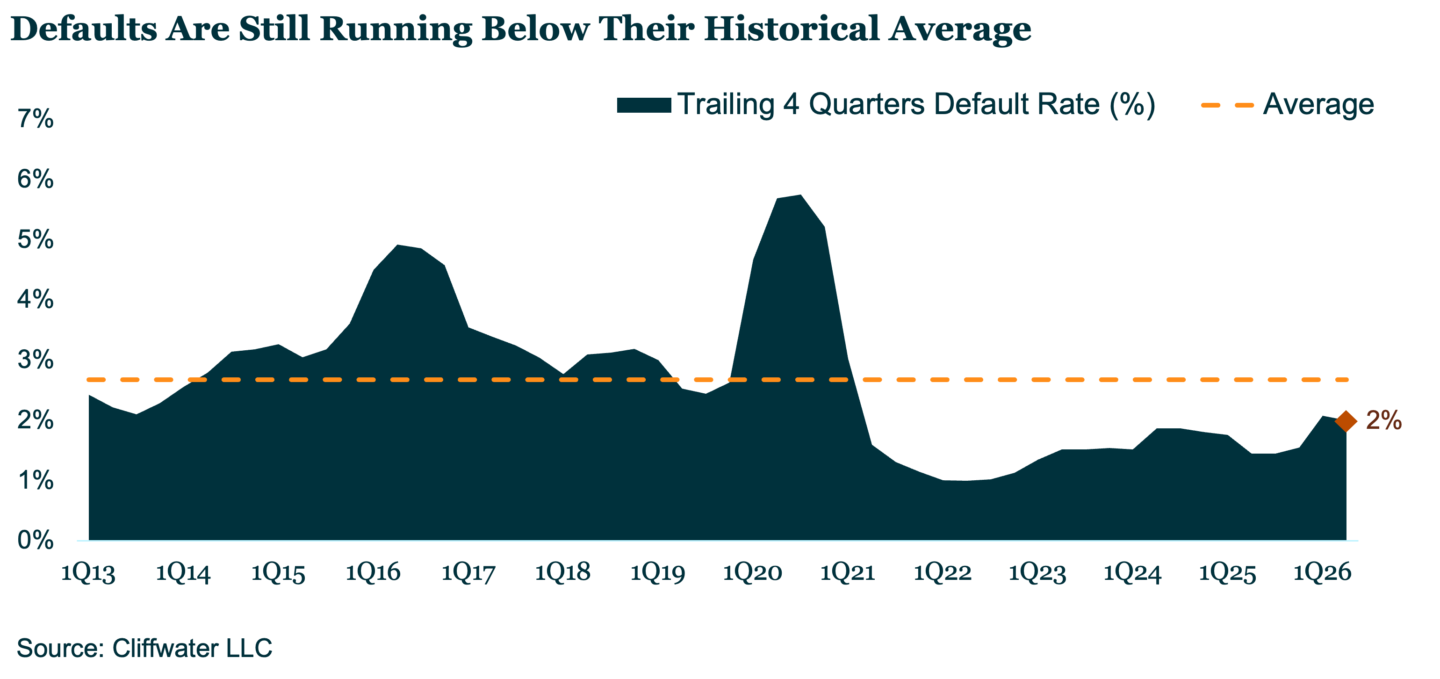
The fundamentals also back this up. The economy remains in good shape, and end markets for core middle market borrowers are holding up reasonably well, with local business confidence running at its second highest level in the last four years. Revenue growth among these companies also continues to outpace the S&P 500 – not the profile you’d expect in the early stages of a cycle turn.
None of this means it’s time to stop monitoring portfolios closely. Things look fine today, but that can change quickly. And when the music does eventually slow, the managers who come out ahead will be the ones who never stopped listening to the music.



Latest news
US Leveraged Loans Return 3.36% to Investors YTD
The Bloomberg US Leveraged Loan Index (Ticker: LOAN) returned 0.96% in August and has gained an additional 0.28% through September…

PE dry powder
The capital that is being raised is flowing overwhelmingly to the largest, most established managers.

Middle market debt held by BDCs vs High yield vs Treasury yields
The blue line represents the current dividend yield of the VanEck BDC Income ETF (BIZD), which stood at 11.7% as…