



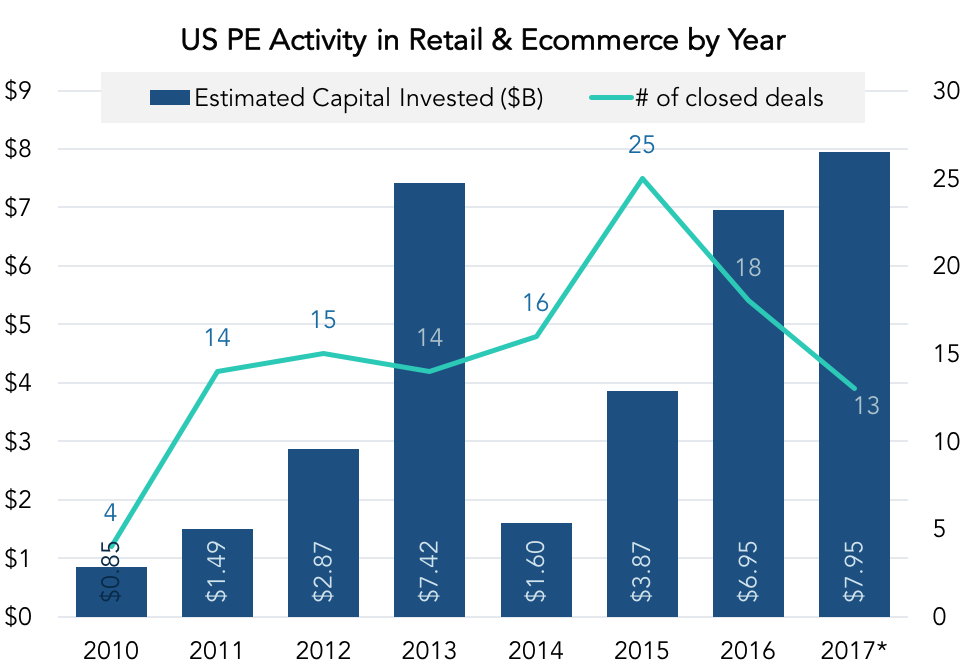
Nordstrom, thought to be a prime buyout candidate, is now having trouble securing debt commitments for a would-be deal. It opted this week to wait until after the holiday season to assess any PE buyout, even with an investor waiting in the wings. Following the bankruptcy of Toys R Us, another PE-backed retailer, the Nordstrom story says less about the credit market and more about private equity’s place in retail. Earlier this year, a CNBC story noted that half of all 2017 retail bankruptcies were for companies owned, at least in part, by private equity. CNBC pointed to changes in the bankruptcy code in 2005 as a key reason for the increase: the law used to give bankruptcy filings up to 18 months to re-organize, but the law now limits that runway to 210 days.
Left unsaid is this: how big of a difference should that really make to private equity? Asked another way, would an extra few months solve private equity’s woes in retail, or just postpone it? For an industry that prides itself on being ahead of the curve and finding value in distress, it’s worth asking whether private equity missed the massive transformation underway in the consumer sector, spearheaded by one Jeff Bezos. Retail as a whole is in distress, which is another situation entirely. The traditional PE model seems to be stalling in today’s market—leverage isn’t an elixir when the industry itself is being redefined.
Retail investors are quickly readjusting. While overall PE retail activity is set for a big dip this year, activity in the ecommerce space is alive and well, already notching a record this year in terms of value. Specialist consumer investors have been quicker to adjust to the changing landscape, but it’s hard to imagine generalist PE firms will catch up as quickly; Amazon has been laying the groundwork for disruption for over a decade, and it will take additional time for the post-Amazon dust to settle. For once, anyway, private equity is taking a backseat, and troubled industries are taking cues from one of their own instead.
Contact: Alex Lykken
alex.lykken@pitchbook.com



Latest news

Rate hike expectations ease as term SOFR curve flattens
The CME six-month Term SOFR rate reached a recent high of 3.979% on July 28 before retreating to 3.837% as…
3Q26: New loan assets rise to 44% of total lending, a 3-year high
New loan assets as a proportion of total US loan volume make up 44% of the 3Q26 pipeline to date,…

North American GPs dominant as fundraising accelerates
Our PEI Private Credit 200 ranking also shows capital raising increasing overall – and accelerating especially fast for the largest…