
Following the announcement of the Amazon/Whole Foods merger, one telling footnote deserves more attention: private equity was eyeing Whole Foods but, due to a rapidly evolving industry, didn’t really have a chance against Amazon. An interesting scoop from Techcrunch reported that, after hearing PE firms were trying to start exploratory conversations, “Amazon put pressure on Whole Foods not to talk to them.” Normal jockeying aside, industry professionals in the consumer sector point to a broader trend affecting the entire market: consumer product companies are more hesitant with PE suitors today. Why?
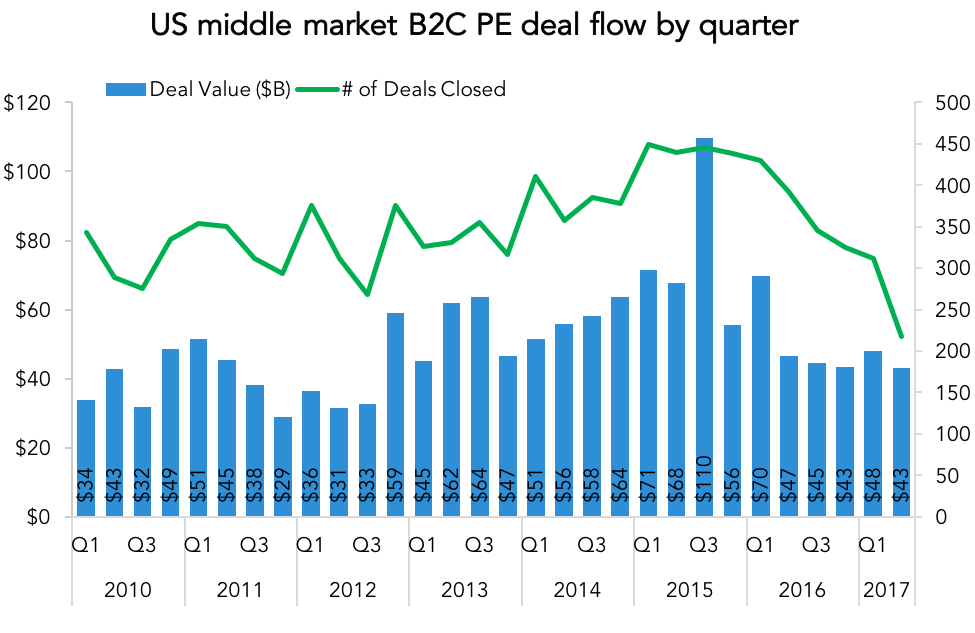
The historical leveraged buyout/financial engineering approach no longer works with B2C companies as it once did. PE investors are expected to fundamentally transform the value of those businesses through add-on acquisitions, alongside executives with tangible turnaround experience in today’s market. PE firms that don’t have transformational plans laid out ahead of time are having trouble winning auctions. Hence the accompanying chart, which shows a clear decline in PE deal activity over the past two years. Another data point worth mentioning: of all listed consumer companies that have been bought out this year, only 19% of those de-listings were done by financial sponsors. The rest were strategic competitors. The trend goes back exactly one year – PE firms were behind 26% of take-privates in the consumer industry in 2016, a big drop from the 50/50 split between PE and strategics dating back several years. In other words, PE appears to be behind the curve keeping up with a rapidly evolving consumer sector, as the numbers are starting to show.
Contact: Alex Lykken
alex.lykken@pitchbook.com




Latest news

US leveraged loans returns turn negative in October
The Bloomberg US Leveraged Loan Index (Ticker: LOAN) has returned -0.26% this month through October 21, reducing its year-to-date return…

M&A activity begins to tick upward
In the third quarter of 2026, acquisition-linked loan volume across North America and Europe reached about $47 billion, up from $30.6 billion in Q2 and $29.5 billion a year ago.